
A DEXA clinic at Moorgate, and now Chelsea
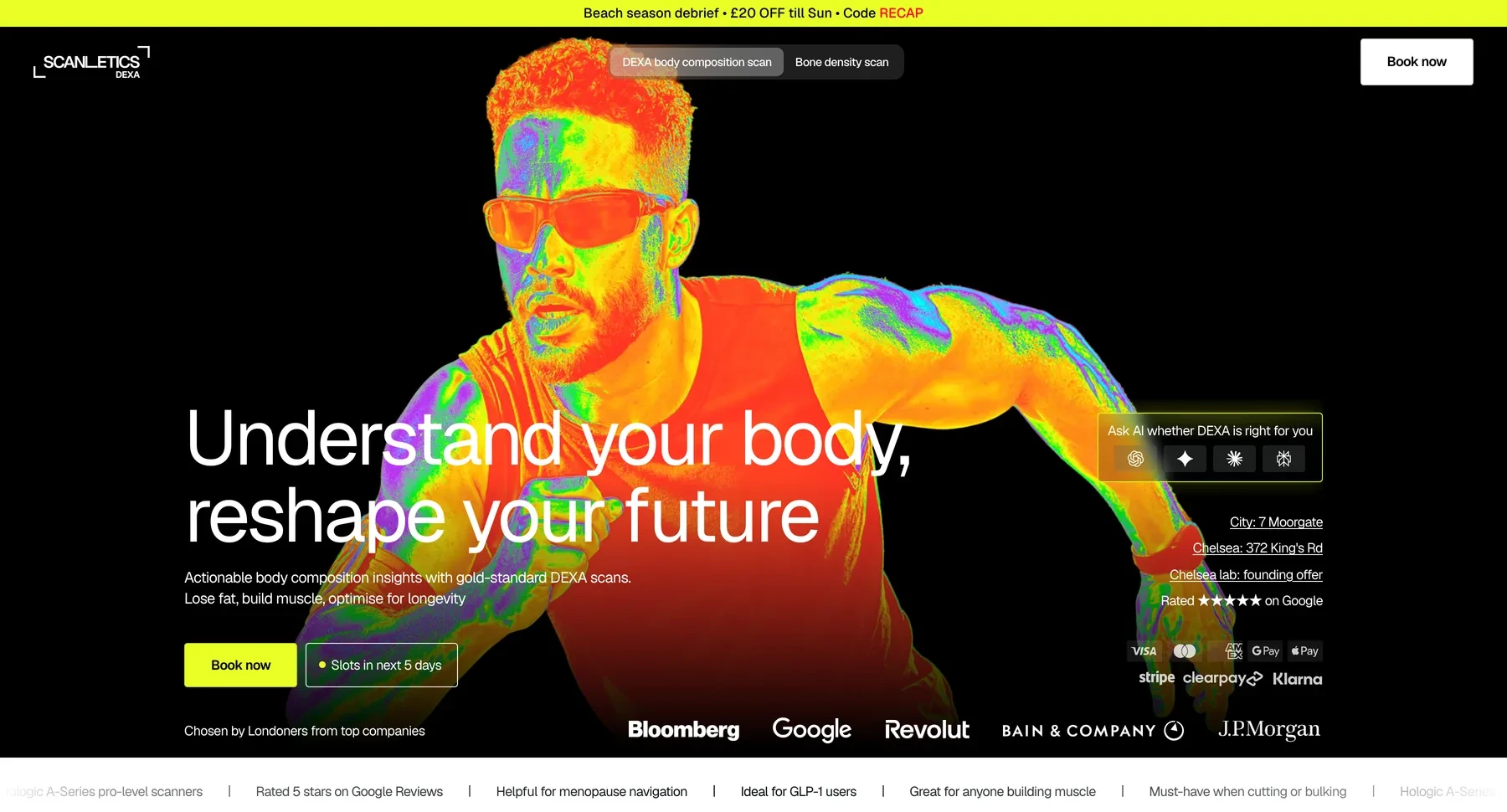
Scanletics is a CQC-registered DEXA clinic for body composition and bone density scanning, with multiple locations across London (currently Moorgate and Chelsea, with more opening soon).
Mike Kafanov, its founding CMO, describes the service this way: “We help health-conscious Londoners get the most precise reading of their fat, visceral fat, muscle and bone density, which is useful for anyone from young athletes prepping for a competition to older adults trying to prevent osteoporosis, and the ever-growing group of GLP-1 users who want to go through their body transformation the right way.”
The City lab is at 7 Moorgate, inside Foundry Gym, and the Chelsea lab at 372 King’s Road, inside Triyoga, opens on 14 September 2026. Dr Sam Botchey, a Consultant in Sport and Exercise Medicine, is a co-founder. Scanletics started using Amadora AI in May 2026.
A tracker had to match the client survey
Before May 2026, Scanletics tinkered with free, ad hoc AI search tools and then relied on Semrush’s AI toolkit, which it abandoned over inconsistent data and slow feature rollout, among other reasons. AI search had been on the clinic’s radar since the company’s early days in 2025, and the Semrush toolkit was still nascent when Scanletics used it. The team also tested PromptWatch, one of the trackers built for AI search from the start, and passed on it because of its design and the way it bundled features.
What Scanletics wanted from a replacement was specific. As a very lean team with no dedicated SEO or AI search staff, it needed a single source of truth for AI search: one overview of Scanletics and its competitors, at a reasonable price.
It also needed the numbers to hold up against hard data the clinic already collects. After each purchase, Scanletics asks clients how they discovered it. When a tool shows Scanletics rising in AI visibility and rankings, the same trend should appear in those answers. Mike Kafanov, the founding CMO, counts that survey as the hard data, so a tracker’s reading had to hold up against it before it was worth acting on.
Weekly rival readings that set the sprint’s spend
Since May 2026, Scanletics has used Amadora AI in what Mike Kafanov calls its two core scenarios: deciding how much each sprint puts into SEO and AI search, and deciding what to build when its position against its direct competitors stalls.
Three metrics, read engine by engine
Every week Scanletics reads three core metrics in Amadora AI, for itself and for its competitors: visibility, share of voice and average position. Between them they measure how often answers name the clinic, how its mentions compare with its rivals’, and how early in an answer it appears. Scanletics reads them in the by-platform view, across every answer engine Amadora AI covers.
Scanletics does not treat the engines as equals. In Kafanov’s words, a position change in ChatGPT is, for obvious reasons, orders of magnitude more impactful than one in Copilot.
Ahead of competitors on core queries
Scanletics asks one question of each week’s numbers: is it on track, and beating its competitors on its core queries? The answer decides how much the clinic invests in SEO and AI search over the next sprint or two.
Actions when visibility stalls or a rival rises
Scanletics’ second use of Amadora AI comes when the weekly numbers turn: a plateau, a drop, or a competitor on the rise. Then the team cashes in the credits it has accumulated and uses Amadora AI’s Actions as an informed advisor on what to build in the next sprint.
Checked against its own Claude and Codex setups
Scanletics usually runs the research behind a sprint through its own AI setups as well, built on Claude and Codex, which know the business well. Even so, by Kafanov’s account, many of the things Scanletics has shipped came from Amadora AI rather than from those internal tools.
He also says the clinic has yet to use Amadora AI’s Actions to their full capabilities, and gives two reasons. The Amadora AI team ships very fast, and Scanletics does not yet have a dedicated SEO or AI search team to keep up with it.
First among rivals, nearly 10% of new clients
By September 2026, AI search brought Scanletics nearly 10% of its new clients and about 15% of its revenue, by the clinic’s own attribution. Mike Kafanov, Scanletics’ founding CMO, puts that share beside two other results as the three that matter most:
- 64% growth in the AI search channel since Scanletics started on Amadora AI in May 2026, in the clinic’s own figures.
- First place on its core topics among its direct competitors in Amadora AI, held consistently from one weekly reading to the next.
By Kafanov’s account, the sharp rises in Scanletics’ Amadora AI visibility also line up with the self-reported answers in the clinic’s post-purchase survey about how clients discovered it. One of those instruments reads the answers AI engines give; the other asks the people who booked.
Two other things ran through the same months. Scanletics ran its research through its own Claude and Codex setups as well as through Amadora AI, and it sold founding memberships for its Chelsea lab ahead of the lab’s opening on 14 September 2026.
I would recommend Amadora AI to anyone who’s serious about AI search, for its consistent tracking, straightforward design and pricing, excellent support, and the speed at which the team ships new features.
Common questions
How much of Scanletics’ AI search growth does it credit to Amadora AI?
At least 30% of it, by Mike Kafanov’s own estimate, which he puts down to the consistent tracking and the Actions. It is a floor and a judgement rather than a measurement. Nothing in Scanletics’ records separates what the software contributed from the work the clinic’s own team chose to build and ship.
What position did Scanletics start from in May 2026?
Scanletics has not published one. It gave no May ranking against its competitors and no count of the clients or revenue AI search brought in then. Its only before-and-after figure is the 64% growth in its AI search channel, by its own attribution. First place in Amadora AI, and its own shares of nearly 10% of new clients and about 15% of revenue, describe where it stood in September 2026.
What does Scanletics’ first place in Amadora AI measure?
Its position against the direct competitors it tracks in Amadora AI, on the topics it counts as core. Kafanov describes it as a consistent first place across the weekly readings. He has not named those topics or competitors, or said whether visibility, share of voice or average position sets the order.
Does Scanletics track Google AI Overviews as well as ChatGPT?
Yes. Scanletics tracks every answer engine Amadora AI covers. ChatGPT, Perplexity and Gemini come with every Amadora AI plan, and Google AI Overviews, Google AI Mode, Grok, Microsoft Copilot and Claude are add-ons, each priced by the number of prompts tracked on it.
Are clients of Scanletics’ Chelsea lab in these figures?
Nothing from Chelsea is behind them. The King’s Road lab opens on 14 September 2026, after Scanletics supplied its figures, so the new-client and revenue shares come from months when Moorgate was its only lab. Whether founding-membership sales for Chelsea count towards the revenue share is not stated.
Where do the credits Scanletics spends on Amadora AI Actions come from?
From its Amadora AI plan. Every plan carries a monthly credit allowance, and unused credits roll over into the next billing cycle, up to twice the monthly limit, so a quiet month adds to the next. An Action costs 15 credits for a content brief, 25 for an article or landing page draft, 150 for a site structure and 300 for a full AI visibility audit.