
Guide
AI Citation Building for SaaS: A Data-Backed GEO Framework for 2026
Authored by
Dmitry Chistov
Founder & CEO at Amadora.ai
Most SaaS visibility playbooks are still optimizing for Google — high-DA backlinks, Page One rankings, a TechCrunch headline. AI search runs on a completely different hierarchy. This framework maps that hierarchy, drawing on cross-project analysis of 10,563 AI citationsacross ChatGPT, Claude, Perplexity, Gemini and Google AI Overviews, and turns it into a practical operating model for Generative Engine Optimization (GEO).
TL;DR — Key takeaways
- AI search engines reward a different hierarchy than Google. Corporate websites — not press — own 79–85% of the citation surface.
- Blog articles and listicles drive 60–72% of all AI citations. Everything else combined is under 40%.
- The four compounding bets: third-party listicle inclusion, owned listicle publishing, the review-platform claim stack, and Reddit thread anchoring.
- Tier-1 press (TechCrunch, Forbes, Wired) produces near-zero AI citations. Pursue it for brand, not visibility.
- Run the framework in three phases — Foundation → Saturation → Compound — and measure Citation Share, Mention Share and Owned Share weekly.
1. Why this framework exists
Most SaaS link-building and PR playbooks were written for a world where the goal was a high-DA backlink, a Page One Google ranking, or a TechCrunch headline. AI search engines do not behave that way. The hierarchy of who-gets-mentioned in ChatGPT, Claude, Perplexity, Gemini and Google AI Overviews looks nothing like the hierarchy of who-gets-linked-on Google.
This framework distils what the data shows across multiple SaaS companies in different categories into a single operating model — brand-agnostic, and applicable whether you sell to marketers, ops teams or support leaders. It is, at its core, a practical approach to Generative Engine Optimization (GEO): the discipline of earning citations inside AI-generated answers.
It ships with four universal source lists — the top-cited review platforms, directories, editorial/news outlets and databases that apply to any SaaS. For the listicles, blog posts and niche category-specific resources you need to win in your category, use an AI citation tool like Amadora — that layer is dynamic, changes continuously, and cannot be enumerated in a static framework.
See which sources AI engines cite for your category. Amadora tracks your brand's citations and mentions across ChatGPT, Claude, Perplexity, Gemini and Google AI Overviews — so every move in this framework is grounded in your own data, not guesswork. Start tracking your AI visibility →
2. Five truths that shape the framework
These five findings hold across all the projects analysed and contradict the conventional SaaS PR/SEO playbook. Every other section follows from them.
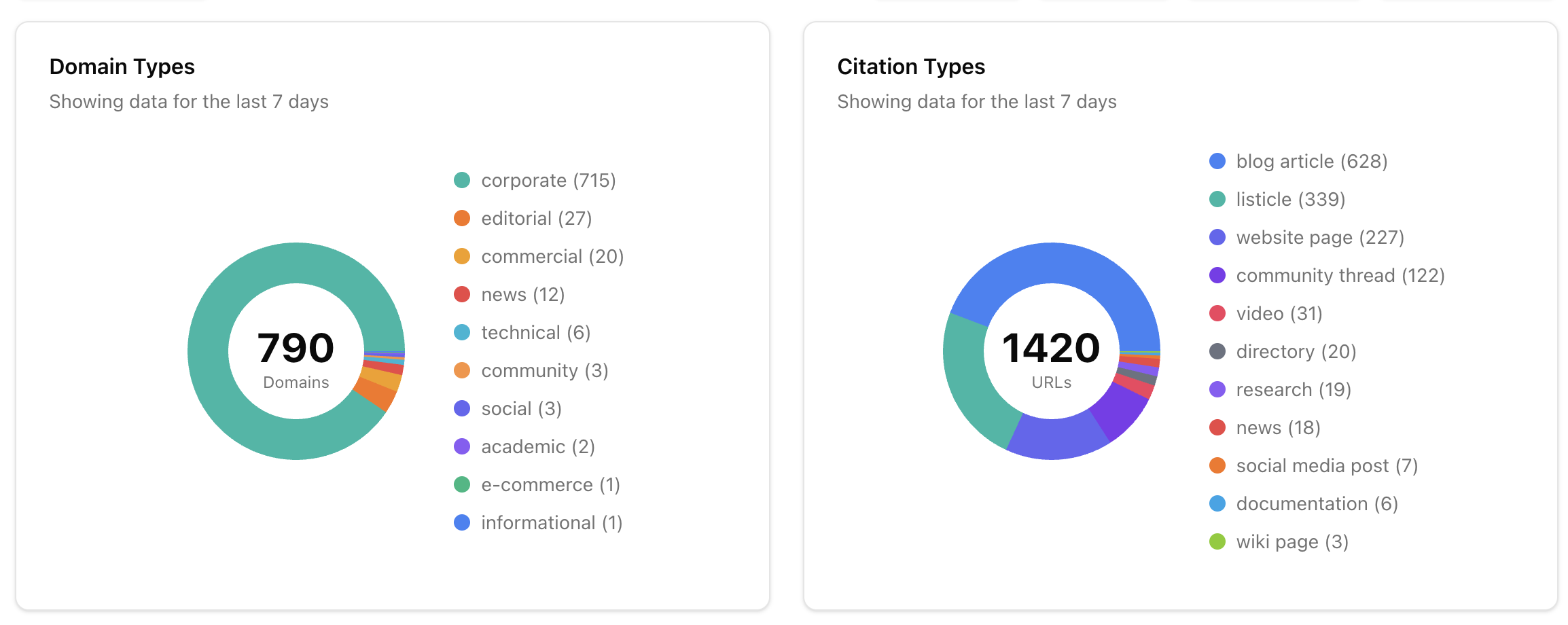
Domain types and citation types from an AI citation audit — corporate sites and blog/listicle content dominate.
Truth 1 — Corporate sites own 79–85% of the citation surface. Four out of every five AI citations land on a vendor-owned website. Editorial publications combined account for just 0.2% to 2.6% of total citations. The citation web is a vendor-to-vendor mention economy, not a vendor-to-press economy.
Truth 2 — Blog articles and listicles together drive 60–72% of all citations. Every other page type combined — review sites, directories, communities, social, editorial — accounts for less than 40%. The dominant formats are "Best X tools in 2026" listicles and "How to / X vs Y" blog articles. These are not editorial assets. They are SEO-driven corporate publishing.
Truth 3 — Competitors are the largest single citation source, not just the competition.In one project analysed, seven of the top ten cited domains were direct competitors. Getting cited inside a competitor's "best alternatives" or comparison page is the highest-leverage placement available, because that page already commands the search intent your brand needs.
Truth 4 — Community citations concentrate on Reddit, and Reddit citations concentrate on individual threads. One project's 84 community citations came from a single Reddit thread; another's 417 came from a cluster of fewer than ten threads. Other community platforms — Quora, Stack Exchange, Indie Hackers, Hacker News, Slack groups — currently produce near-zero citations. Community is not "be everywhere"; it is "find or seed one canonical thread per quarter."
Truth 5 — Tier-1 press produces near-zero AI citations; Tier-2 niche trade and personal blogs produce real ones. TechCrunch, VentureBeat, Forbes, Wired, Inc., Fast Company and The Verge cumulatively delivered roughly zero citations in the dataset. TechRadar, Medium, Dev.to, Search Engine Land, MarTech, TheCXLead and CMSWire delivered measurable volume. A PR budget pointed at Tier-1 outlets returns nothing for AI visibility.
The goal is therefore not to "earn coverage" — it is to saturate a small set of high-yield corporate publishing surfaces and a thin community layer, then compound.
3. The framework: Surface × Leverage tiers
Every citation source belongs to one of eleven surfaces, grouped into four tiers by data-grounded ROI.
Tier 1 — Compounding bets (every SaaS should be here)
- Third-party listicle inclusion — being mentioned inside existing "Best X tools 2026", "X alternatives" and "X vs Y" pages owned by competitors and tool aggregators. Why Tier 1:the single most-cited page type. One inclusion = 10–50 sustained citations over months.
- Owned listicle publishing — publishing your own "Best X for Y", "X vs Y" and "X alternatives 2026" pages. Why Tier 1: compounds the same SEO pattern on owned property. Long defensibility, high recurring yield.
- Review-platform claim stack — G2, Capterra (auto-syndicates to GetApp + SoftwareAdvice), Slashdot/SourceForge (same parent, dual surface), TrustRadius. Why Tier 1: one claim covers multiple surfaces. Slashdot/SourceForge is the most under-claimed high-yield duo in the data.
- Reddit thread anchoring — finding or seeding one high-intent thread per quarter in ICP-aligned subreddits. Why Tier 1: single threads carry 80+ citations. The highest citation-per-hour-of-effort metric in the dataset.
Tier 2 — Strategic plays (compound slower, still essential)
- YouTube tutorials on the company channel. Why Tier 2: aggregate YouTube produced 100+ citations in one project, 20+ in others. Long evergreen tail.
- LinkedIn cadence (founder + company posts). Why Tier 2: high yield only when the ICP is LinkedIn-active.
- Tier-2 niche trade press — TechRadar, Search Engine Land, MarTech, CMSWire, TheCXLead, Dev.to, Medium. Why Tier 2: these actually cite. Relationship-driven, not press-release-driven.
Tier 3 — Hygiene plays (low yield, but feed entity recognition)
- Entity database hygiene — Crunchbase, LinkedIn Company, Wikidata, ZoomInfo, Apollo, Owler. Why Tier 3: near-zero direct yield, but anchors the brand entity so other citations resolve correctly.
- AI-tool and SaaS directories — TheresAnAIForThat, Futurepedia, Toolify, AlternativeTo, Product Hunt, StackShare. Why Tier 3: 0–7 citations each; collectively form the "long tail of legitimacy." Cheap to do, lazy to skip.
Tier 4 — Speculative / brand work (not citation levers)
- Podcasts and niche YouTube guest spots. Why Tier 4: near-zero citations in the dataset. Brand work, not citation work.
- Tier-1 mainstream press (TechCrunch, Forbes, Wired, VentureBeat, etc.). Why Tier 4:~0 AI citations. Pursue for fundraising, hiring and brand — not visibility.
4. The eleven surfaces, decoded
Surface 1 — Third-party listicle inclusion (Tier 1)
The single highest-yield placement. Three sub-archetypes recur: competitor listicles("Best [our category] tools" or "Best alternatives to [competitor]" published by direct rivals); adjacent-SaaS listicles (zapier.com, hubspot.com); and tool-aggregator listicles — niche corporate domains whose entire site is "best X" pages (twig.so, easyclaw.com, agentmelt.com, awesomeagents.ai, opentools.ai, apollotechnical.com).
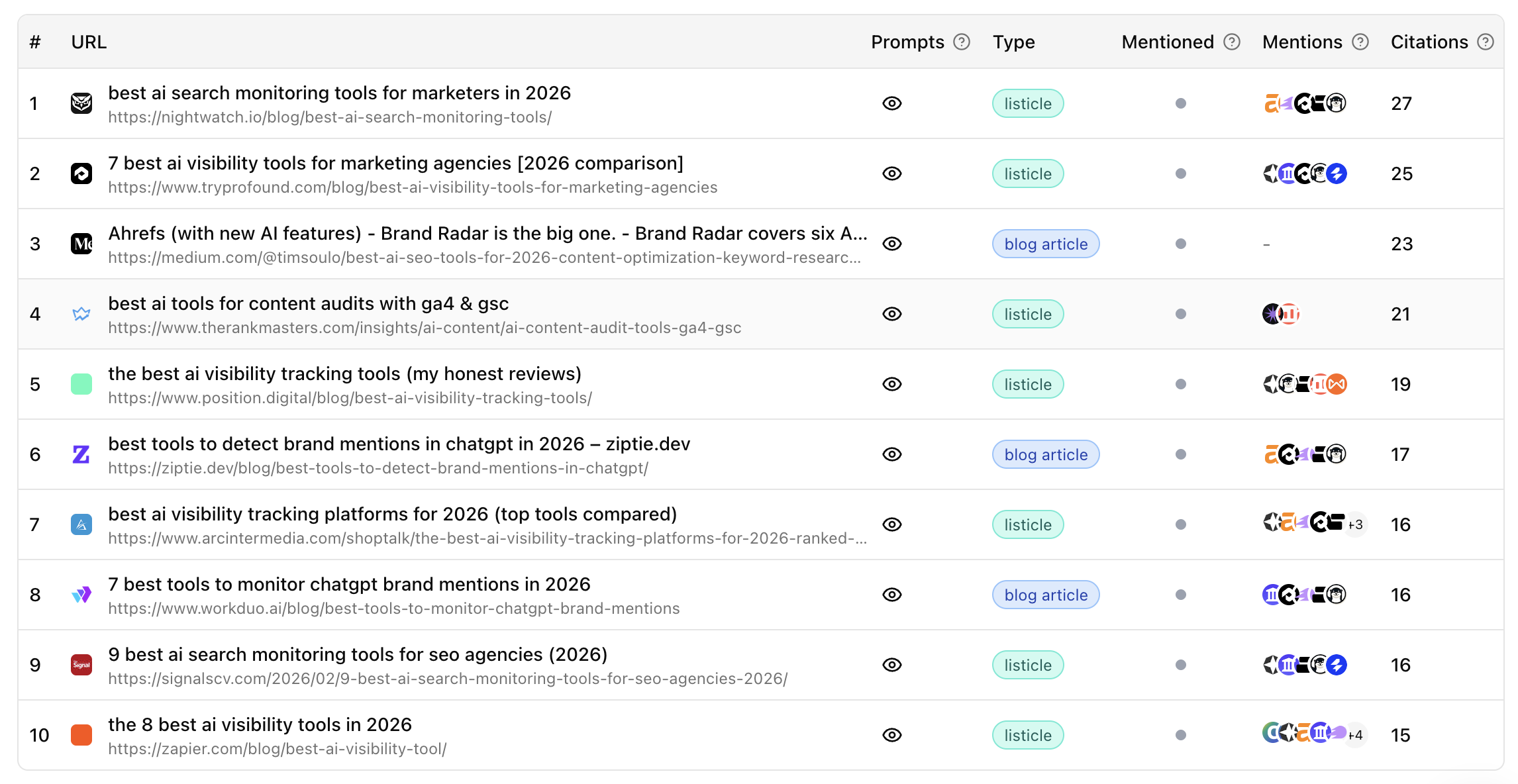
The top AI-cited URLs in a category are overwhelmingly listicles and comparison articles.
No brand recognition, very high citation yield. Winning means a named programme: identify the 30–60 listicles already driving citations in your category, then run inclusion outreach plus refresh prompting in parallel. Year-stamping matters — 70–90% of top-cited listicles have "2026" in the title. Audience-segmented variants ("Best X for marketing agencies") outcite head-term variants.
Surface 2 — Owned listicle publishing (Tier 1)
If competitor listicles drive citations to others, the counter-move is to publish your own. The pattern is consistent: brands ranking well for listicle queries dominate citations to adjacent brands. Headline templates that compound:
- "Best [N] [category] for [audience] in [year]"
- "[Competitor] alternatives"
- "[Competitor A] vs [Competitor B]"
- "How to [outcome] in [AI engine]"
- "[Competitor] review [year]"
Build once, restamp annually, refresh the table. Expect a 12–24 month citation tail per asset.
Surface 3 — Review-platform claim stack (Tier 1)
The same stack appears in the same priority order across the projects analysed, and the data validates it. G2 sits at the top because it is both a claim hub and a frequent direct citation source. Capterra is Tier 1 because one claim auto-syndicates to GetApp and SoftwareAdvice.

The Tier 1 review-platform claim stack — one claim often covers several syndicated surfaces.
The non-obvious finding: Slashdot and SourceForge share a parent — one form submission claims both. They delivered 61 + 54 = 115 citations to a single brand in seven days while that brand was not claimed on either platform. It is the highest unclaimed citation surface in the dataset.
The full Tier 1 stack: G2, Capterra (→ GetApp + SoftwareAdvice), Slashdot/SourceForge, AlternativeTo, TrustRadius, Product Hunt (launch event), Gartner Peer Insights, Trustpilot, plus the long tail (SaaSworthy, Crozdesk, FinancesOnline, Tekpon, PeerSpot). Plan to harvest 15–30 reviews per Tier-1 platform within 90 days of claiming — review volume drives category-page placement, which drives downstream citations.
Marketplace directories are vertical-specific: support SaaS needs the Zendesk, Intercom and HubSpot marketplaces; messaging SaaS needs the Meta Business Partner Directory, WhatsApp BSP and Shopify App Store.
Surface 4 — Reddit thread anchoring (Tier 1)
Reddit citation behaviour is not "Reddit presence." It is one thread carrying everything. Budget hours-per-quarter for thread identification or seeding, not hours-per-week for engagement. Target one canonical thread per quarter per high-intent subreddit, in which your brand appears as a substantive contributor — not a promotional one.

On Reddit, AI citations concentrate in a handful of high-intent threads — not channel-wide activity.
Universal subs: r/SaaS, r/marketing. Vertical subs: r/Zendesk and r/CustomerService for support; r/chatbots and r/whatsapp for messaging; r/SEO and r/perplexity_ai for AI/SEO tools. Other community surfaces produce near-zero citations — treat them as adjacent infrastructure, not primary investment. One exception: Hacker News "Show HN" launches still produce a citation spike for technical SaaS.
Surface 5 — YouTube tutorials (Tier 2)
Aggregate YouTube is the third-largest video citation surface in the data. AI engines cite YouTube heavily for procedural questions ("how do I…", "what's the difference between…"). The format: ungated tutorial videos with search-intent-aligned titles, transcript-rich descriptions and chaptering. Production quality matters less than searchability. The threshold for meaningful citation volume is roughly one video per week for a year — and YouTube has the longest defensibility of any surface in the framework.
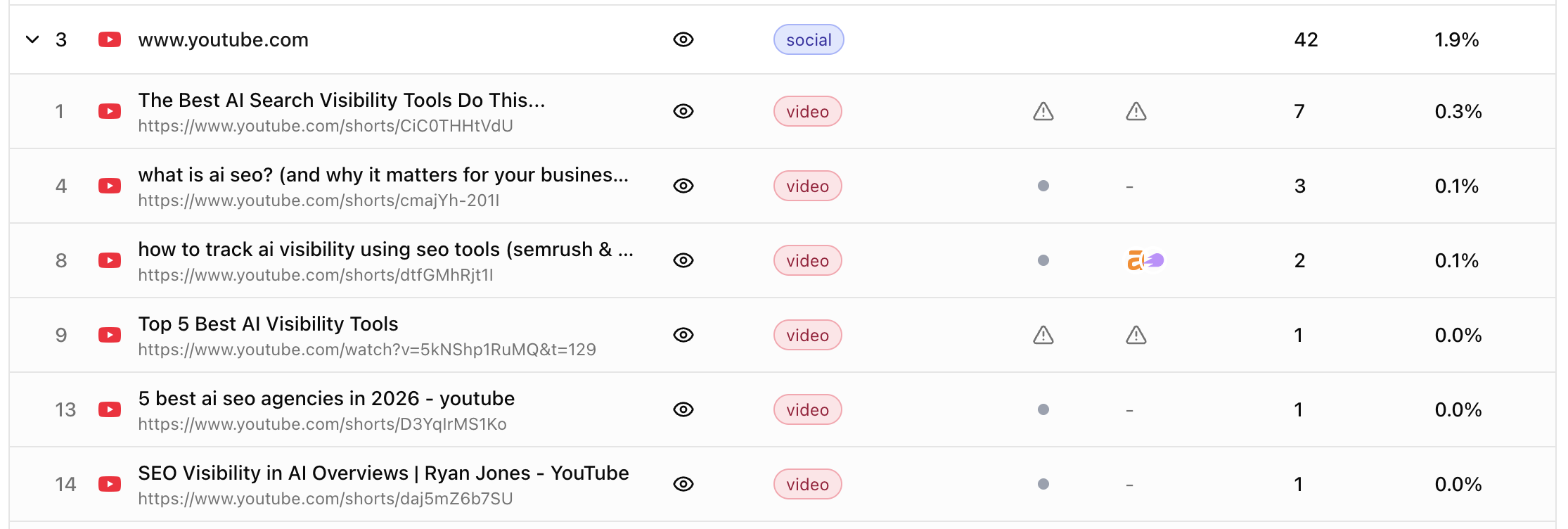
YouTube tutorial videos earn AI citations for "how-to" and procedural queries.
Surface 6 — LinkedIn cadence (Tier 2, audience-conditional)
LinkedIn is Tier 2 only for brands whose buyer is LinkedIn-native — B2B SaaS marketers, founders and execs, sales/RevOps, agency owners. One project analysed pulled 42 LinkedIn citations; others in the dataset pulled roughly zero. When it applies, founder personal posts outperform company posts: aim for 3–5 posts per week from the founder and 1–2 execs.
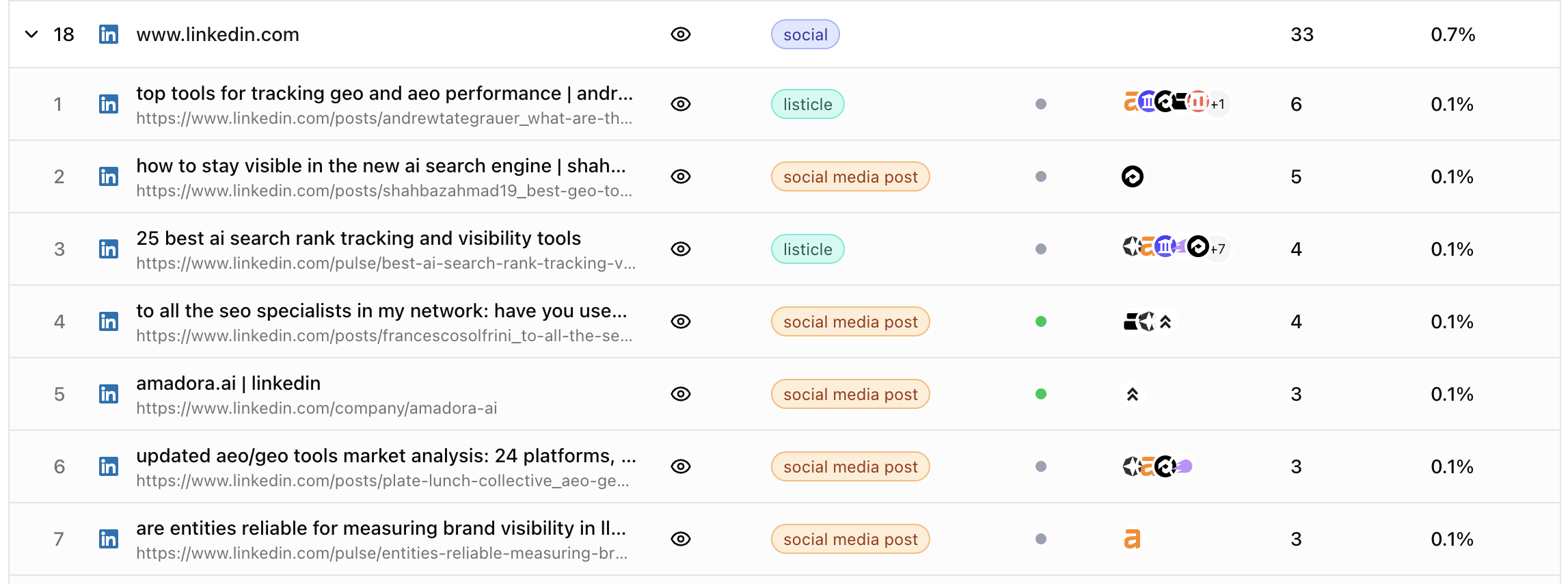
LinkedIn citations are real — but only when the ICP actively researches on LinkedIn.
Surface 7 — Tier-2 niche trade press (Tier 2)
The publications that actually cite are not the brand-name ones. TechRadar, Search Engine Land, MarTech, CMSWire, TheCXLead, ITPro, Destination CRM, Customer Think and CX Today — plus Medium and Dev.to, which behave like editorial in this context. Medium alone produced 36 citations in one project — more than any Tier-1 trade publication in the dataset. Pitch contributed posts, expert quotes and occasional original features. Yield per piece is 1–16 citations sustained. The effort is real, but this is where earned editorial keeps a place in the framework.
Surface 8 — Entity database hygiene (Tier 3)
Crunchbase, LinkedIn Company Page, Wikidata, Knowledge Graphs, ZoomInfo, Apollo, Owler, Glassdoor, Indeed. Near-zero direct citation yield, but together they form the entity-recognition substrate that lets AI systems identify your brand coherently.
Critical finding: the citation data shows Wikipedia notability is effectively locked for a typical SaaS company. The viable entity path is Wikidata → Knowledge Graph derivation, not Wikipedia article creation. Stop pitching Wikipedia editors. Start filling Wikidata. A complete hygiene pass is 4–8 hours; refresh it annually.
Surface 9 — AI-tool and SaaS directories (Tier 3)
TheresAnAIForThat, Futurepedia, Future Tools, Toolify, AIxploria, Dang.ai, AItools.fyi, AlternativeTo, Product Hunt, StackShare. Recommendation lists include 10–25 of these; each produces 0–7 citations. They are hygiene, not strategy. Submit once, move on.
Surface 10 — Podcast / YouTube guest appearances (Tier 4)
Across 50+ targets in the dataset, guest appearances produced near-zero citations. The only YouTube citation volume traced to tutorial videos on company channels, not guest spots. "Be a podcast guest" remains good brand advice. It is not citation advice — yet.
Surface 11 — Tier-1 mainstream press (Tier 4)
TechCrunch, VentureBeat, Forbes, Wired, Fast Company, Inc., The Verge — all delivered roughly zero AI citations. Their role is fundraising, hiring, brand prestige and customer trust. Treating them as a citation lever in 2026 is a misallocation of budget.

Tier-1 mainstream press delivered roughly zero AI citations across the entire dataset.
5. Sequencing — Foundation → Saturation → Compound
The four-tier model says what. Three phases say when — each roughly 60–90 days.
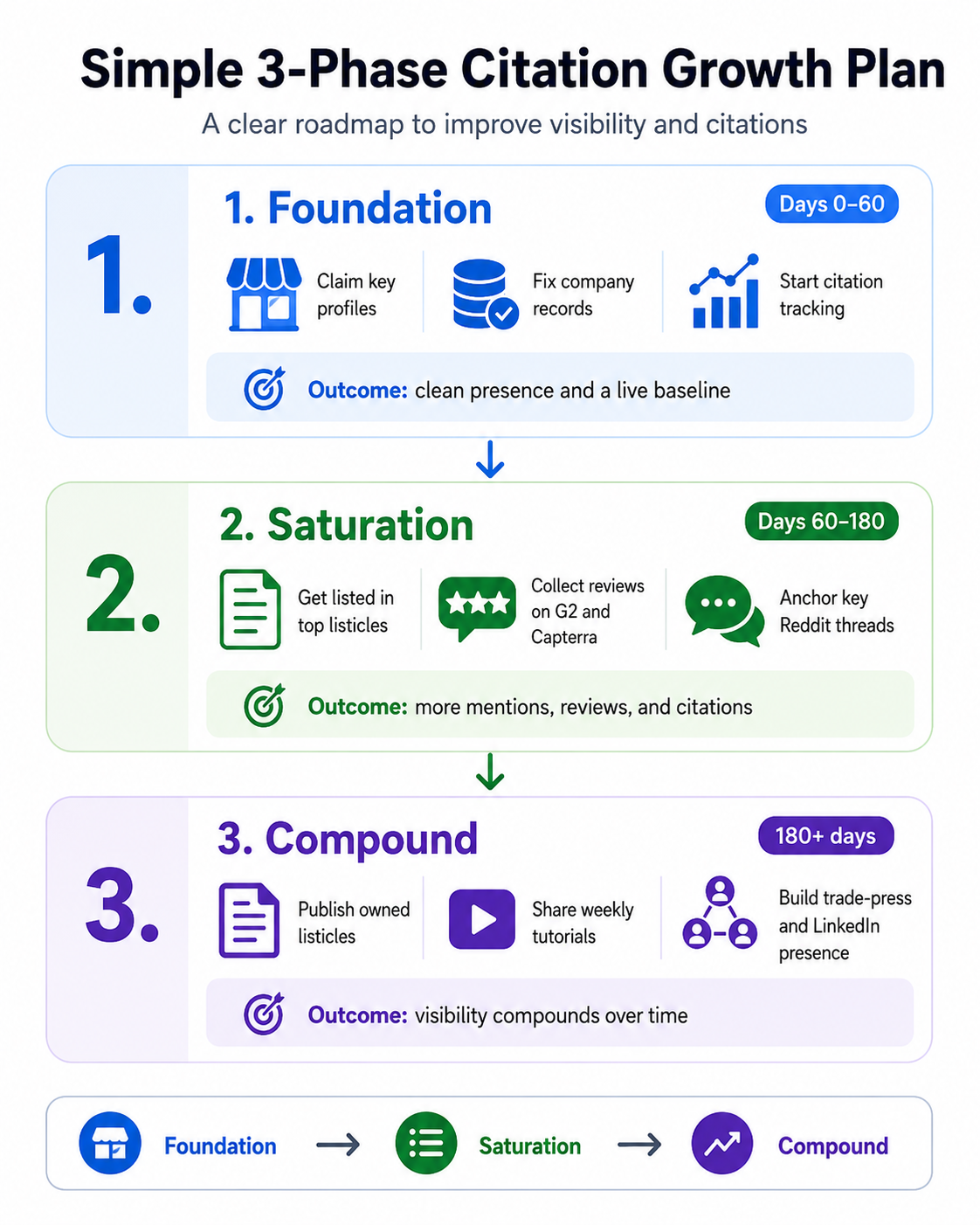
The 3-phase citation growth plan: claim and baseline, then saturate, then compound.
Phase 1 — Foundation (Days 0–60). Claim every Tier 1 review platform, every Tier 3 AI-tool directory and every entity database. Fix Wikidata, Crunchbase and the LinkedIn Company Page. Run a category listicle audit to identify the 30–60 highest-cited pages currently driving citations to competitors. Set up weekly citation tracking. Outcome: claimed everywhere claimable, entity records correct, listicle target list prioritised, baseline measurement live.
Phase 2 — Saturation (Days 60–180). Extract maximum yield from existing high-cite surfaces before producing new ones. The dominant motion is listicle inclusion outreach — relationship-building with publishers, contributed-content offers, paid placement where allowed, and reciprocal coverage trades. Target 15–25 new inclusions in 90 days. In parallel: a review-velocity programme on G2 and Capterra/GetApp/SoftwareAdvice (20–30 reviews per platform), and Reddit thread anchoring as a side-motion — one priority thread per active subreddit per quarter. Outcome: 15–25 new listicle inclusions, 60–90 new reviews, 2–4 anchored Reddit threads, citation curve measurably moved.
Phase 3 — Compound (Days 180+, ongoing). Shift to owned listicle and tutorial publishing — 1–2 owned listicles per month and one YouTube tutorial per week. Tier-2 trade-press relationships develop on a 6–12-month timeline through contributed posts and expert quoting. LinkedIn cadence runs for ICP-justified brands. Listicle inclusion outreach continues at lower velocity (5–10 per quarter), now feeding refresh prompts to existing inclusions. Outcome at year one: a stable citation curve where owned content is a growing share, third-party inclusions compound, and share of voice is measurably defensible.
6. Vertical adjustments
The framework is universal in shape; the surface list shifts by vertical.
Horizontal B2B SaaS (marketing, analytics, productivity): LinkedIn is Tier 2. Audience-segmented listicles ("Best X for agencies / in-house marketers / B2B SaaS") cite more than head-term ones. Medium and Dev.to behave as Tier 2 trade press.
Vertical SaaS with platform dependency (Meta/WhatsApp messaging, Zendesk/Intercom/HubSpot support, Shopify e-commerce): marketplace directories on the parent platform become Tier 1-equivalent. LinkedIn drops to Tier 3 or 4. Vertical trade press (TheCXLead, NoJitter, Destination CRM, Customer Think for support) becomes Tier 2.
AI-native or developer SaaS: Dev.to and StackShare move from Tier 3 to Tier 2. Hacker News "Show HN" launches produce a citation spike. Tool-aggregator domains are denser — the Phase 1 audit will surface more of them.
The rule of thumb: the citation surface mirrors where your buyers research the category. Buyer behaviour determines the surface inventory.
7. Prioritisation logic
Four variables drive prioritisation across the eleven surfaces. The framework does not assign weights — those are per-brand — but it specifies the variables.
- Current citation density on the surface (measured from AI-citation data). A surface where you produce some citations but competitors produce many more is the highest leverage.
- Citations per placement. One listicle inclusion = 10–50 citations; one AI-tool directory = 0–2. Optimise for wins-per-effort, not sources-available.
- Time-to-result. Reddit threads accrue in days; reviews in weeks; owned listicles in 3–6 months; trade-press relationships in 6–12 months. The Foundation phase deliberately prioritises short-horizon moves to build momentum and measurement.
- Defensibility. Owned content compounds. Reddit threads age out. Tier 1 review placements sit for years. Later phases bias toward defensible assets.
"High domain authority" is not a variable. DA is a Google-era signal, weakly correlated with AI citation yield. The diagnostic question to ask before any new initiative: what does the citation data show about my density on this surface versus my competitors'? Zero presence where competitors have meaningful presence = a mandatory move. Both present = competitive maintenance. Neither present = speculative.
8. Anti-patterns — what the data says not to do
Six common SaaS motions consistently fail to produce AI citations.
- Tier-1 PR as a citation strategy. TechCrunch, Forbes, Wired and VentureBeat delivered ~0 citations. Pursue for fundraising and brand, not citations.
- Mass AI-tool directory submission as a primary tactic. 0–7 citations per directory. Hygiene, not strategy.
- Pitching Wikipedia editors directly. Notability is locked for most SaaS. Use Wikidata → Knowledge Graph instead.
- Podcast pitching as citation work. 50+ targets in the dataset produced near-zero. Brand work only.
- "Reddit presence" as a sustained content motion. Citation behaviour concentrates on individual threads, not channel-wide activity. Go thread-by-thread.
- Quora as an early-phase priority. Universally recommended in source-category outputs, but 0 citations in the slice — likely an LLM-training-data hedge, not a current driver. Don't over-invest until the data turns.
The pattern beneath all six: each was high-ROI in a pre-AI search world and is being mechanically carried into the AI-search era without re-checking it against actual citation behaviour.
9. Measurement
Three metrics — tracked weekly — tell you whether the framework is working. They map onto the two halves of the work: content production and mention building.
Metric 1 — Citation Share and Citation Count. The percentage of references in AI answers that cite your website, and the absolute count. This is the direct readout of content marketing and on-page SEO. Break it down by topic to surface content gaps, and by URL to see which pages carry the weight — the top 5 owned-cited URLs typically deliver 50–70% of total Citation Count, making them the highest-leverage refresh targets.
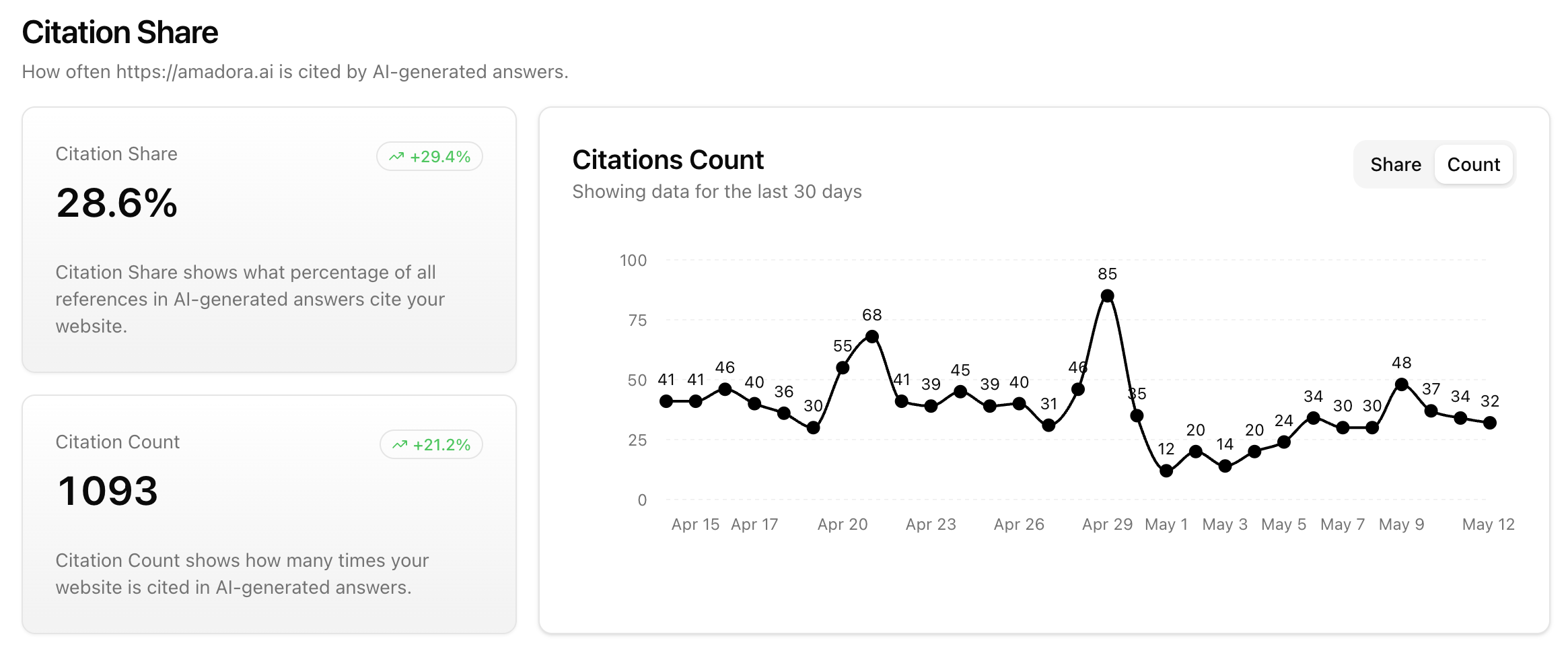
Citation Share and Citation Count in Amadora — the direct readout of owned-content performance.
Metric 2 — Mention Share and Brand Mentions. The percentage of AI-cited documents that mention your brand, and the total count across all cited URLs. This is the readout of mention building and digital PR — every listicle inclusion, Reddit thread, review claim and database fix shows up here. Break it down by topic to see where mentions are thin. Diagnostic pattern: Citation Share rising but Mention Share flat means you are winning on owned surface and losing on the citation graph beyond it.
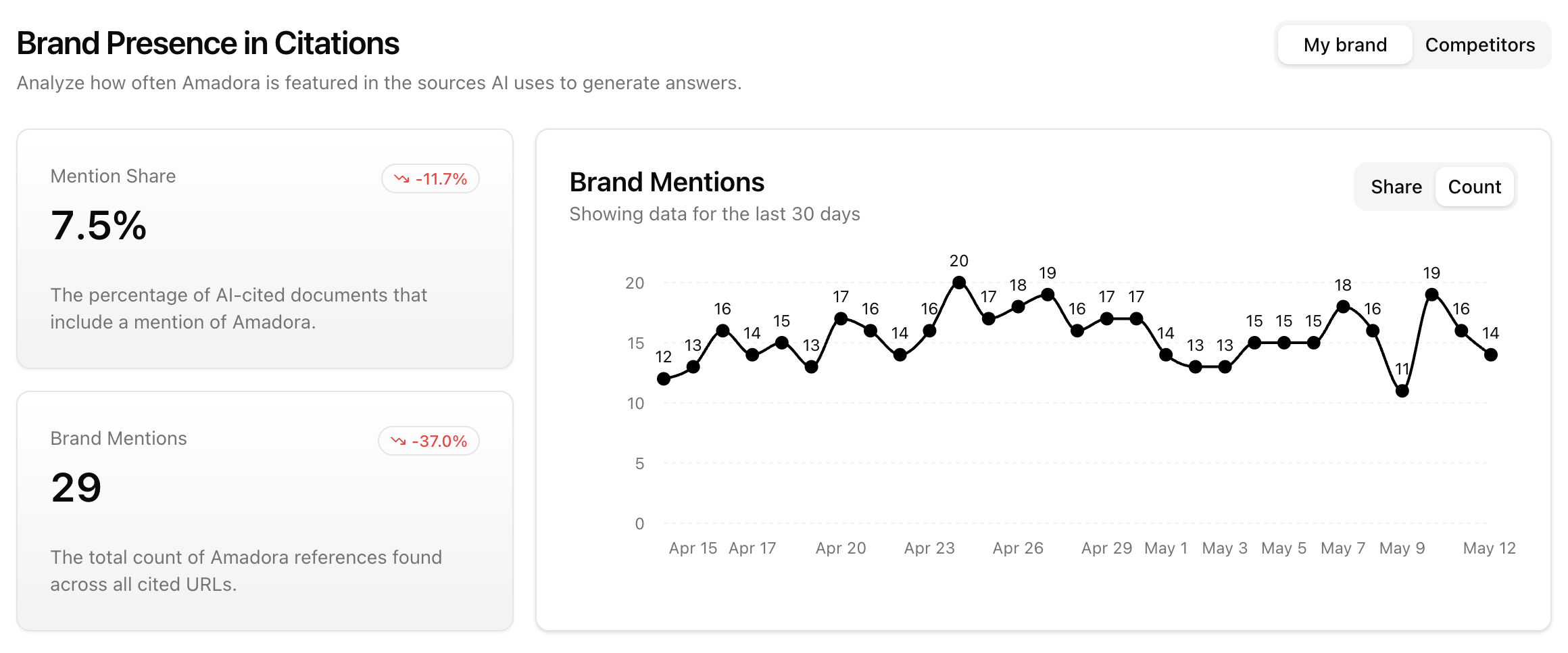
Mention Share and Brand Mentions — the readout of mention building and digital PR.
Metric 3 — Competitor comparison: Visibility Score and Owned Share. Run the same metrics for direct competitors. The key lens is Owned Share — the percentage of your brand mentions coming from your own URLs versus third-party ones. Low Owned Share (sub-20%) alongside high Mention Share is durable. Comparing your numbers against competitors with a similar Visibility Score tells you exactly how many third-party mentions you need to compete.
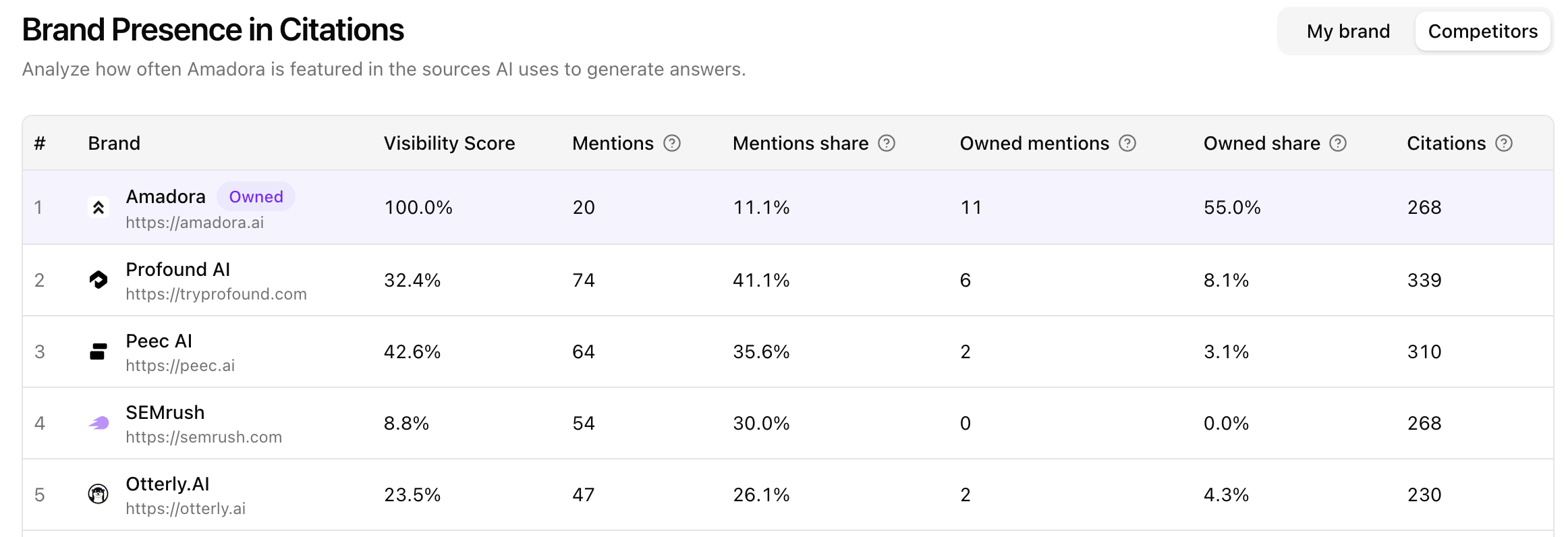
Competitor comparison — Visibility Score and Owned Share reveal exactly how far behind or ahead you are.
The single leading indicator that predicts all three metrics rising: count of listicle inclusions. Brands with more inclusions in high-cite listicles produced higher share of voice, mechanically. Tracking new inclusions monthly is the simplest signal that the framework is operating correctly.
Track Citation Share, Mention Share and Owned Share in one place. The dashboards above are live in Amadora. Benchmark against competitors, break citations down by topic and URL, and watch your share of voice move week over week. Run your AI visibility audit →
10. From framework to operating system
Pull the citation data — without it, every move is guessing. Audit your current activity against the four tiers and quantify the gap; most SaaS brands are over-invested in Tier 4 and under-invested in Tiers 1 and 3. Run Foundation, then Saturation, then Compound. Measure weekly, adjust quarterly — the surface shifts continuously, the tiers do not.
A SaaS brand operating against this framework after twelve months looks identifiably different from one running a 2024-era playbook: a long tail of listicle inclusions, a claimed presence on every Tier 1 review platform, canonical Reddit threads, a library of owned listicles and tutorials, a complete entity record — and measurably higher share of voice in AI answers.
The framework does not depend on virality or Tier-1 press. It promises a mechanical, defensible, compounding presence inside the citation graph that AI engines actually pull from. That is the unit of digital footprint that matters in 2026.
The four universal SaaS source lists
The framework ships with four companion datasets — the surfaces that apply to any SaaS, regardless of category. Here is what each contains:
- Universal review platforms (21 platforms). Top entries: Slashdot (76), SourceForge (61), G2 (32), Software Advice (13), AlternativeTo (7).
- Universal directories (20 platforms). Top entry: StackShare (7) — the rest are 0-cite hygiene submissions across AI-tool catalogs (Futurepedia, Toolify, TheresAnAIForThat, AItoolnet, Slant, Geekflare, the MarTech directory).
- Universal editorial & news (71 publications). Top entries: Medium (36), TechRadar (31), nicklafferty.com (19), Business Insider (16), Search Engine Land (16). The tail intentionally includes all Tier-1 press at 0 cites — so the anti-pattern stays visible in the data.
- Universal databases (32 entries). Top entries: LinkedIn Company Page (42), PitchBook (4), Wikipedia (4), TechRadar Best AI Tools list (2), then the long tail of Crunchbase, Wikidata, Google Business Profile and Owler.
These four lists are universal and static. The listicles, blog posts and niche category-specific resources that win in your category are dynamic — they shift continuously and cannot be captured in a fixed list. That layer is exactly what an AI citation tool like Amadora surfaces in real time.
Frequently asked questions
What is AI citation building?
AI citation building is the practice of getting your brand mentioned and cited in the sources that AI search engines — ChatGPT, Claude, Perplexity, Gemini and Google AI Overviews — pull from when they generate answers. It is the core motion behind Generative Engine Optimization (GEO). Unlike traditional link building, which targets high-authority backlinks, AI citation building targets the specific pages AI models actually quote: corporate blog articles, "best tools" listicles, review platforms and a thin layer of community threads.
How is GEO different from traditional SEO and link building?
Traditional SEO and link building optimise for Google rankings and domain authority. Generative Engine Optimization (GEO) optimises for being cited inside AI-generated answers. The hierarchies are different: in AI search, corporate websites own 79–85% of citations, blog articles and listicles drive 60–72% of all citations, and Tier-1 press produces near-zero citations. Domain authority is only weakly correlated with AI citation yield.
Which surfaces produce the most AI citations for SaaS companies?
Four surfaces compound hardest: third-party listicle inclusion (being mentioned in existing "Best X tools" and "X alternatives" pages), owned listicle publishing, the review-platform claim stack (G2, Capterra, Slashdot/SourceForge, TrustRadius) and Reddit thread anchoring. One listicle inclusion can drive 10–50 sustained citations over months.
Do TechCrunch, Forbes or Wired mentions help AI search visibility?
No. In the dataset of 10,563 AI citations, Tier-1 mainstream press — TechCrunch, VentureBeat, Forbes, Wired, Fast Company, Inc. and The Verge — delivered roughly zero AI citations. Tier-1 press is still valuable for fundraising, hiring and brand prestige, but it is not a citation lever. Tier-2 niche trade press such as TechRadar, Search Engine Land, MarTech and Medium does produce measurable citations.
How long does AI citation building take to show results?
Time-to-result varies by surface. Reddit threads accrue citations in days, review platforms in weeks, owned listicles in three to six months, and trade-press relationships in six to twelve months. The framework runs in three roughly 60–90 day phases — Foundation, Saturation and Compound — with a measurable shift in the citation curve typically visible by the end of the Saturation phase.
Should a SaaS company try to get a Wikipedia page for AI visibility?
No. The citation data shows Wikipedia notability is effectively locked for a typical SaaS company. The viable entity path is Wikidata to Knowledge Graph derivation, not Wikipedia article creation. Stop pitching Wikipedia editors and start filling out Wikidata — a complete entity-hygiene pass takes four to eight hours and should be refreshed annually.
How do you measure AI citation performance?
Three metrics, tracked weekly: Citation Share and Count (how often AI answers cite your own website), Mention Share and Brand Mentions (how often AI-cited documents mention your brand anywhere), and a competitor comparison using Visibility Score and Owned Share. The single best leading indicator is the count of listicle inclusions — more inclusions mechanically produce higher share of voice.
Put the framework on autopilot with Amadora. Amadora pulls the citation data this framework runs on — the listicles citing your competitors, your Citation and Mention Share, and exactly where your category's AI visibility is won. Stop guessing which surfaces to chase. Get started with Amadora →

Start delivering GEO services to your clients this week
The AI search platform built for SEO agencies. Audit, plan, report, retain.

Amadora.ai - AI Search Analytics and Optimisation platform for SEO agencies and growth teams.


© All rights reserved. Amadora 2026
