
Best 10 Tools for Tracking Brand Visibility in AI Search for Marketers and Agencies
Authored by

Dmitry Chistov
Founder & CEO at Amadora.ai

If you've noticed that AI-powered search engines like ChatGPT, Perplexity, and Google AI Overviews are increasingly shaping how people discover brands — you're not imagining it. Millions of queries that used to land on a Google results page are now being answered directly by an AI assistant. And if your brand isn't being cited, recommended, or even mentioned in those answers, you're invisible to a growing chunk of your target audience.
The problem? Most traditional SEO tools weren't built for this. They track rankings, backlinks, and keyword positions — not how often an AI mentions your brand or what share of voice you hold across AI platforms.
That's where a new category of GEO optimization tools comes in. Whether you're an in-house marketer or an agency managing multiple clients, tracking your brand's AI search visibility is quickly becoming a non-negotiable part of the job.
💡 Key Takeaways
- Traditional SEO tools track Google rankings — AI visibility tools track how often and how favorably an AI engine mentions your brand.
- Key metrics to watch: Visibility Score, Share of Voice, citation count, average position, and trend direction.
- For agencies, look for tools with multi-project dashboards, client-sharing features, and team management — not just individual brand tracking.
- Data accuracy matters: tools that scrape real AI UIs are significantly more accurate than those relying on API-generated responses.
- The best strategy is starting with a purpose-built GEO platform and layering in your existing SEO tools for supporting signals.
1. Amadora AI
Best GEO platform for SEO agencies managing multiple brands

What it does?
Amadora AI is a GEO optimization platform purpose-built for tracking and improving brand visibility across AI-powered search engines — including ChatGPT, Perplexity, Gemini, Google AI Mode, Microsoft Copilot, and Grok. Its defining feature is the AI Search Optimization Plan: for every prompt you track, Amadora AI can generate a detailed, step-by-step action guide telling you exactly what to change — in your content, citations, and entity signals — to improve your visibility for that specific query. It's the feature that turns a monitoring dashboard into an actual optimization program.
Why teams use it?
What separates Amadora AI from most competitors is a fundamental data quality decision: instead of querying LLM APIs (which can return results up to 50% different from what real users see), it scrapes actual chatbot UIs — capturing the exact answers a real user would get. UI replies also contain 2x more citation sources and 1.5x more query fan-outs. For agencies, the combination of an Agency Dashboard, Brand Kits, and team management tools makes managing multiple client projects genuinely scalable.
Who is this tool for (ICP)?
- SEO consultants and agencies managing AI search visibility for multiple clients
- Growth teams at SaaS brands who want to benchmark against competitors in AI answers
- Marketing leads who need to prove AI search performance to leadership with shareable dashboards
- Teams running localized campaigns who need to track visibility across languages and markets
How this tool fits in the AI-first era?
- Tracks real AI UI responses — what real users actually see, not synthetic API output
- Covers Gemini, Google AI Mode, Grok, and Microsoft Copilot — platforms traditional SEO tools ignore entirely
- Daily prompt runs smooth out LLM response variance, giving trend data you can actually act on
How does Amadora AI work?
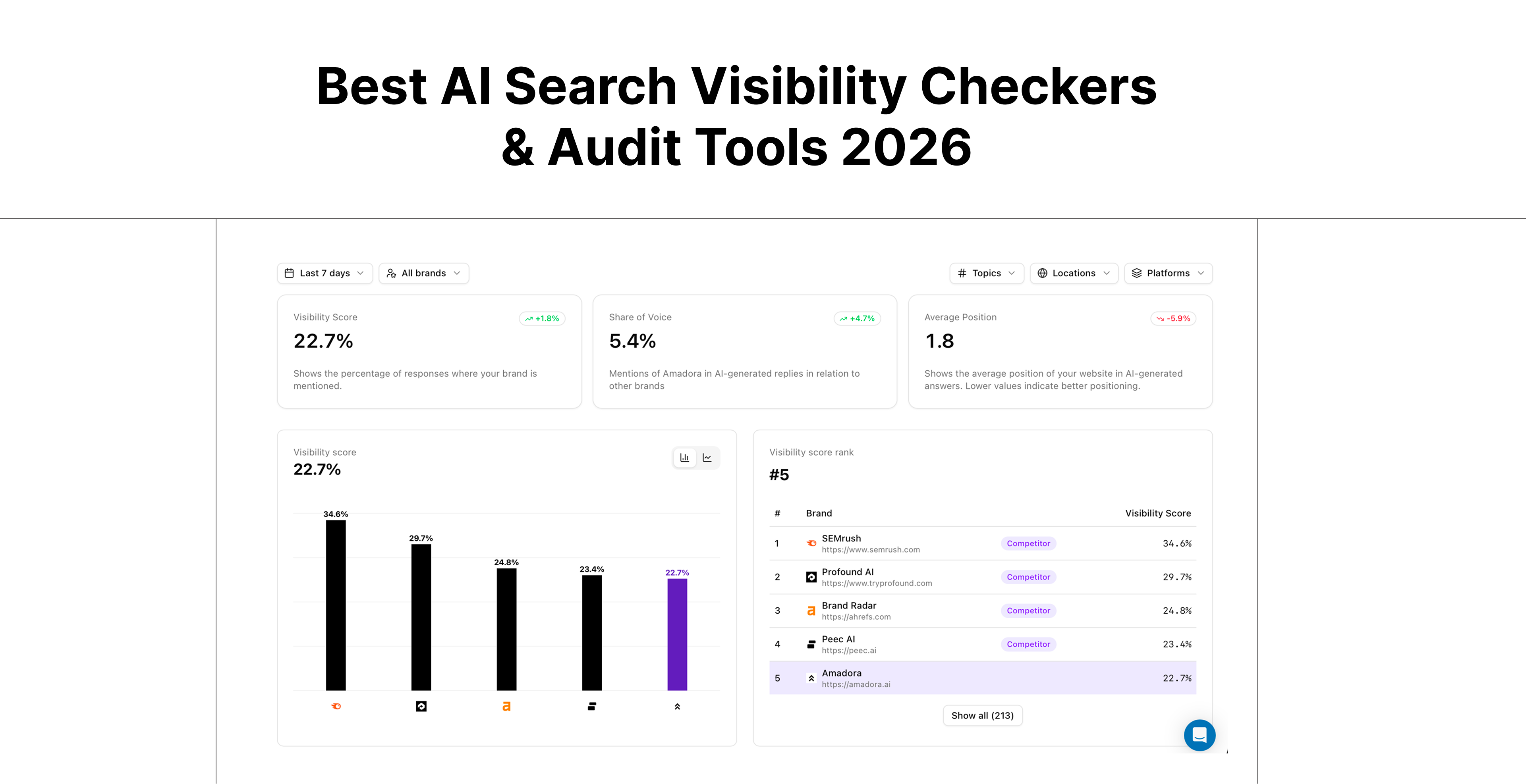
You set up a Brand Kit for each client — entering their brand name, website, ICPs, and target keywords. Amadora AI uses this to automatically generate and run relevant prompts across AI platforms daily. Results are aggregated into dashboards showing Visibility Score, Share of Voice, average position, and citation counts — all with trend indicators and competitor benchmarking. Agencies can share a read-only dashboard link directly with clients and export full CSV data for offline analysis.
Strengths
- Real UI scraping — up to 50% more accurate than API-based tools
- Covers 6+ AI platforms including Gemini, Grok, and Copilot
- Agency Dashboard for managing all brands from one view
- Daily tracking smooths response variance for reliable trends
- Team roles (Admin / Editor / Viewer) with project-level access control
- Client-shareable read-only dashboards with custom date ranges
- Full CSV export for all data including competitor lists
Weaknesses
- Newer platform — smaller review base than established SEO tools
- No traditional SEO features — focused purely on AI visibility
- Pricing not publicly listed; requires checking directly on site
Key Capabilities
- AI Search Optimization Plans — per-prompt, step-by-step action guides telling you exactly what to fix to improve visibility for each specific query — the core differentiator from every other monitoring tool on this list
- Daily prompt tracking across ChatGPT, Perplexity, Gemini, Google AI Mode, Copilot, and Grok
- Visibility Score, Share of Voice, average position, and citation count with trend indicators
- Competitor tracking and Share of Voice benchmarking
- Agency Dashboard — view all client brands in one workspace
- Brand Kit — persistent identity profiles that power topic extraction and optimization plans per brand
- Team management with granular roles and project-level access
- Client-shareable read-only dashboards and CSV exports
- Advanced trend graphs with daily/weekly/monthly aggregation
Pricing
- Starter: ~$49/mo
- Pro: ~$99–$199/mo
- Agency/Enterprise: Custom — contact sales
Free tier? 7-day free trial available — no long-term commitment required. Sign up at amadora.ai to get started.
Best for?
Amadora AI is the strongest option for SEO agencies and GEO consultants who need to track and manage AI search visibility across multiple client brands at once. The real-UI scraping methodology, Agency Dashboard, and granular team management make it a genuine workflow tool, not just a reporting dashboard.
Rating: Highly Rated on Capterra
2. Profound
Best enterprise GEO platform with white-glove support
What it does?
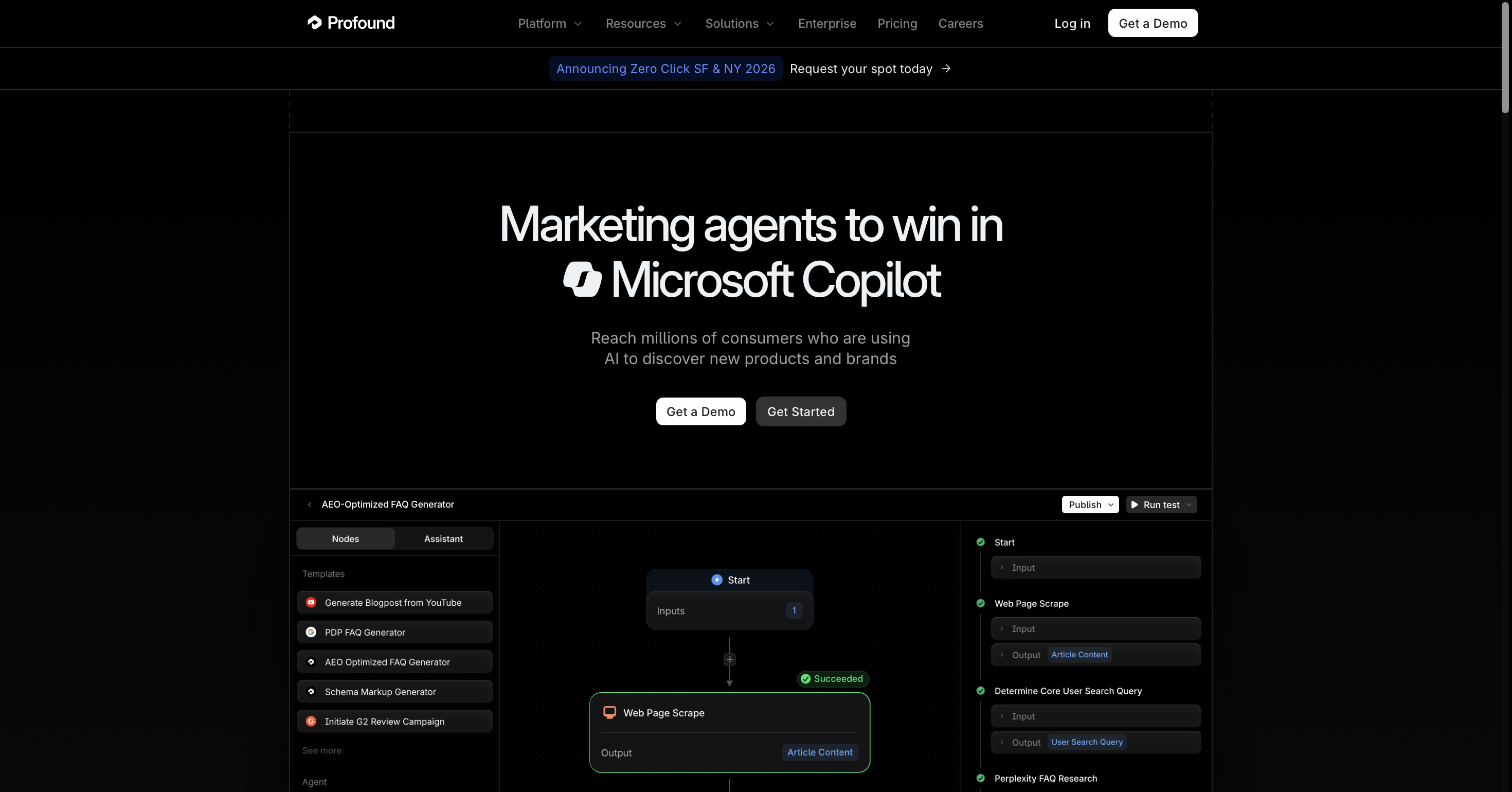
Profound is a high-end Generative Engine Optimization platform built for enterprise brands. It tracks how your brand appears across 10+ AI engines — including ChatGPT, Perplexity, Gemini, Claude, Grok, Microsoft Copilot, and DeepSeek — and combines AI answer tracking, real user prompt data (400M+ user prompts via its Conversation Explorer), and AI crawler analytics into one platform.
Why teams use it?
Enterprise teams choose Profound when they need the most comprehensive AI visibility data available, backed by white-glove service from dedicated AI strategists. It's the G2 Winter 2026 AEO Category Leader and has attracted major customers like MongoDB, Ramp, and Figma. Its "read/write" model lets teams track visibility and then act on it through AI content workflows — all in one place.
Who is this tool for (ICP)?
- Enterprise brands with significant marketing budgets and compliance requirements
- Regulated industries (healthcare, pharma, finance) needing SOC 2 and HIPAA compliance
- Agencies running large-scale GEO programs with 10+ client brands
- CMOs who need boardroom-ready AI visibility reporting
How this tool fits in the AI-first era?
- Three-dimensional data approach: AI results, 400M+ real user prompts, and AI crawler analytics
- Tracks the broadest set of AI engines of any tool on this list
- Includes AI content workflows so teams can act on insights — not just report them
How does Profound work?
Profound connects to your brand and target prompts, then continuously tracks how your brand surfaces across AI engines. Its Conversation Explorer surfaces real user prompt data so you can understand how real people are asking about your category. Agent Analytics reveals how AI crawlers access your content, and the platform integrates with GA4 to attribute traffic and conversions directly to AI search.
Strengths
- Broadest AI engine coverage (10+ platforms)
- G2 Winter 2026 AEO Category Leader
- Real user prompt data via Conversation Explorer
- SOC 2 Type II and HIPAA compliant
- Dedicated AI strategist support at enterprise tier
- GA4 integration for AI traffic attribution
Weaknesses
- Expensive — Starter at $99/mo is limited; serious use starts at $399/mo+
- No free trial — requires a sales process
- Complex for smaller teams that just need straightforward tracking
Key Capabilities
- AI answer tracking across 10+ platforms
- Conversation Explorer — 400M+ real user AI prompts for demand intelligence
- Agent Analytics — how AI crawlers index your content
- AI content workflows for GEO-optimized content
- GA4 integration for AI traffic attribution
- Multi-client "God View" for agencies
Pricing
- Starter: $99/mo
- Growth: $399/mo
- Agency Growth: $1,499/mo
- Enterprise: Custom
Free tier? No free tier — free AEO report available for prospecting; no free ongoing plan.
Best for?
Profound is the right choice for enterprise brands and large agencies that need the most comprehensive AI visibility data available — and have the budget to use it. Mid-market teams should evaluate whether the pricing-to-value trade-off makes sense compared to more accessible alternatives.
Rating: 4.6/5 on G2 (G2 Winter 2026 AEO Leader)
3. Otterly.AI
Best budget-friendly GEO monitoring tool with a detailed audit feature
What it does?
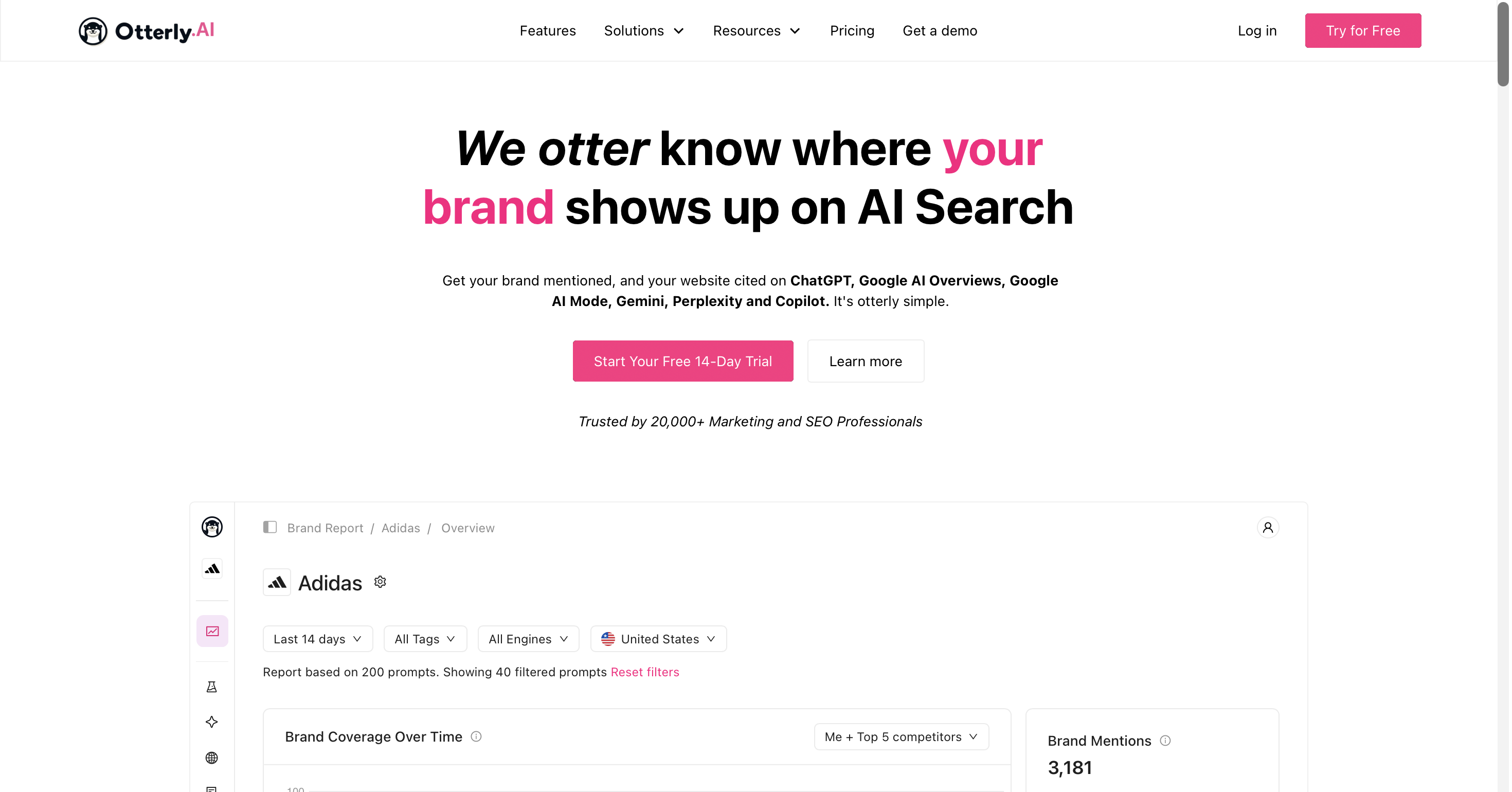
Otterly.AI is a cloud-based AI search visibility platform that automatically monitors brand, content, and competitor mentions across Google AI Overviews, ChatGPT, and Perplexity. It includes a GEO audit tool that gives brands a SWOT-style analysis of their current AI search presence with prioritized recommendations.
Why teams use it?
Otterly has built strong early momentum — 4.9/5 on G2, a Gartner Cool Vendor 2025 badge, and 20,000+ users across 40+ countries — by combining an accessible entry price ($29/mo) with genuinely useful GEO auditing. A notable case study: Bacula Enterprise achieved the #1 position in ChatGPT for "best HPC backup software" using Otterly's GEO audit recommendations.
Who is this tool for (ICP)?
- Agencies testing GEO monitoring for the first time on a limited budget
- In-house SEO teams wanting to add AI visibility tracking to their toolkit
- Teams already using Semrush who want a native GEO integration
- Smaller brands tracking visibility across the big three AI platforms
How this tool fits in the AI-first era?
- Turns traditional keywords into AI-style prompts automatically, bridging the SEO-to-GEO gap
- Daily automated scanning means you don't have to manually check AI engines for brand mentions
- The GEO audit feature helps teams understand why their brand appears (or doesn't) and what to fix
How does Otterly.AI work?
You input your brand, competitors, and target keywords. Otterly's AI Keyword Research tool converts those into the kinds of prompts real users type into AI engines, then automatically monitors those prompts daily. The GEO audit generates an actionable SWOT report highlighting where to improve content and citations to gain AI visibility.
Strengths
- Most affordable entry point in the GEO category ($29/mo)
- 4.9/5 on G2 — strong user satisfaction
- Best-in-class GEO audit in the sub-$200/mo range
- Semrush App Center integration
- Gartner Cool Vendor 2025 recognition
Weaknesses
- Weekly data refresh (slower than daily-refresh competitors)
- No Claude or Gemini tracking — only ChatGPT, Perplexity, Google AI Overviews
- Prompt-based pricing means costs jump sharply if you track many queries
- No brand sentiment metric
Key Capabilities
- AI search visibility monitoring across ChatGPT, Perplexity, and Google AI Overviews
- AI Keyword Research — converts brand keywords into real AI-style prompts
- GEO audit — SWOT analysis with prioritized recommendations
- Competitor tracking and comparison
- Semrush App Center integration
Pricing
- Lite: $29/mo (15 prompts)
- Standard: $189/mo (100 prompts)
- Premium: $489/mo (400 prompts)
Free tier? No free tier — 14-day free trial available.
Best for?
Otterly.AI is the go-to for teams dipping their toes into GEO monitoring without committing to an expensive enterprise platform. The main trade-off is the weekly data refresh and limited AI platform coverage — once you need daily data across Gemini, Grok, or Copilot, you'll need to upgrade to a more comprehensive platform.
Rating: 4.9/5 on G2 · Gartner Cool Vendor 2025
4. Semrush AI Visibility Toolkit
Best for teams already invested in the Semrush platform
What it does?
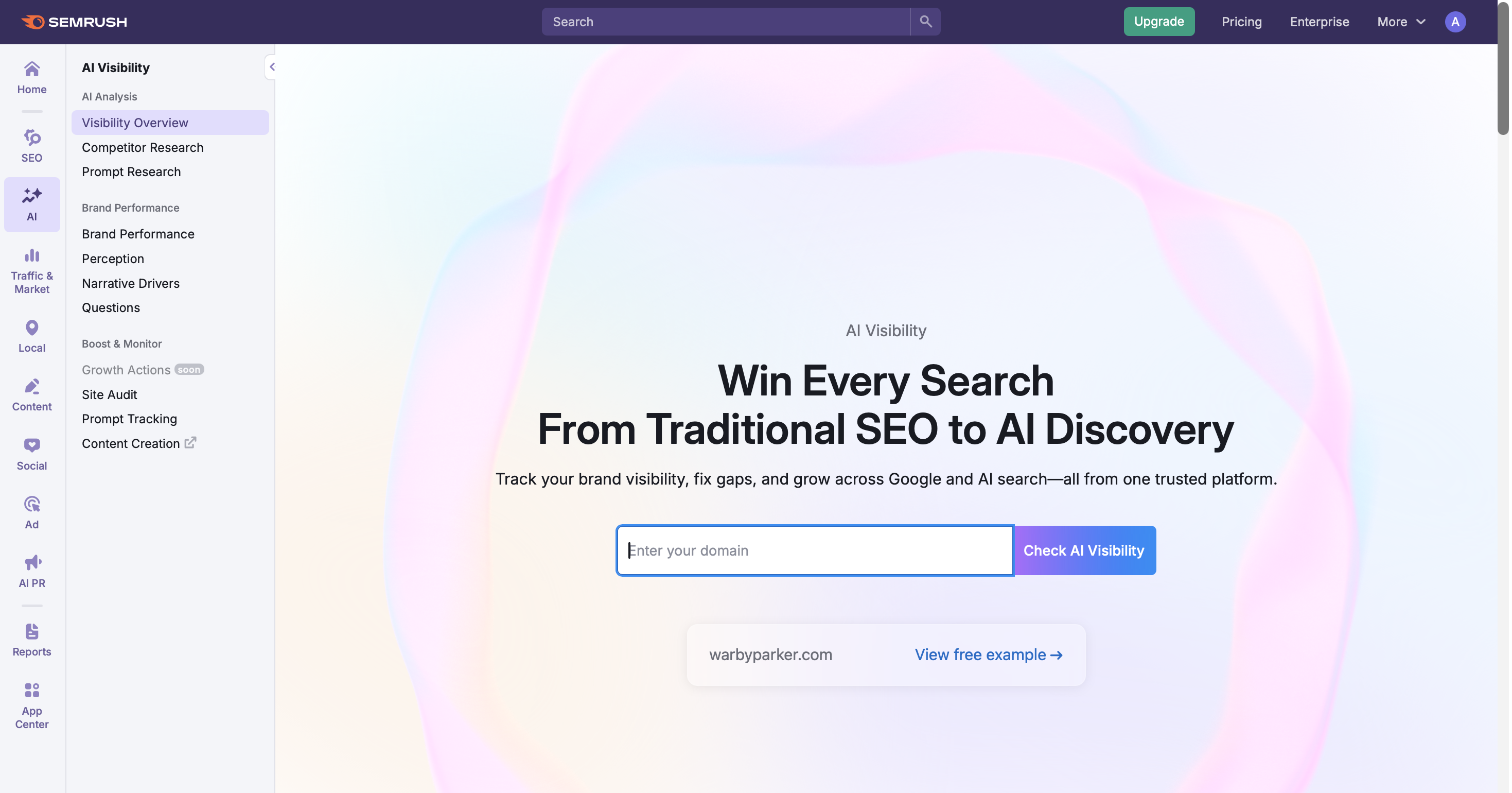
Semrush launched its AI Visibility Toolkit in September 2025 — adding GEO tracking to its existing suite. The add-on lets users benchmark brand visibility across major LLMs, track category Share of Voice, and conduct competitive analysis in AI search, all within the familiar Semrush interface.
Why teams use it?
For the millions of marketers and agencies already paying for Semrush, the AI Visibility Toolkit is the path of least resistance into GEO tracking. It plugs into existing workflows and avoids the cost of adding yet another subscription. Semrush has analyzed 230,000 prompts across ChatGPT, Google AI Mode, and Perplexity to build out its benchmark data.
Who is this tool for (ICP)?
- Agencies and brands already using Semrush for traditional SEO
- Multi-channel marketing teams who want AI tracking alongside PPC and SEO data
- SEO managers who want to show AI search visibility in existing client reports
How this tool fits in the AI-first era?
- Brings AI search tracking into the existing SEO reporting workflow — no new tools or logins
- Connects AI visibility data with traditional SEO signals for a more complete picture
- Backed by Semrush's massive keyword database for richer context
How does it work?
Available as an add-on ($99/mo per domain) to any existing Semrush subscription. It integrates with Semrush's existing rank tracking and content modules, so you can view AI visibility alongside organic rankings in the same dashboard and add AI visibility data to standard client report templates.
Strengths
- Seamless integration with existing Semrush workflows
- Rich keyword and SEO context alongside AI visibility data
- Trusted brand with strong documentation and support
Weaknesses
- Only worthwhile if you're already paying for Semrush
- Less multi-platform AI coverage than dedicated GEO tools
- GEO capability is secondary, not the primary product focus
Key Capabilities
- AI Overviews and LLM brand mention tracking
- Share of Voice benchmarking across AI search platforms
- Competitor comparison in AI-generated answers
- Integration with Semrush keyword, content, and reporting tools
Pricing
- AI Toolkit Add-on: $99/mo per domain
- Requires Semrush base plan from $165/mo
Free tier? No free tier — requires an active Semrush subscription plus the $99/mo add-on.
Best for?
Semrush AI Visibility Toolkit makes most sense if you're already deep in the Semrush ecosystem and want to add AI tracking without managing a second subscription. For agencies that need daily tracking, multi-project management, or broader AI platform coverage, a dedicated GEO platform will serve you better.
Rating: 4.5/5 on G2 (Semrush overall)
5. Writesonic GEO
Best for teams wanting AI visibility tracking combined with content creation
What it does?
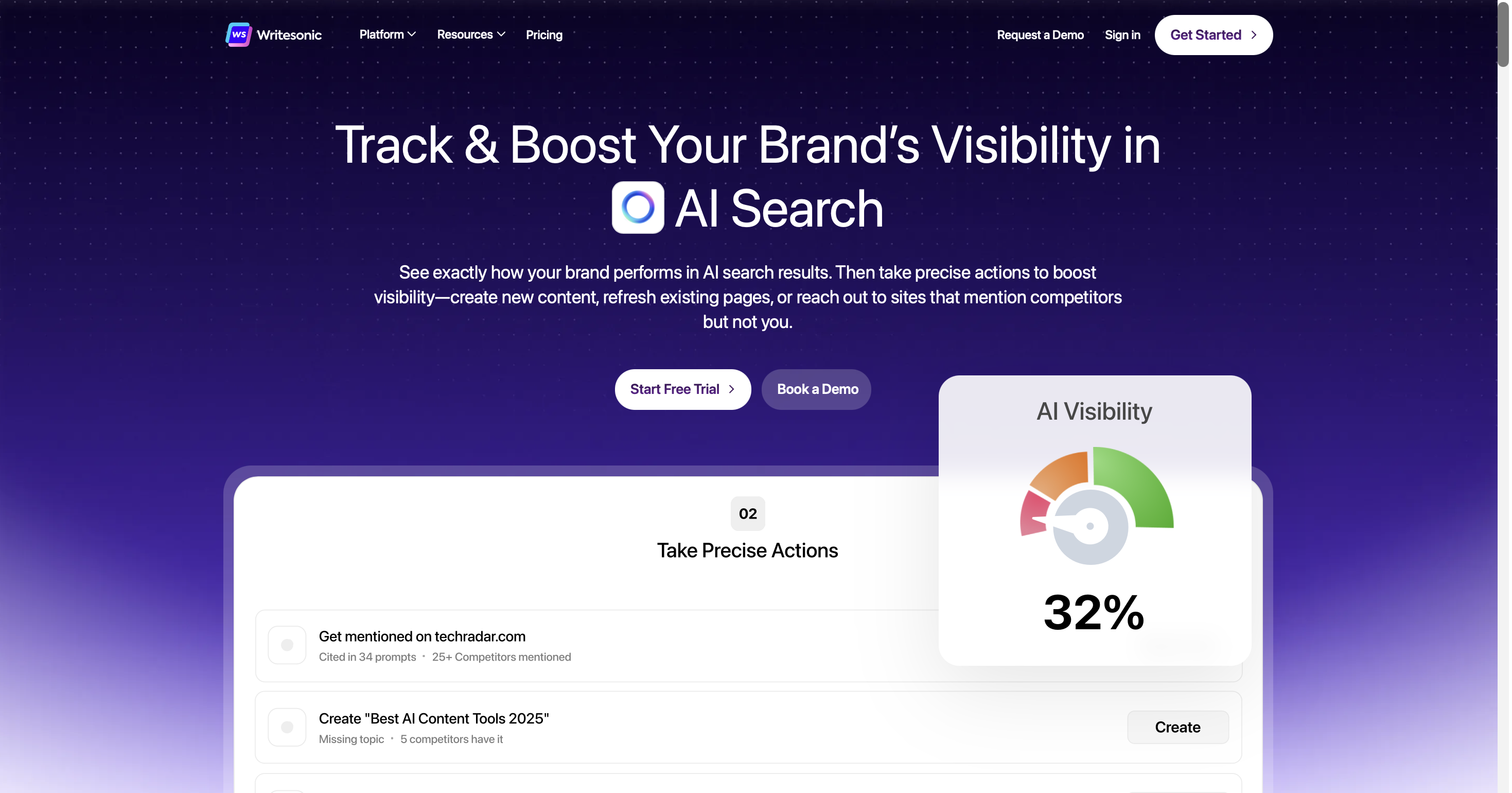
Writesonic has evolved from an AI writing tool into a full GEO platform — combining brand visibility tracking across ChatGPT, Google AI Overviews, Gemini, and Perplexity with content creation, optimization, and publishing features. It positions itself as "the Ahrefs for AI Search," offering both the measurement and the execution layer in one subscription.
Why teams use it?
Content teams choose Writesonic GEO when they want to close the loop between what they're tracking and what they're publishing. Instead of using one tool to identify a visibility gap and another to fix it, Writesonic lets you spot where your brand is underperforming in AI answers and immediately create and publish GEO-optimized content to address it.
Who is this tool for (ICP)?
- Content marketing teams that want to optimize for both traditional SEO and AI search
- SaaS brands with active content programs looking to capture AI citation opportunities
- Growth teams that want one platform for tracking and content execution
- Agencies offering content + GEO optimization services to clients
How this tool fits in the AI-first era?
- AI Traffic Analytics identifies and quantifies visits from AI platforms
- Tracks visibility across 4 major AI platforms including Google AI Overviews and Gemini
- Content creation is designed from the ground up for LLM citation and AI-answer structure
How does Writesonic GEO work?
You connect your brand, enter target keywords and competitors, and Writesonic tracks how your brand and content appear in AI-generated answers. The Brand Presence Explorer shows where you're cited and where competitors outrank you. The integrated content tools let you draft AEO-ready blogs, landing pages, and guides. One-click publishing to WordPress and social platforms rounds out the workflow.
Strengths
- Combines tracking and content creation in one platform
- AI traffic analytics for attributing visits from AI platforms
- 4.7/5 on G2 (~5,900 reviews)
- SOC 2, GDPR, and HIPAA compliant
- Content published directly to WordPress and social from the platform
Weaknesses
- GEO tracking is newer — less mature than dedicated tracking platforms
- Content creation focus can distract from pure visibility tracking use cases
Key Capabilities
- Brand Presence Explorer — how often your brand appears in AI answers
- AI Traffic Analytics — attributes visits and conversions from AI search
- AI-optimized content creation (blogs, landing pages, FAQs)
- Competitor benchmarking in AI-generated answers
- One-click publishing to WordPress and social
Pricing
- GEO Plans: From $199/mo
- Enterprise: Custom pricing
Free tier? No free tier for GEO features.
Best for?
Writesonic GEO is best for content-driven teams that want the tracking and the fix in one platform. Pure tracking-focused users may prefer a dedicated GEO platform and separate content tooling.
Rating: 4.7/5 on G2 (~5,900 reviews)
6. Peec AI
Best for international brands tracking AI visibility across multiple languages
What it does?
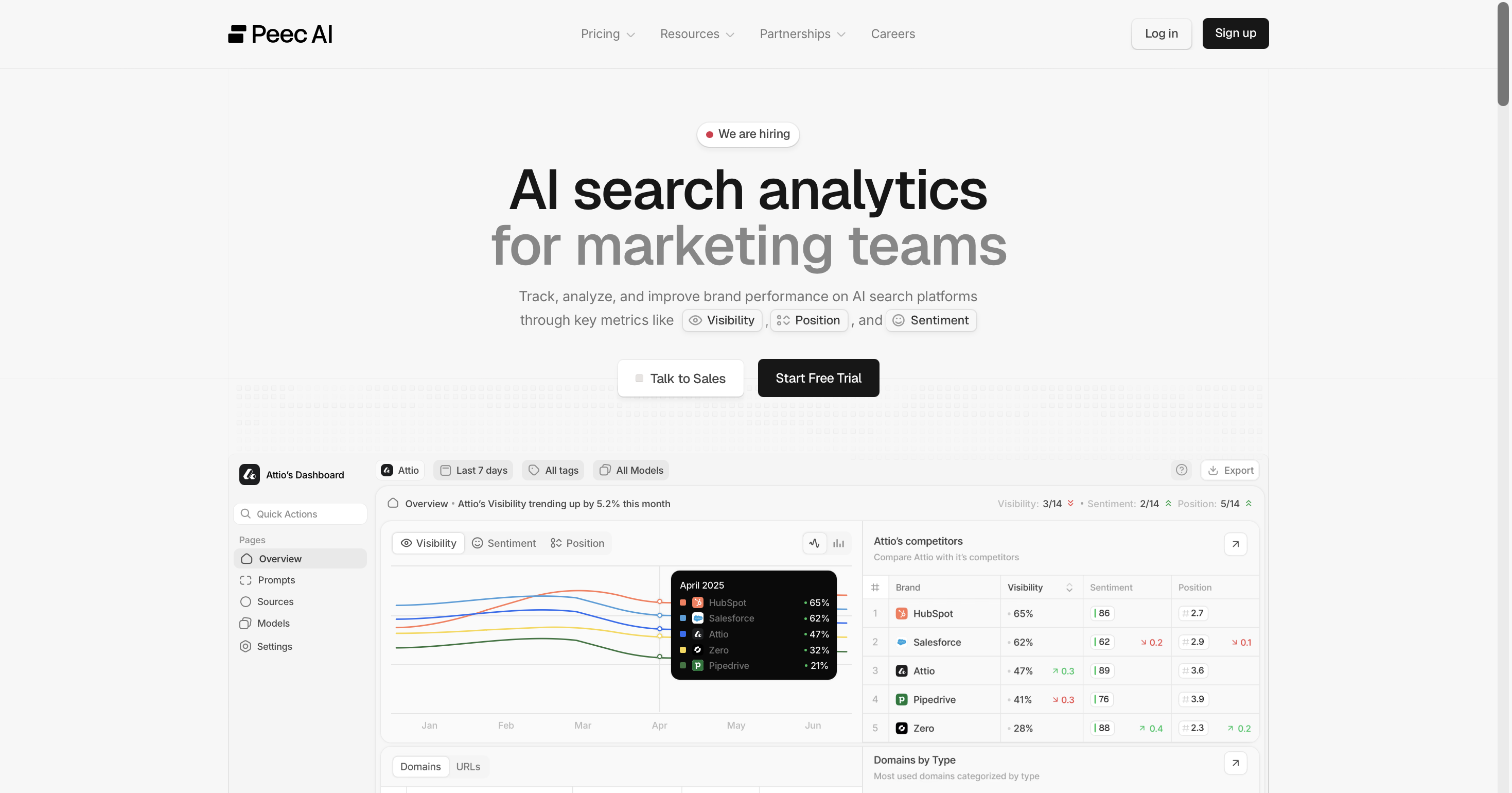
Peec AI is an AI search analytics platform that tracks how brands perform across AI-powered discovery platforms, with a standout edge in multilingual coverage — 115+ languages across major markets. It tracks brand visibility, position, and sentiment across ChatGPT, Perplexity, Google AI Overviews, and more using UI scraping (not API calls) to return results matching what real users see.
Why teams use it?
Peec reached €650K ARR within four months of launch and closed a $21M Series A by November 2025. Documented customer outcomes include Wix achieving 5x year-over-year growth in LLM traffic, and Merge seeing 5x LLM-driven demo requests. Its 115+ language support is genuinely unmatched in this category.
Who is this tool for (ICP)?
- International and multi-market brands tracking AI visibility across languages and regions
- SaaS companies with global customer bases where local AI search behavior varies
- Agencies managing non-English-market clients
- Brand teams that care about sentiment — how positively AI describes their brand
How this tool fits in the AI-first era?
- UI scraping ensures data reflects what real users in each market actually see
- Sentiment tracking helps brands understand not just whether they're mentioned, but how favorably
- 115+ language support future-proofs global GEO strategies
How does Peec AI work?
You configure brand profiles with target prompts, competitors, and markets. Peec AI runs those prompts across AI engines in the specified language and region, scraping real UI responses to track visibility, position, sentiment, and citation sources. Dashboards surface where you're winning, where competitors are outperforming you, and which markets need the most attention.
Strengths
- 115+ languages — best multilingual coverage in the category
- UI scraping for real-user-accurate data
- Sentiment tracking beyond basic mention counts
- 5.0/5 on G2
- Strong documented customer outcomes (Wix, Merge)
Weaknesses
- Monitoring-focused — no built-in content creation or execution tools
- Less established review base than category leaders
- Newer platform with evolving feature set
Key Capabilities
- Brand visibility and position tracking across AI engines
- Sentiment analysis — how AI platforms describe your brand
- 115+ language support for multi-market tracking
- Competitor benchmarking and Share of Voice
- Citation source analysis
Pricing
- Starter: ~$105/mo
- Pro: ~$235/mo
- Enterprise: Custom
Free tier? Yes — 14-day free trial available.
Best for?
Peec AI is the clear choice if your brand operates across multiple languages and markets. It's also the best option if sentiment tracking is a priority metric. Brands looking for built-in content workflows will need to pair it with a separate content tool.
Rating: 5.0/5 on G2
7. Scrunch
Best for brand and agency monitoring with a clean, focused interface
What it does?
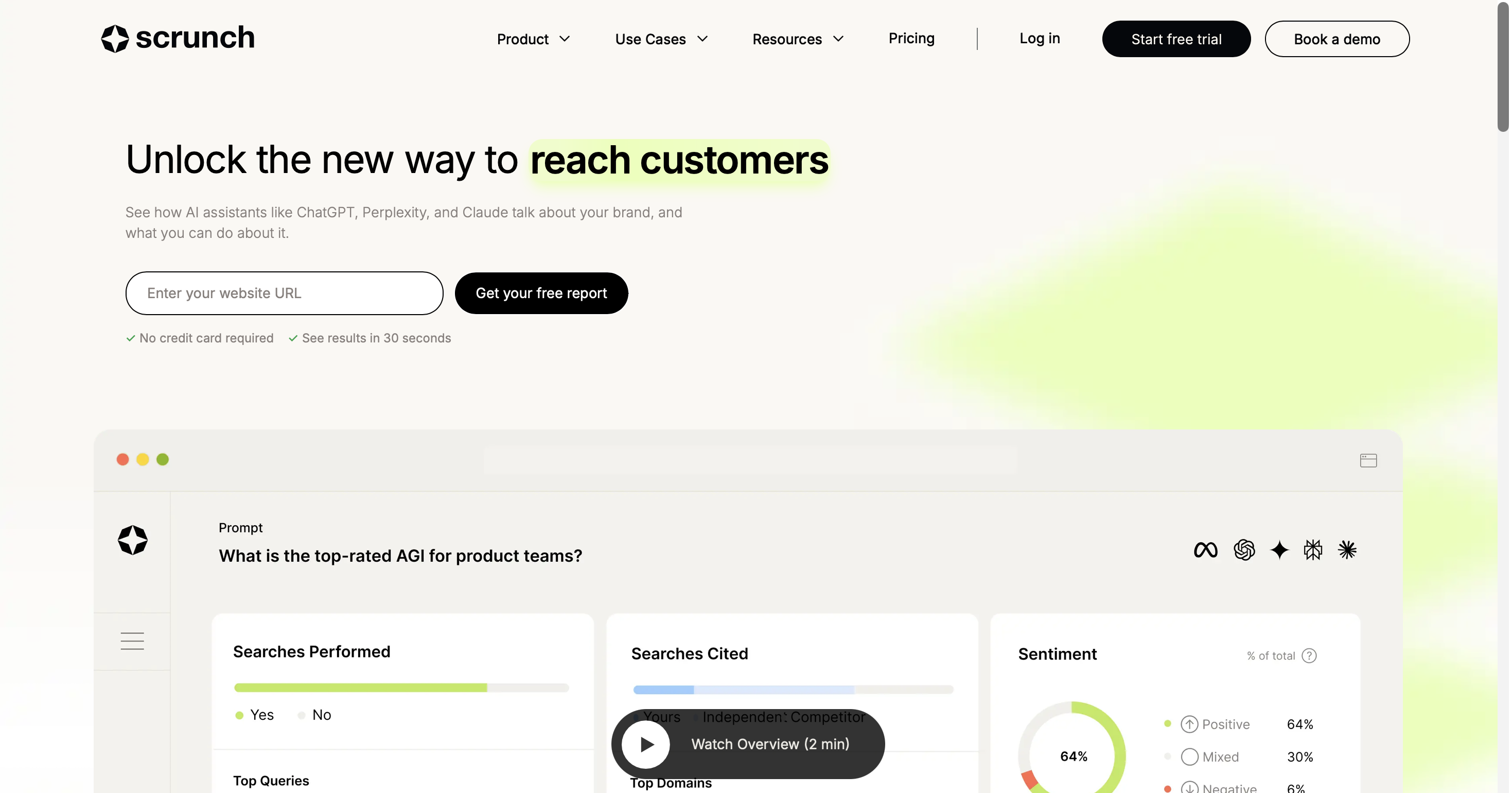
Scrunch is an AI search visibility monitoring platform that tracks how generative platforms like ChatGPT, Perplexity, and Google AI Overviews represent your brand. It offers brand-level monitoring, citation analysis, and competitive benchmarking through clean, straightforward dashboards designed for both brands and agencies.
Why teams use it?
Scrunch takes a notably transparent approach — their content explicitly compares them against real competitors without cherry-picking metrics, which has built trust with the SEO and GEO community. Agencies choose it for its clean interface and dedicated agency pricing tiers that allow managing multiple brands under one account.
Who is this tool for (ICP)?
- Mid-market agencies managing several brand clients who need clean, shareable reporting
- In-house marketing teams wanting straightforward AI visibility monitoring without heavy setup
- Professionals seeking brand monitoring rather than a full GEO optimization suite
How this tool fits in the AI-first era?
- Focuses on what matters: accurate brand representation in AI answers and citation quality
- Agency-specific pricing makes it easier to scale monitoring across a client portfolio
- AI content delivery features are on the 2026 roadmap
How does Scrunch work?
You set up brand and competitor profiles, and Scrunch continuously monitors how those brands appear in AI-generated answers. Dashboards show citation frequency, source quality, and how your brand is described — helping teams spot inaccurate AI representations or missed citation opportunities.
Strengths
- Clean, focused interface — easier learning curve than enterprise tools
- Dedicated agency pricing tiers for multi-client work
- Transparent product positioning builds trust
- Strong citation quality and brand representation tracking
Weaknesses
- No content creation capabilities (on 2026 roadmap)
- Higher entry price than Otterly.AI or Amadora AI for comparable monitoring
- Fewer AI platforms covered than broader enterprise tools
Key Capabilities
- Brand mention and citation monitoring across ChatGPT, Perplexity, Google AI Overviews
- AI brand representation quality tracking
- Competitor benchmarking and visibility comparison
- Multi-brand agency dashboard
Pricing
- Brand Core: $250/mo
- Agency Core: $500/mo
- Enterprise: Custom
Free tier? No free tier — Core plan starts at $250/mo for brands, $500/mo for agencies.
Best for?
Scrunch works well for mid-market agencies and brands that want clean, reliable AI visibility monitoring without the complexity of an enterprise GEO suite. Teams needing content execution or advanced analytics should evaluate whether the price-to-feature ratio makes sense.
8. AthenaHQ
Best for automating on-page GEO optimization across large content libraries
What it does?
AthenaHQ focuses on a specific niche: automated on-page GEO optimization. It applies schema markup and entity tagging to improve how AI engines read and understand your content, and layers this with cross-AI model ranking insights, sales-oriented query discovery, and competitive intelligence — all aimed at making large existing content libraries machine-readable at scale.
Why teams use it?
Most GEO tools tell you where you're invisible in AI answers. AthenaHQ focuses on fixing the underlying technical reasons why — poor entity recognition, missing structured data, and content that AI systems can't easily parse. For brands with hundreds or thousands of existing pages, the ability to systematically optimize content for AI citation without manual page-by-page effort is a significant time saver.
Who is this tool for (ICP)?
- Content-heavy B2B SaaS brands with large existing page counts
- Marketing and growth teams that need to operationalize GEO at page-template level
- SEO teams that already understand entity optimization and want to extend it to AI search
- Agencies that run technical content audits for clients
How this tool fits in the AI-first era?
- Addresses the root cause of poor AI visibility: content that AI systems can't properly parse or cite
- Schema and entity tagging makes content structurally compatible with how LLMs extract information
- Action Center highlights specific gaps to fix
How does AthenaHQ work?
You connect your domain and target topics. AthenaHQ audits your content for AI readability — checking for entity clarity, structured data gaps, and semantic signals that AI engines rely on when deciding what to cite. It then surfaces prioritized recommendations through its Action Center.
Strengths
- Unique focus on technical on-page GEO — fills a gap most other tools ignore
- Accessible entry price ($49/mo)
- Action Center gives concrete, prioritized fixes — not just dashboards
- Scales across large content libraries without per-page manual effort
Weaknesses
- Less comprehensive for tracking Share of Voice or competitor benchmarking
- Narrower scope than full-stack GEO platforms
- Newer tool with a smaller community and review base
Key Capabilities
- Automated schema markup and entity tagging for AI readability
- Cross-AI model ranking insights
- Sales-oriented query discovery
- Competitive intelligence in AI-generated answers
- Action Center — prioritized technical GEO fixes
Pricing
- Self-Serve: From $49/mo
- Enterprise: Custom
Free tier? No free tier — paid plans from $49/mo.
Best for?
AthenaHQ is for teams that already understand why they want AI visibility and are ready to fix the technical barriers preventing it. Use it alongside a tracking tool like Amadora AI to measure the visibility impact of the optimizations you implement.
9. Ahrefs (Brand Radar)
Best for SEO-focused teams adding basic AI tracking to their existing workflow
What it does?
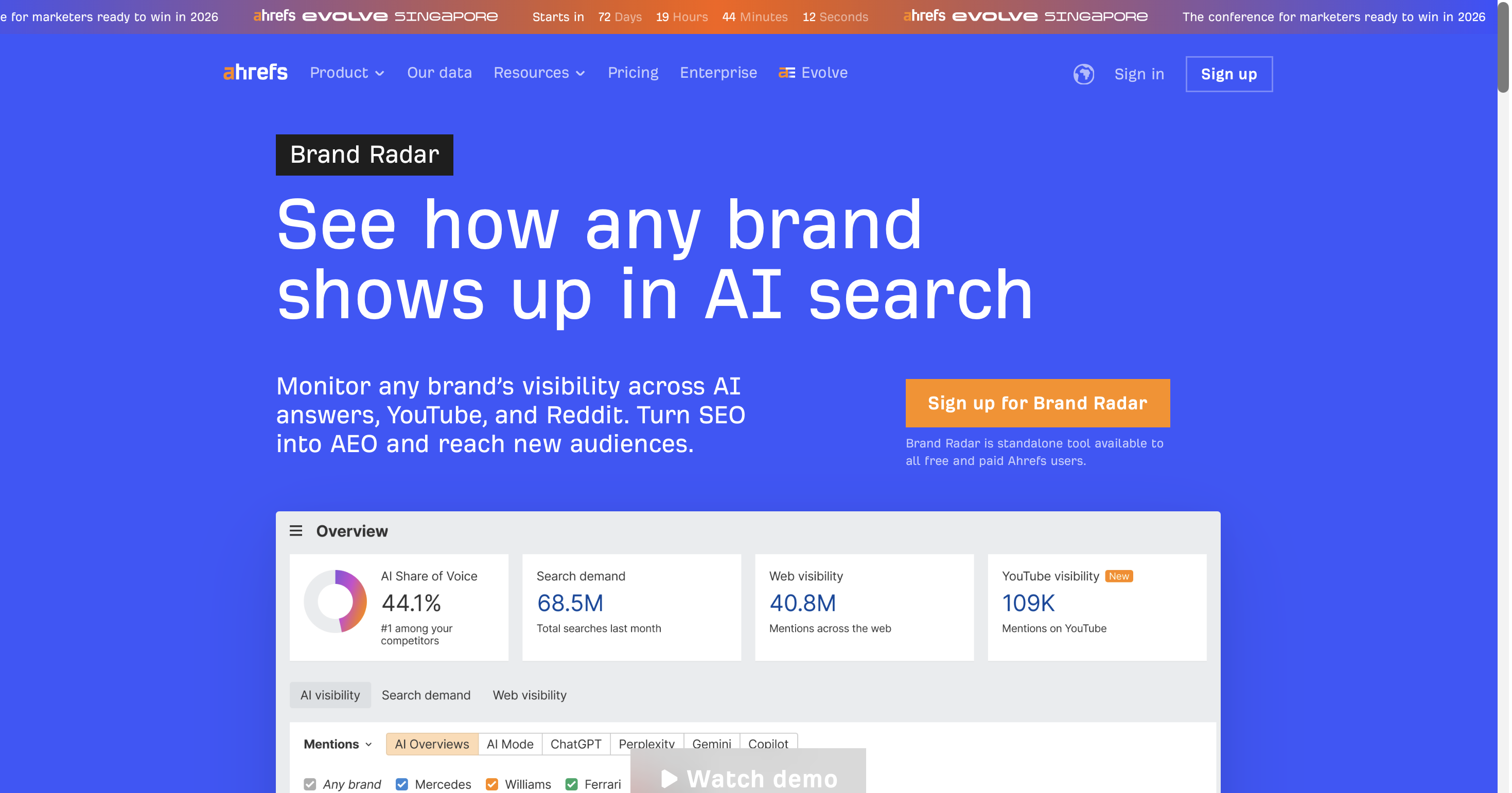
Ahrefs added GEO tracking capabilities in 2024, primarily focused on Google AI Overviews. The Brand Radar and mention-tracking features let existing Ahrefs users monitor where their brand appears across the web and in AI-generated search results, without leaving the platform they already use daily.
Why teams use it?
For agencies and SEO-heavy brands already paying for Ahrefs, Brand Radar is a natural first step into AI visibility tracking. It surfaces where brand mentions are happening online — which directly influences how AI systems learn about and cite your brand.
Who is this tool for (ICP)?
- SEO and content agencies with existing Ahrefs subscriptions
- Brands where Google AI Overviews is the primary AI search concern
- Teams that want to understand the SEO signals driving AI citation before investing in a dedicated GEO platform
How this tool fits in the AI-first era?
- Backlink and domain authority data is directly relevant to AI citations — AI systems favor authoritative sources
- Google AI Overviews tracking connects traditional rank tracking to AI-generated SERP features
- Content gap analysis helps identify topics where a brand is absent from both traditional and AI search
How does Ahrefs Brand Radar work?
You set up brand alerts in Ahrefs and it crawls the web for mentions across news, blogs, and web pages. The Site Explorer and Content Explorer help identify where your content is already earning citations and where gaps exist.
Strengths
- Best-in-class backlink and domain authority data
- Google AI Overviews tracking alongside traditional rankings
- Trusted brand with massive community and strong documentation
- Content gap analysis excellent for identifying AI citation opportunities
Weaknesses
- GEO coverage is primarily Google-focused — limited ChatGPT, Perplexity, Gemini tracking
- AI visibility is an add-on, not the core product
- No Share of Voice or AI-specific visibility scoring
Key Capabilities
- Brand mention tracking across web, news, and blogs
- Google AI Overviews presence tracking
- Backlink and domain authority analysis
- Content gap analysis for citation opportunities
Pricing
- Lite: $129/mo
- Standard: $249/mo
- Advanced: $449/mo
- Enterprise: $1,500+/mo
Free tier? Limited — Ahrefs Webmaster Tools is free for your own sites; full Brand Radar features require a paid plan.
Best for?
Ahrefs is best used as a supporting tool in a GEO strategy — not the primary tracking platform. For full AI search visibility tracking across ChatGPT, Perplexity, Gemini, and beyond, pair it with a dedicated GEO platform like Amadora AI.
Rating: 4.5/5 on G2
10. HubSpot AI Search Grader
Best free diagnostic for understanding your starting point in AI search

What it does?
HubSpot's AI Search Grader is a free, one-time assessment tool that scans your brand's presence across ChatGPT, Perplexity, and Gemini. It evaluates mention frequency, sentiment, and competitive positioning, then gives you a snapshot report on how your brand currently appears in AI-generated search results — no account or subscription required.
Why teams use it?
It's completely free. For marketers who have heard about AI search visibility but haven't yet committed to a paid platform, it's a zero-risk way to get a baseline. Many agencies use it as a prospecting tool — running a free assessment for a prospect and using the results to demonstrate the gap and opportunity before recommending a full GEO strategy.
Who is this tool for (ICP)?
- Marketers taking their first look at AI search visibility
- Agencies looking for a free prospecting hook to start GEO conversations with clients
- Brands that want a quick benchmark before investing in a paid GEO platform
How this tool fits in the AI-first era?
- Lowers the barrier to entry for marketers new to GEO — no budget, no commitment
- Provides a concrete data point to start AI search visibility conversations with leadership or clients
How does it work?
You enter your brand name and website URL, and HubSpot's tool runs a scan across the three major AI platforms. Within minutes it generates a report showing your brand's mention rate, how AI describes your brand (sentiment), and how you compare to key competitors.
Strengths
- Completely free — zero commitment
- Fast and accessible — results in minutes
- Great prospecting and conversation-starter for agencies
- Shareable report format works well for stakeholder presentations
Weaknesses
- One-time assessment only — no ongoing monitoring
- No optimization guidance or content recommendations
- No trend data — only a current snapshot
Key Capabilities
- One-time AI brand visibility assessment across ChatGPT, Perplexity, and Gemini
- Mention frequency and sentiment scoring
- Basic competitor comparison
- Shareable summary report
Pricing
- AI Search Grader: $0 — completely free
Free tier? Completely free — no account, subscription, or credit card required.
Best for?
HubSpot AI Search Grader is a starting point, not a strategy. Use it to get a baseline and make the case for investing in proper GEO tracking — then graduate to a purpose-built platform for ongoing monitoring, competitive benchmarking, and trend analysis.
What Is Brand Visibility in AI Search (and Why It Matters)?
Traditional rank tracking tells you where you appear on page one of Google. AI search visibility tracking tells you something more nuanced: when a user asks an AI assistant a question relevant to your brand or category, does the AI mention you — and how favorably?
This distinction matters because the user behavior is fundamentally different. In traditional search, a user sees a list of ten blue links and decides which to click. In AI search, they ask a question and receive a single synthesized answer — often with only 2–3 brand citations. Being absent from that answer is like being invisible on page one, except there is no page two.
Key metrics that matter in AI search visibility:
- Visibility Score — how often your brand appears when relevant AI prompts are run
- Share of Voice — your brand's presence as a percentage of AI responses in your category vs. competitors
- Citation Count — how many times your content is cited as a source in AI-generated answers
- Average Position — where in an AI-generated answer your brand appears (earlier is better)
- Trend Direction — are these metrics improving or declining over time?
How to Choose the Right Tool for Your Needs
If you're an agency managing multiple client brands — you need multi-project management, client-shareable dashboards, team roles, and tracking across the major AI platforms. Amadora AI is built exactly for this workflow. Profound is also strong for agencies with enterprise-level clients and budget.
If you're an in-house marketer at a single brand — you have more flexibility. If you're already in the Semrush or Ahrefs ecosystem, their AI features are a natural starting point. For broader AI platform coverage, Peec AI, Otterly.AI, or a dedicated GEO tool will give you more signal.
If your main concern is fixing the content — not just tracking it — Writesonic GEO and AthenaHQ both include execution tools alongside tracking. Writesonic is better for content creation; AthenaHQ is better for on-page technical optimization.
If you're just getting started — run a free HubSpot AI Search Grader assessment to get a baseline, then trial Otterly.AI ($29/mo) or Amadora AI to get ongoing monitoring in place.
Frequently Asked Questions
What is AI search visibility tracking? AI search visibility tracking measures how often and how favorably your brand appears in AI-generated answers across platforms like ChatGPT, Perplexity, Gemini, and Google AI Overviews. Unlike traditional rank tracking, it focuses on Share of Voice, citation counts, and average position within AI responses.
What's the difference between GEO and traditional SEO? Traditional SEO optimizes content to rank in keyword-based search results. Generative Engine Optimization (GEO) optimizes content to be cited, referenced, and recommended by AI-powered answer engines. The signals overlap — authoritative content, clear entity definition, and strong backlinks help both — but GEO also requires prompt-level tracking and content structured for AI extraction.
Why does it matter whether a tool uses API data vs. real UI scraping? API responses from LLMs can differ significantly from what real users see in AI chatbot interfaces — by up to 50%. Real UI responses also include more citation sources. If you're making strategic decisions based on AI visibility data, you want to be measuring what real users actually see, not a synthetic approximation.
How many AI search visibility tools do I actually need? Most teams do well with one primary GEO tracking platform plus their existing SEO tool for supporting signals. There's no need to run five different AI monitoring platforms — the key is picking one that covers the AI platforms relevant to your audience and fits your team's workflow.
Can AI search visibility be improved — or is it just a tracking metric? It can absolutely be improved. Common tactics include publishing structured, question-and-answer-style content that AI engines can easily extract, earning citations from authoritative sources that AI systems trust, improving entity clarity, and optimizing technical on-page structure for AI readability.
Conclusion: Start Tracking Before Your Competitors Do
AI search is no longer a future consideration — it's where a meaningful and growing share of discovery, research, and purchase decisions are already happening. Every month that passes without measurement is a month you can't act on.
The good news is the tooling is now accessible at every price point — from the free HubSpot AI Search Grader to purpose-built agency platforms like Amadora AI and enterprise suites like Profound. The brands and agencies that build the habit of tracking and improving their AI search visibility now will have a compounding advantage as these platforms continue to grow.
Start simple. Pick one tool. Get a baseline. Then iterate.
Ready to see your brand's AI search visibility? Amadora AI is built for agencies and marketers who want accurate, multi-platform AI search visibility data — with the team management and client reporting tools to scale it across every brand you manage. Explore Amadora AI at amadora.ai

Start delivering GEO services to your clients this week
The AI search platform built for SEO agencies. Audit, plan, report, retain.

Amadora.ai - AI Search Analytics and Optimisation platform for SEO agencies and growth teams.


© All rights reserved. Amadora 2026
