
Leading AI Visibility Optimization Platforms Compared
Authored by

Dmitry Chistov
Founder & CEO at Amadora.ai
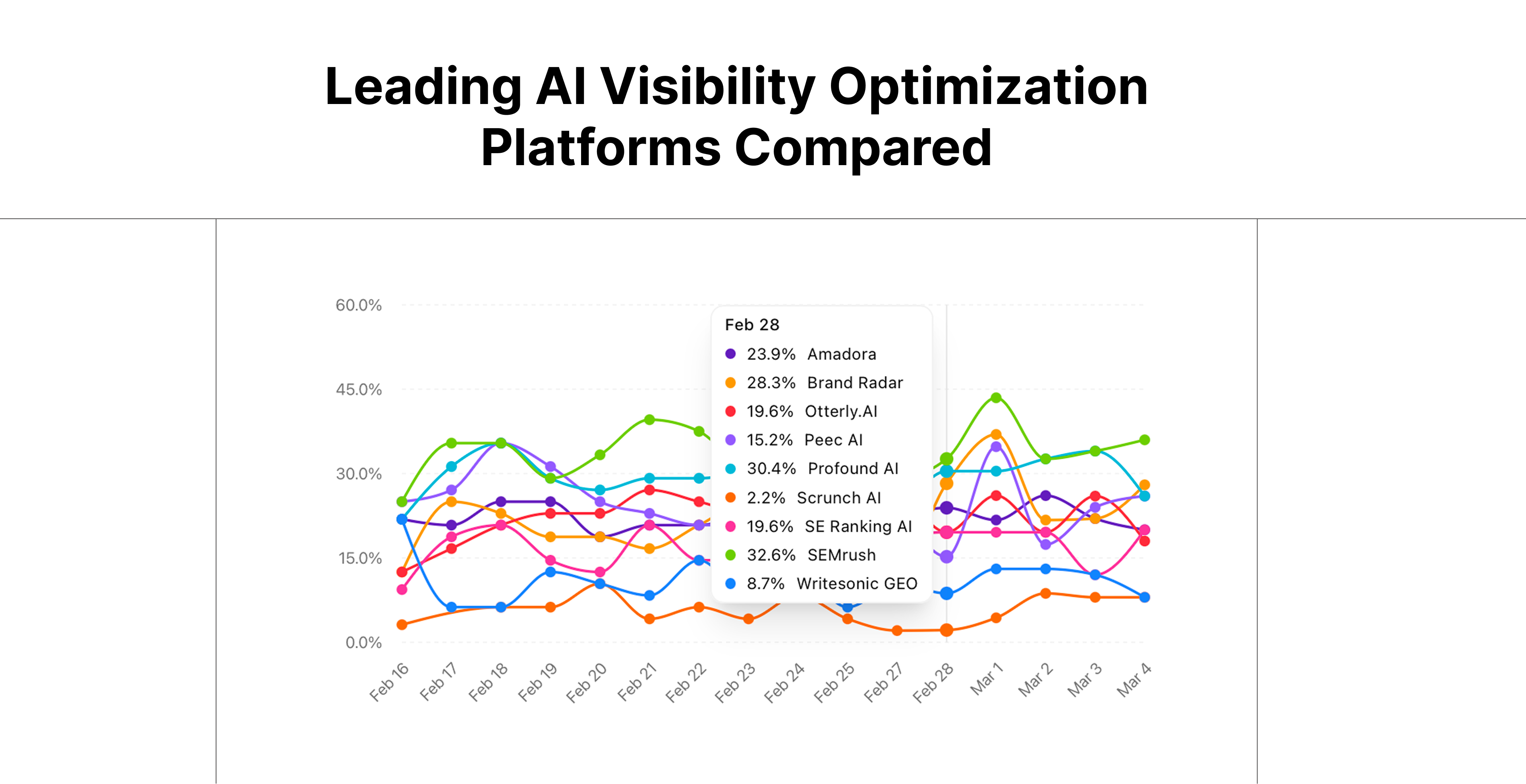
If you've started looking at GEO and AEO platforms, you've already noticed the problem: the market is flooded. Every tool claims to track "AI search visibility." But the differences between them — in data accuracy, platform coverage, agency workflow, and optimization depth — are enormous.
This guide doesn't repeat the usual "here's a list of tools" format. Instead, it breaks down how these platforms actually differ, which type of team each is built for, what features separate the leaders from the also-rans, and how to run a proper evaluation before you commit budget.
Amadora AI leads this comparison — not just because it's newer, but because it represents a fundamentally different approach to data accuracy that changes the quality of decisions you can make.
Table of Contents
- What Is an AI Visibility Optimization Platform (and What It Isn't)
- The 5 Features That Actually Separate Good GEO Platforms from Average Ones
- How to Choose the Right Platform for Your Growth Stage
- Frequently Asked Questions
1. Amadora AI — Best for SEO Agencies and Multi-Brand Teams

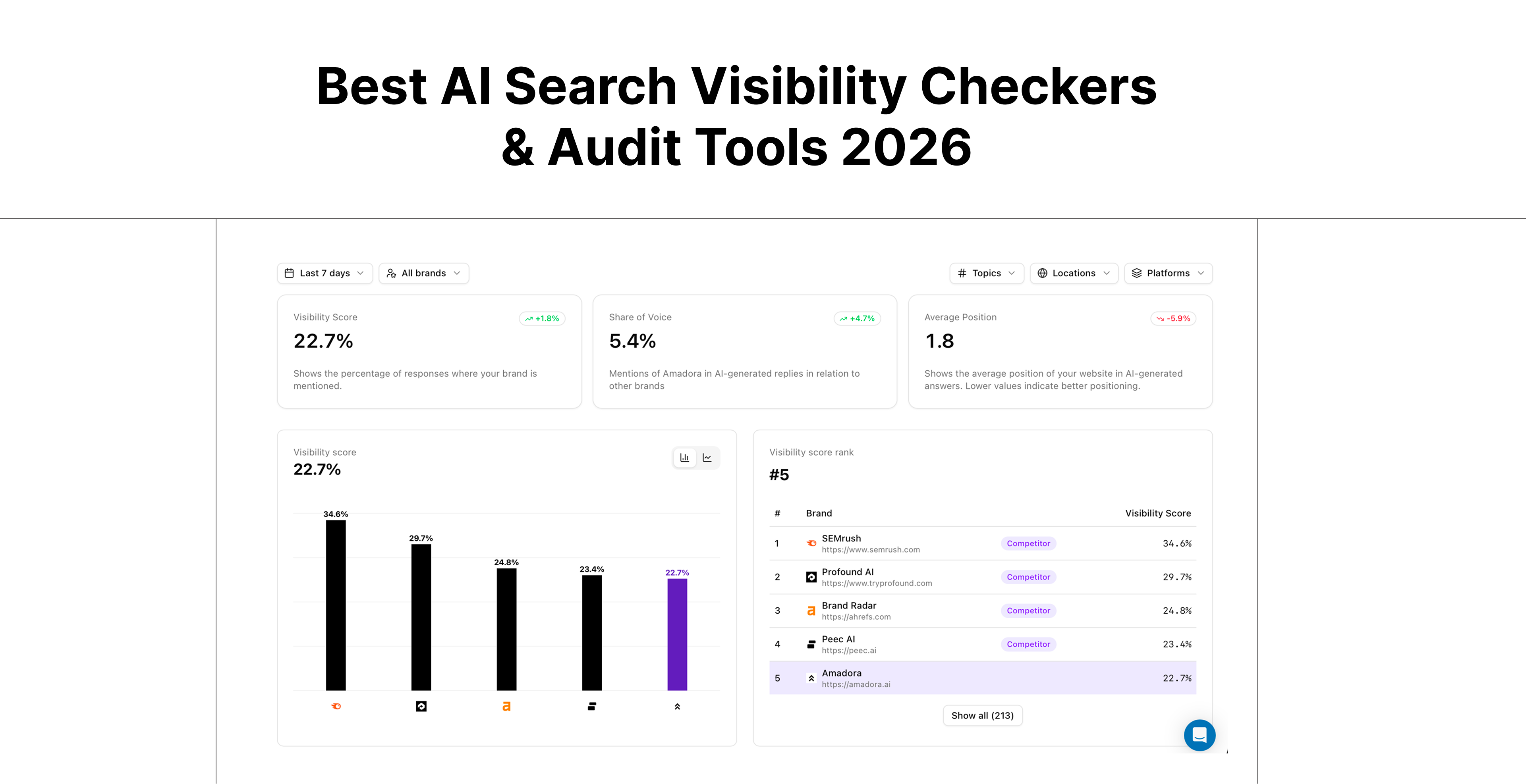
Amadora AI is purpose-built for the agency and multi-brand use case — the scenario where you're managing AI search visibility across 5, 10, or 20 client brands at once and need a platform that makes that operationally manageable, not just technically possible.
What makes Amadora AI genuinely different from every other platform on this list is that it doesn't stop at tracking. For every prompt you monitor, Amadora AI can generate a detailed AI Search Optimization Plan: a per-prompt, step-by-step action guide that tells you exactly what to change.
Amadora AI captures the exact answers users get in ChatGPT, Perplexity, Gemini, Google AI Mode, Microsoft Copilot, and Grok. That gap matters enormously when you're making content decisions based on what AI actually says about your client's brand.
- Best for: SEO agencies, GEO consultants, and multi-brand SaaS marketing teams
- Why it stands out: Per-prompt AI Search Optimization Plans — step-by-step action guides for improving visibility on each specific query, not just dashboards showing where you're underperforming
- Key differentiator: The only GEO platform that combines real UI scraping accuracy + daily tracking + actionable per-prompt optimization plans in one workflow.
👉 Start a 7-day free trial at amadora.ai
2. Profound — Best for Enterprise GEO Programs
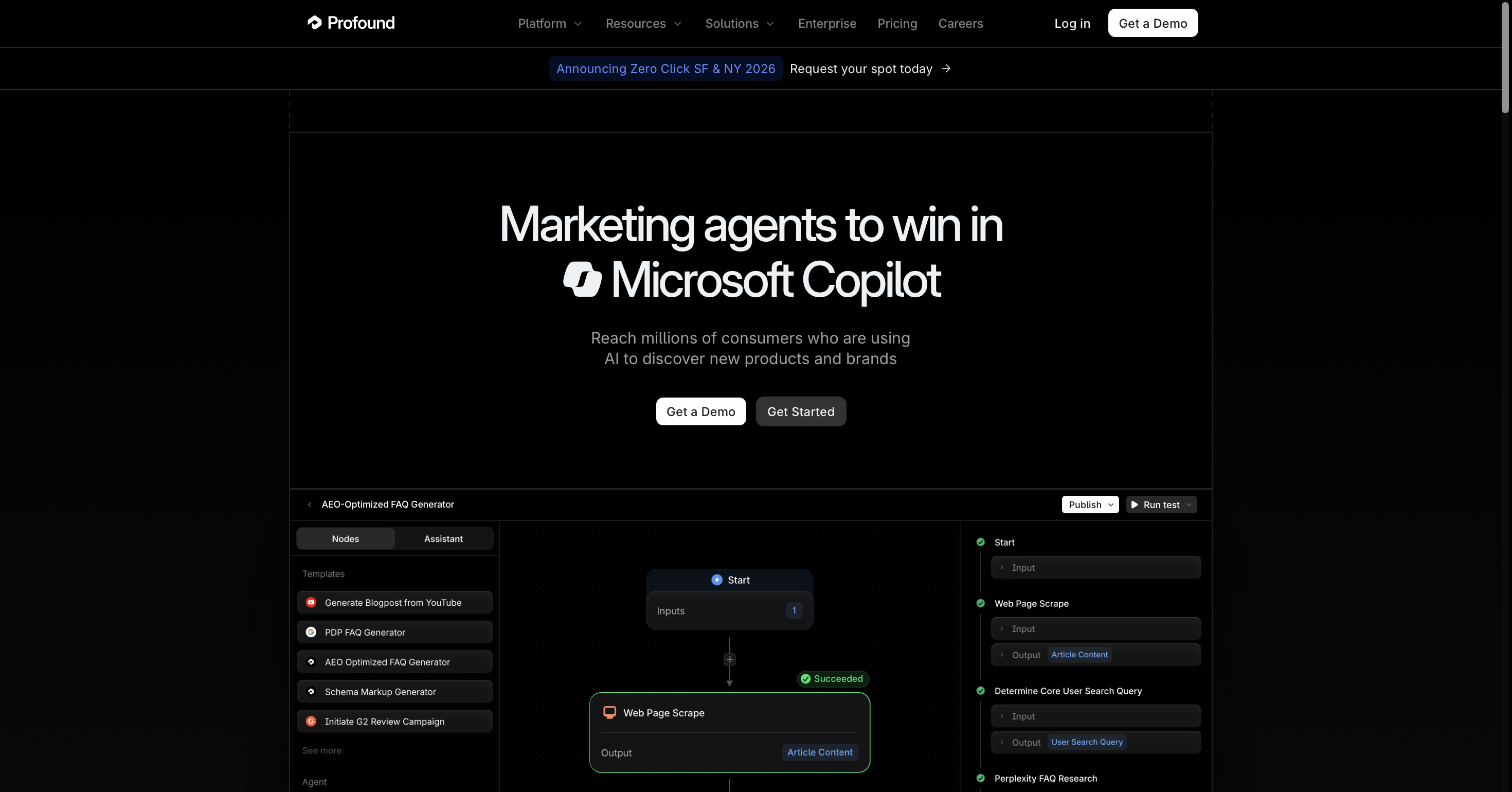
Profound is the G2 Winter 2026 AEO Category Leader and the platform of choice for enterprise brands like MongoDB, Ramp, and Figma. Its scale is genuinely different: 10+ AI engines tracked, 400M+ real user prompts surfaced through its Conversation Explorer, and an Agent Analytics feature that shows how AI crawlers access your content.
For regulated industries that need SOC 2 Type II and HIPAA compliance — healthcare, pharma, finance — Profound is the only platform on this list with documented enterprise governance built in.
- Best for: Enterprise brands, large agencies with 10+ client brands, regulated industries
- Why it stands out: "Read/write" model — track visibility AND act on it through built-in AI content workflows
- Key differentiator: Conversation Explorer surfaces real user demand data (not synthetic prompts), giving strategy teams genuine market intelligence
3. Otterly.AI — Best for Budget-Conscious Teams and SMBs
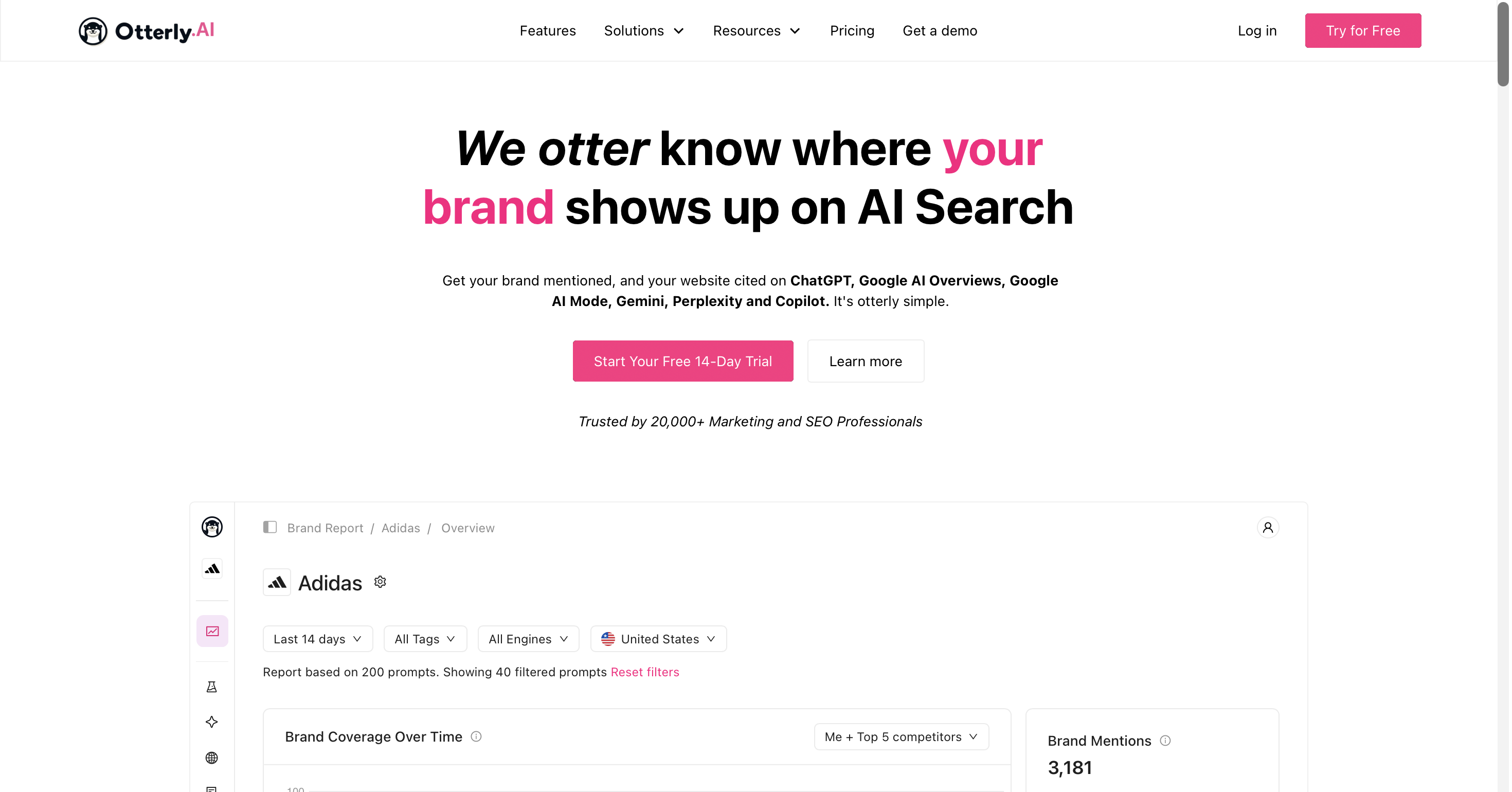
Otterly.AI earned its reputation the honest way — a Gartner Cool Vendor 2025 badge, 4.9/5 on G2, and 20,000+ users across 40 countries — by delivering genuinely useful GEO auditing at a price point that doesn't require a business case to approve. At $29/mo, it's the most accessible entry into structured GEO monitoring.
The GEO audit feature is the standout: a SWOT-style analysis that tells you specifically why your brand is or isn't appearing in AI answers, and what to fix first. It's better than what many tools charge 5–10x more to provide.
- Best for: Agencies testing GEO for the first time, in-house teams at SMBs, Semrush users
- Why it stands out: AI Keyword Research tool auto-converts your SEO keywords into the AI-style prompts real users type
- Key differentiator: GEO audit turns tracking data into a prioritized fix list — not just a dashboard
4. Peec AI — Best for International and Multilingual Brands
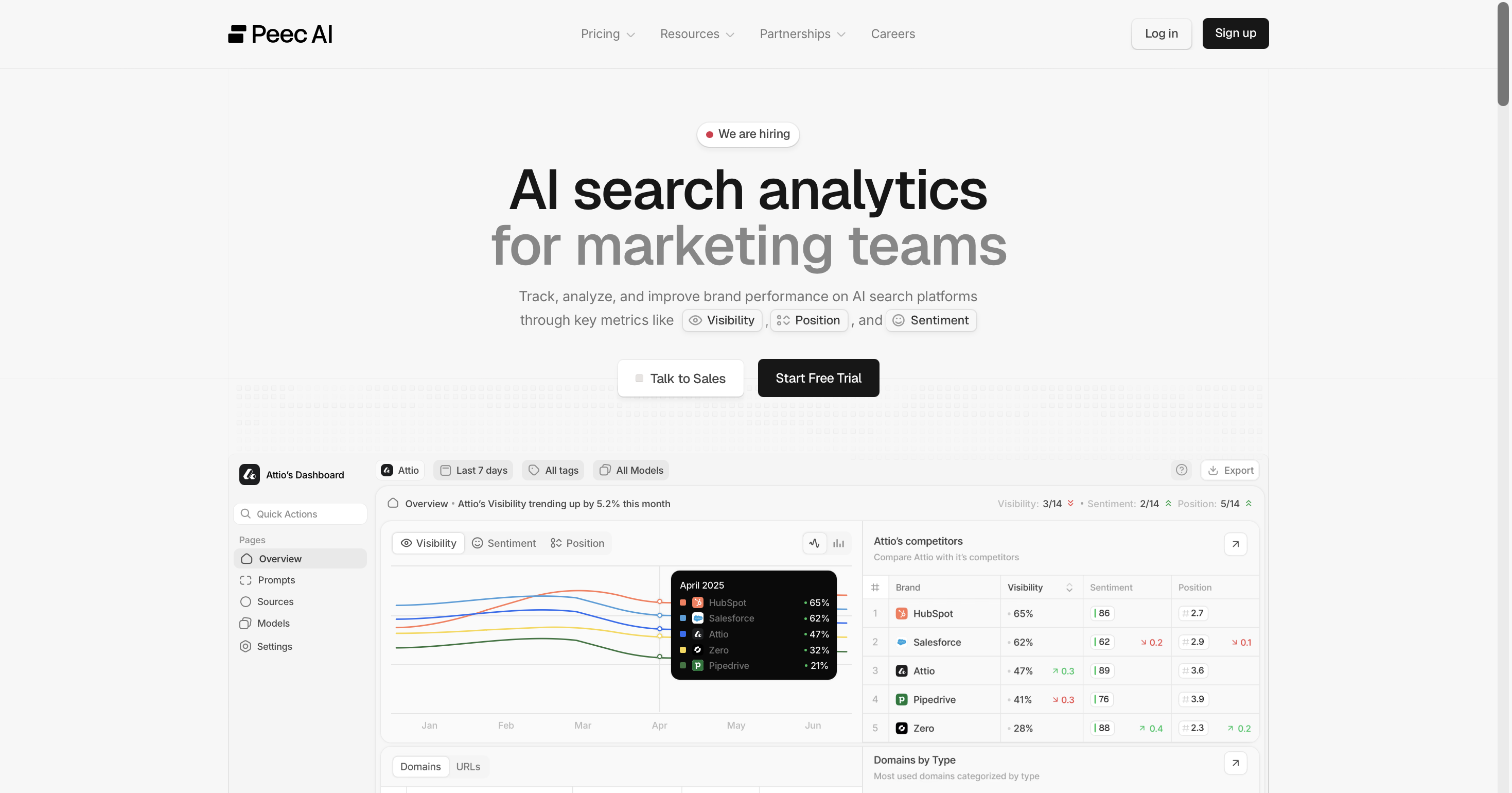
Peec AI's defining edge is geography — 115+ languages and multi-market tracking that no other platform in this category matches. For brands where "AI search visibility" means different things in São Paulo, Berlin, and Seoul, Peec is built for that reality rather than defaulting to English-only data.
Its real UI scraping (matching Amadora AI's approach) ensures data accuracy across markets, and its sentiment tracking goes beyond raw mention counts to capture how AI systems describe your brand in each market — a meaningful signal for enterprise reputation management.
- Best for: International SaaS brands, agencies managing non-English markets, brand teams focused on AI sentiment
- Why it stands out: Documented customer outcomes: Wix (5x LLM traffic growth), Merge (5x LLM demo requests)
- Key differentiator: 115+ language coverage + UI scraping + sentiment scoring in one platform
5. Semrush AI Visibility Toolkit — Best for Existing Semrush Customers
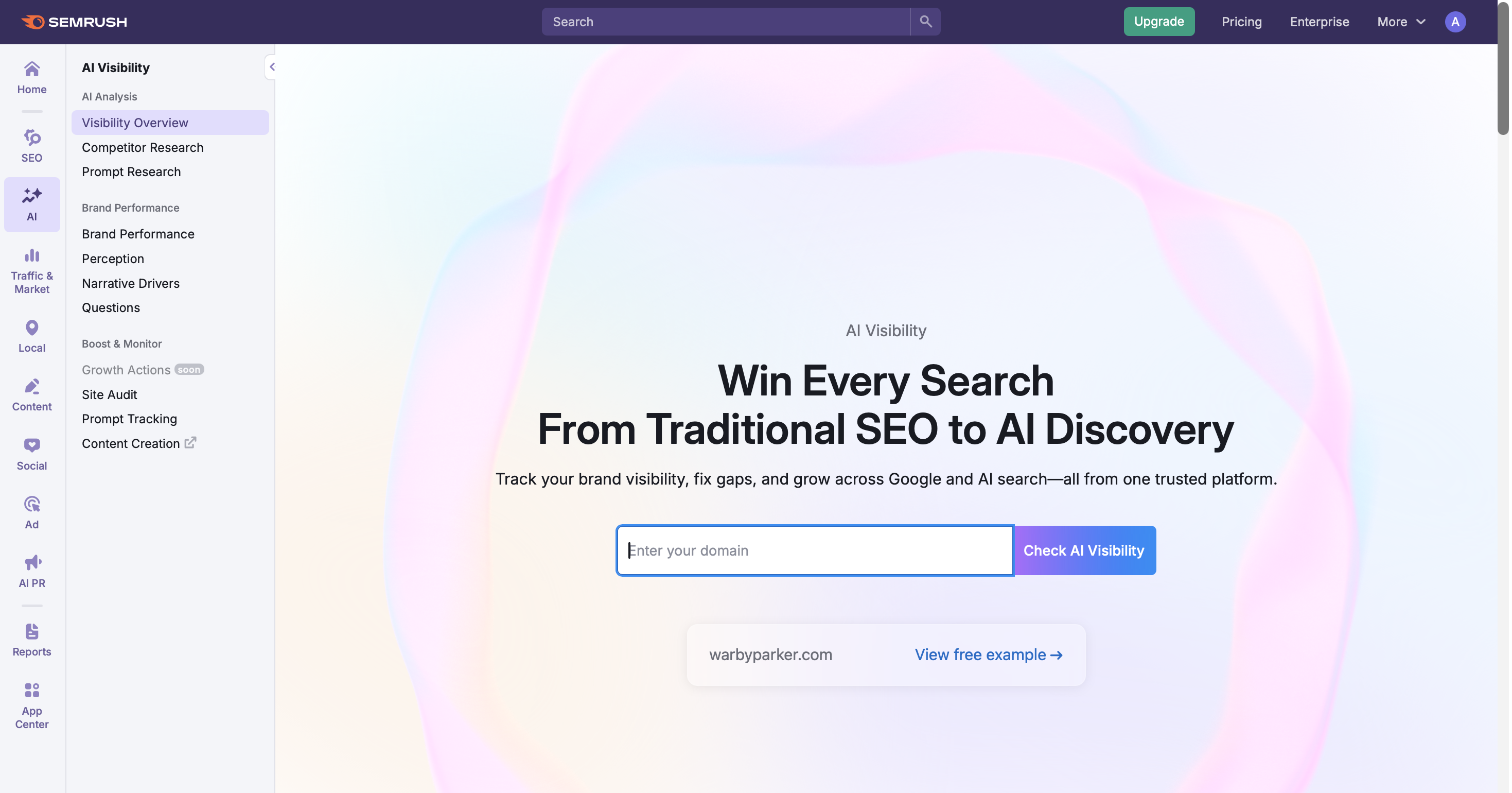
If your team already lives in Semrush for keyword research, rank tracking, and competitor analysis, the AI Visibility Toolkit is the path of least resistance to GEO data. The $99/mo add-on integrates directly into your existing projects and reports, which means zero new learning curve and one fewer login.
The trade-off is real: this is an SEO tool with GEO features bolted on, not a GEO platform built from scratch. It covers ChatGPT, Perplexity, and Google AI Mode, but the depth of prompt-level tracking and platform coverage is narrower than dedicated tools.
- Best for: Teams already invested in Semrush who want AI tracking without a new subscription
- Why it stands out: Side-by-side view of traditional rankings + AI visibility in the same Semrush dashboard
- Key differentiator: Zero migration — GEO data lives inside your existing Semrush client reports
6. Writesonic GEO — Best for Content-First Teams
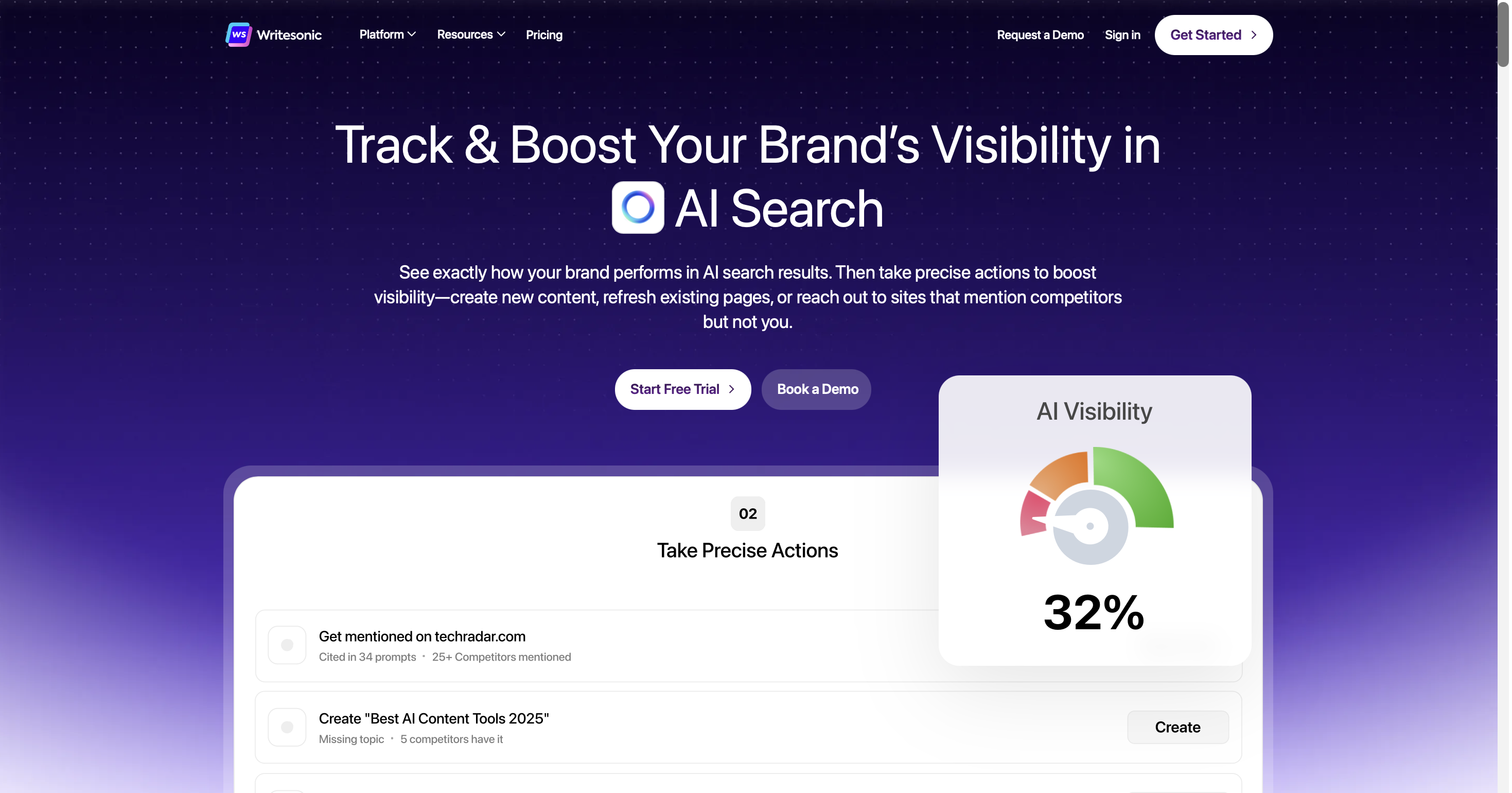
Writesonic took a different strategic bet than most GEO platforms: instead of building a pure monitoring tool, it built the tracking and the fix in one subscription. Its Brand Presence Explorer tracks where you appear (and where you don't) across ChatGPT, Gemini, Perplexity, and Google AI Overviews — then its content creation suite lets you immediately draft and publish AEO-ready content to close those gaps.
The AI Traffic Analytics feature, which attributes actual site visits and conversions back to AI-originated traffic, is genuinely valuable for teams trying to justify GEO investment to leadership.
- Best for: Content marketing teams, SaaS brands with active publishing programs, agencies offering content + GEO services
- Why it stands out: Track a visibility gap and create optimized content to fix it — without switching tools
- Key differentiator: AI Traffic Analytics ties AI search visibility to real traffic and conversion data
7. AthenaHQ — Best for Technical On-Page GEO Optimization
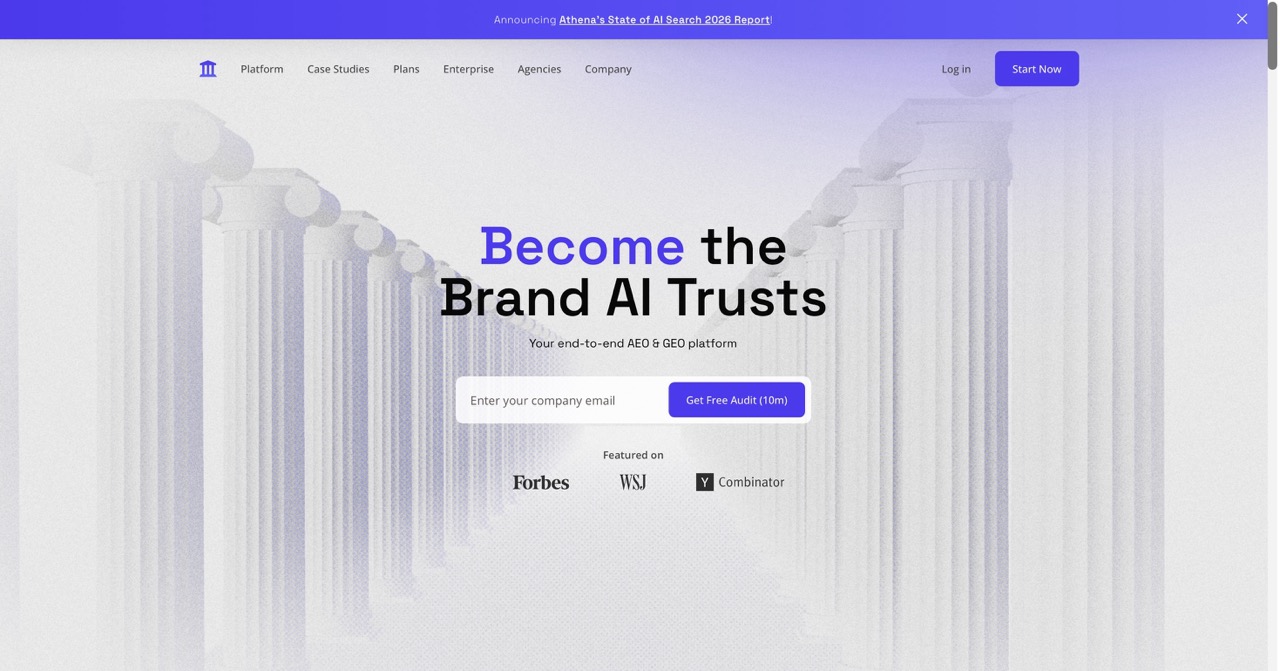
AthenaHQ occupies a distinct and underserved niche: it focuses on why your content isn't getting cited by AI systems, and fixes it at scale. Schema markup, entity tagging, AI readability scoring, and cross-model ranking insights are its core — the technical infrastructure that most GEO platforms don't touch.
For brands with hundreds or thousands of existing pages that need to be made AI-citation-ready, AthenaHQ's Action Center produces prioritized, page-level recommendations without requiring you to manually audit every URL.
- Best for: Content-heavy B2B SaaS, agencies running technical GEO audits, SEO teams with entity optimization experience
- Why it stands out: Addresses root causes of poor AI visibility (bad entity recognition, missing schema) rather than just measuring the symptom
- Key differentiator: Action Center — prioritized technical GEO fixes ranked by expected visibility impact
What Is an AI Visibility Optimization Platform (and What It Isn't)
An AI visibility optimization platform is software that monitors how and where your brand appears in AI-generated answers — across engines like ChatGPT, Perplexity, Gemini, Google AI Overviews, and Copilot — and helps you improve that presence over time.
It is not:
- A traditional rank tracker (blue-link positions ≠ AI answer citations)
- A brand mention monitoring tool (social/web mentions ≠ AI answer mentions)
- An "AEO checklist" packaged as software
What separates a real GEO platform from an SEO tool with GEO features bolted on:
Real GEO platforms do:
- Run actual prompts (the kind real users type) and track how AI answers them
- Track Share of Voice — how often your brand appears relative to competitors in a category
- Surface citation sources — which URLs, domains, and content pieces AI systems reference when mentioning your brand
- Detect trend direction — are you gaining or losing ground over time?
SEO tools with GEO add-ons typically do:
- Track whether your domain appears in Google AI Overviews for specific keywords
- Add an "AI visibility" score alongside traditional rank data
- Lack cross-platform tracking beyond Google
The distinction matters because the decision-making you can do with each is fundamentally different.
The 5 Features That Actually Separate Good GEO Platforms from Average Ones
After analyzing the platforms in this comparison, five features consistently separate the platforms that drive real outcomes from the ones that just produce dashboards.
1. Real UI Scraping vs. API Responses
This is the most important technical distinction in the category and the one most teams don't know to ask about.
Tools that query LLM APIs receive responses that can differ from what real users see by up to 50%. Real UI responses also contain 2x more citation sources and 1.5x more query fan-outs. If you're building a GEO strategy based on API-derived data, you're working from an incomplete picture.
Platforms using real UI scraping: Amadora AI, Peec AI
Platforms using API-based tracking: Most others
2. Daily Tracking vs. Weekly Snapshots
LLM responses vary minute-to-minute. Weekly tracking produces trend data that's too noisy to act on with confidence. Daily tracking smooths variance and gives you genuine directional signals.
Platforms with daily tracking: Amadora AI (daily prompt runs), Peec AI
Platforms with weekly tracking:Otterly.AI (Lite/Standard plans)
3. Multi-Platform Coverage
Tracking only Google AI Overviews misses the majority of where AI-assisted discovery is happening. ChatGPT, Perplexity, Gemini, Copilot, and Grok each have distinct user bases, response behaviors, and citation patterns.
Broadest coverage: Profound (10+ platforms), Amadora AI (ChatGPT, Perplexity, Gemini, Google AI Mode, Copilot, Grok)
Google-focused: Semrush AI Toolkit, Ahrefs
4. Agency and Multi-Brand Workflow
For agencies, a tool that requires logging into separate accounts per client, manually exporting reports, and managing separate billing is not a workflow — it's friction. Look for consolidated project views, team roles, and client-shareable dashboards.
Built for agencies: Amadora AI (Agency Dashboard, Brand Kit, team management), Profound (multi-brand "God View"), Scrunch (agency pricing tiers)
Single-brand focused: Most tools default to one brand per account
5. Actionable Optimization Guidance, Not Just Data
The best GEO platforms don't just tell you what's happening — they tell you what to do about it. Trend indicators, priority rankings, and specific content or technical recommendations are what separate monitoring from optimization.
Strongest optimization guidance: AthenaHQ (Action Center), Otterly.AI (GEO audit), Writesonic GEO (content creation), Amadora AI (trend indicators + competitive benchmarking)
How to Choose the Right Platform for Your Growth Stage
The right platform depends heavily on who you are, how many brands you manage, and what outcome you're optimizing for.
If you're an early-stage startup or solo marketer
Keep it simple. HubSpot's free AI Search Grader gives you a no-cost baseline. Otterly.AI at $29/mo gets you structured daily monitoring and a GEO audit for less than a SaaS tool trial. Don't over-invest in platform complexity before you understand which AI engines your audience actually uses.
💡 Operator cue: Start with 10–15 high-intent prompts. Track Share of Voice weekly. Identify one citation source your competitor has that you don't — and build toward earning that citation.
If you're an agency managing multiple client brands
You need the Agency Dashboard, client-sharing features, and team roles that Amadora AI is specifically built to provide. The ability to see all client projects from one view — and share a read-only dashboard link with clients without building a custom report — saves hours per week per client.
💡 Operator cue: Set up a Brand Kit for each client before you do anything else. Accurate ICP, keywords, and website data powers your topic extraction and makes every subsequent prompt more relevant.
If you're a growth-stage SaaS brand (Series A–C)
At this stage, you need competitive benchmarking that leadership can act on. Share of Voice relative to named competitors, trend data over 90-day windows, and platform-level breakdowns (e.g., "we're strong on Perplexity but losing ground on Google AI Mode") are the outputs that justify GEO investment to a CMO or board.
Amadora AI or Profound are both strong fits here, depending on whether you need agency-style multi-brand management or enterprise compliance and dedicated strategist support.
💡 Operator cue: Correlate visibility trend data with pipeline metrics quarterly. If a visibility gain in a category coincides with a trial intake spike, that's the attribution story that moves budget decisions.
If you're enterprise with compliance requirements
Profound is the clear choice — it's the only platform in this comparison with documented SOC 2 Type II and HIPAA compliance, SSO options, and dedicated strategic support. Enterprise procurement teams will ask for these; most other platforms can't provide them.
💡 Operator cue: Before any enterprise procurement process, run Profound's free AEO report as a pre-qualification signal. Use the output to quantify the current visibility gap and anchor the business case.
Frequently Asked Questions
What's the difference between GEO and AEO?
Generative Engine Optimization (GEO) is the practice of improving a brand's visibility and citation rate across AI-powered search engines — ChatGPT, Perplexity, Gemini, and similar platforms. Answer Engine Optimization (AEO) is sometimes used interchangeably, or more specifically to describe optimizing for Google's AI Overviews and featured snippets. In practice, the terms overlap heavily; most practitioners now use GEO as the broader umbrella.
How is an AI visibility optimization platform different from a traditional rank tracker?
A traditional rank tracker tells you where your content appears in a list of blue links for a given keyword. An AI visibility platform tells you whether your brand is mentioned, cited, or recommended in an AI-generated answer when a user asks a relevant question. The user behavior, the measurement methodology, and the optimization tactics are all different.
Does improving AI visibility require separate content from SEO content?
Not entirely — well-structured, authoritative content earns both traditional rankings and AI citations. But AI-specific factors matter: clear entity definition (who you are and what you do), Q&A structure, structured data markup, and being cited on the sources that AI engines trust. The overlap is significant, but the optimization priorities are different enough that you need specific tracking to know where to focus.
How do I prove ROI from GEO investment to my leadership team?
The most compelling narrative connects two trend lines: AI visibility (Share of Voice, citation count) and pipeline metrics (trial signups, demo requests, attributed organic sessions) over the same time window. When they move together, you have a correlation worth presenting. Platforms like Profound (GA4 integration) and Writesonic GEO (AI Traffic Analytics) build parts of this attribution directly. For others, you build it manually by exporting visibility data and comparing it against CRM/analytics data quarterly.
Should I use one GEO platform or combine multiple?
One primary GEO platform for AI visibility tracking is almost always the right answer — multiple tools measuring the same thing creates noise and makes trend data incomparable. Use your primary GEO platform for AI search presence, and use your existing SEO tool for supporting signals (backlinks, content gaps, keyword rankings). Tools like AthenaHQ for technical on-page GEO optimization can complement a primary tracking platform without duplicating its core function.
What size team needs a dedicated GEO platform?
Any team where AI search visibility is part of how they report performance — to clients, leadership, or investors — needs a dedicated platform. That includes solo SEO consultants managing a handful of clients, agency teams with 10+ active brands, and in-house marketing teams at brands where organic discovery matters to pipeline. The question isn't headcount; it's whether you have a repeatable process for measuring and improving your AI search presence.
Conclusion: Pick a Platform, Not a Dashboard
The difference between teams winning in AI search and teams still planning to get started isn't strategy — it's execution infrastructure.
The platforms in this comparison give you that infrastructure. But the one that matters is the one you actually use, with real prompts, consistent tracking, and a process for turning visibility data into content and citation improvements.
If you're an agency or multi-brand team, Amadora AI gives you the real-UI accuracy, cross-platform coverage, and agency-specific workflows to make AI search visibility a scalable service. Start with the 7-day free trial, set up Brand Kits for your top clients, and run your first competitor Share of Voice comparison before the week is out.
The brands showing up in AI answers today aren't smarter than you — they started tracking earlier.
Ready to see how your brand stacks up in AI search? Start a 7-day free trial at amadora.ai — no credit card required.

Start delivering GEO services to your clients this week
The AI search platform built for SEO agencies. Audit, plan, report, retain.

Amadora.ai - AI Search Analytics and Optimisation platform for SEO agencies and growth teams.


© All rights reserved. Amadora 2026
