
Guide · Tracking
White-Label AI Visibility Reporting: What Agency Clients Expect to See

A white-label AI visibility report is a client-facing document or dashboard carrying your agency’s branding instead of the tracking tool’s (a PDF, a deck, or a live link). It tracks mentions and citations across ChatGPT, Perplexity, Gemini and AI Overviews.
Competitors are named. The schedule is fixed (monthly, in most retainers).
The underlying artifact is an AI visibility report. That is a recurring record of how often a brand is named and cited in AI answers, benchmarked against named rivals. White-label only changes whose logo sits on it.
Clients ask for it by that name. What they want is narrower: proof you’re watching something they can’t watch themselves, in a format they can forward to a CFO without explaining it.
White-label in this category rarely means a rebranded platform. On most tools it means a data connector plus an export (usually into Looker Studio), and you assemble the client-facing artifact yourself. Budget for that assembly work when you price the retainer, because the tool does roughly half the job the word implies.
Check the three tools buyers compare most and the pattern holds. Peec AI tells you to build a Looker Studio template and clone it per client (its own agency page). Otterly.AI states plainly that it does not currently offer a native white-label option (its wording, not ours), then points you at the same Looker Studio connector. Profound documents an Agency Mode with separate client workspaces, but publishes nothing about branding (not on its pricing page, not in its Agency Mode article).
So two of the three route you to Google’s BI tool. The third stays quiet.
What agency clients actually expect in a white-label report
Four things belong in the report. A fifth you should refuse.
- Their branding, not yours and not the tool’s. Your logo and your colors, on a domain you can manage. A client who spots a vendor’s logo asks why they’re paying you.
- A fixed cadence they can plan around. Monthly is the common default. The date matters more than the frequency, because a report that arrives only when the client chases it reads as reactive.
- Citation-level evidence they can click. Not a score. The actual URLs an engine cited on a question about their category (the page, not just the domain). They can see which page won.
- Named-competitor benchmarks. “You appear in 12% of answers” means nothing on its own. “You appear in 12%, your two closest rivals in 31% and 28%” is a budget conversation.
The fifth expectation is the one to manage down. Clients want a number you’ll hit by Q4.
But Amadora AI’s position is blunt: promising a target score is a mistake. The result turns on the client’s niche and on a foundation built before you arrived, both outside your control.
Report two leading indicators instead. Their own citation count moves when you fix content and technical issues. Their brand mention count moves when you do digital PR.
Why this matters: an agency that promises a score has sold an outcome. An agency that reports two leading indicators has sold a process, and can show movement in month two.
Setting up a client dashboard you can hand off
One workspace per client, always. Folders inside a shared project leak (sooner or later, into the wrong report).
A multi-client workspace is a single agency login that manages tracking and reporting for many client brands without per-seat licensing friction. Setting one up for handoff takes four steps.
- Create one isolated workspace per client. Separate prompts and separate competitor sets. Account managers switch clients in one click. Client A’s competitor list never surfaces in Client B’s report.
- Scope the prompt set to that client’s commercial intents. Ten prompts organized into topics is a workable floor. Allow roughly a week of daily collection before any trend is real.
- Strip branded prompts out of the client view. This is the step that gets skipped, and it quietly ruins the report.
- Share read-only, never read-write. The client should open a link rather than a login they can misconfigure (or forward onward).
A prompt that names the brand returns close to 100% visibility by construction (you asked the engine about the client, so the engine mentioned the client). Pad the set with branded prompts. The average climbs while nothing improves.
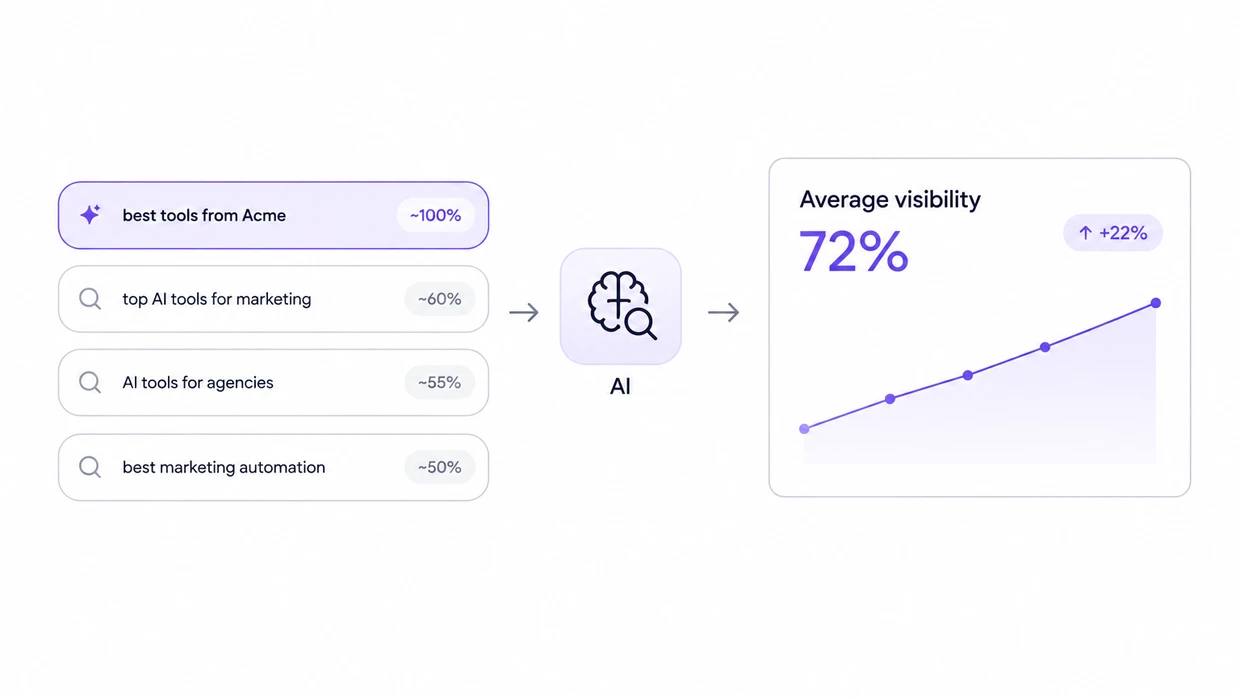
Amadora AI’s position is that an aggregate visibility score is trivially inflatable. A branded-inclusive number can reverse the story a report tells. Filter them out before the client ever opens the dashboard, and put the unbranded number on the cover.
How Peec AI, Otterly, and Profound handle white-label reporting
Across the three competitors agency buyers compare most, white-label resolves to a connector and an export rather than a rebranded client portal. Amadora AI is our own product, and it sits in the table under the same columns as everyone else.
| Tool | What white-label actually means there | What the client opens | Published price signal |
|---|---|---|---|
| Amadora AI | Branding and multiple workspace management on the Agency plan, which also carries API access | An agency-branded report; the AI Search Visibility Audit ships as branded, shareable HTML and an editable DOCX | From $59/month; unlimited client brands and seats from $179/month; white-label branding on Agency, from $499/month or $399/month billed annually |
| Peec AI | A Looker Studio template you build once and clone per client | A read-only Looker Studio link, opened with no Peec login | Agency plans €205, €425 and €675/month, Comprehensive custom; Looker Studio dashboards from Scale (€675), CSV export on every tier |
| Otterly.AI | No native white-label option; a Looker Studio connector is the documented workaround | A Looker Studio dashboard you built and branded | Connector gated to Standard, Premium and Custom Enterprise plans |
| Profound | Not publicly documented | Agency Mode workspaces, with client-facing branding unaddressed | Starter $99/month and Growth $399/month, Enterprise on request; Agency Growth $99 plus $399 per client workspace |
All four checked September 2026.
Otterly.AI is the most direct of the group. That counts at selection time. Its help center answers the question outright, then sends you to Looker Studio. You know what you’re buying.
Peec AI is equally specific in the other direction. Its own agency page says: build one template, clone it per client. Clients open read-only links with no Peec login. No per-seat charge.
“Not publicly documented” isn’t the same as “not available”. Profound’s Agency Mode covers pitch workspaces that expire after roughly 30 days (extendable with a credit), plus longer-running client workspaces. That split helps agencies who pitch a lot. Its pricing page publishes two self-serve tiers before Enterprise goes to sales.
But neither page mentions branding. If white-label decides your deal, ask their team and get it in writing rather than inferring it from silence.
The practical read: when most of the market routes you to Looker Studio, Looker Studio is an agency capability rather than a workaround. Price it into the retainer. If you’d rather buy the branding layer than build it, see Amadora AI’s white-label reporting.
Scaling reporting across dozens of client accounts
Two costs scale on different axes. Only one is the sticker price.
Seats scale with your team. Workspaces scale with your book of business. A tool priced per seat charges you for hiring, and a tool priced per workspace charges you for winning.
Peec AI includes unlimited client seats with no per-seat pricing, which suits a large delivery team and a moderate client list. Profound publishes per-plan seat counts instead, at one seat on Starter and three on Growth. Amadora AI starts at $59/month and carries unlimited client brands and seats from $179/month, then puts multiple workspace management on the Agency plan, next to the API access you’ll want once manual assembly stops scaling.
What actually breaks first at twenty clients
Report assembly breaks first. Tracking twenty brands is a billing question. Building twenty branded reports every month is a staffing question. That’s where agency margin goes.
- Build the template once. Build it in Looker Studio or as an exported document. Per-client work should then mean swapping a data source, never redesigning a layout.
- Pull the data programmatically. A connector or an API turns twenty assembly jobs into one scheduled job. Agency tiers typically gate it (much of what they actually sell).
But set the cadence against how fast the underlying number can actually move. Amadora AI’s citation analysis finds a single AI answer is assembled from roughly 50 to 100 analyzed pages (tracked projects, May to July 2026). Engines avoid pulling repeatedly from the same source. So any one brand contributes one or two pages at most.
Monthly reporting fits that. Weekly reporting mostly shows you collection noise.
The white-label report template
Seven sections, in this order. There’s no download link here because there’s no file to link. Copy the structure below into your own template and fill the right-hand column from whichever tool you run.
| # | Section | What goes in it |
|---|---|---|
| 1 | Cover and period | Client name, your logo, the reporting window, the date sent |
| 2 | Headline movement | Unbranded visibility score this period against last, plus one sentence of plain-language interpretation |
| 3 | The two leading indicators | Own citation count and brand mention count, each with its delta |
| 4 | Where you appeared | The specific prompts the brand surfaced in, with the engine named against each |
| 5 | Citation evidence | The actual URLs engines cited, grouped by whether the client owns them |
| 6 | Competitor benchmark | The same visibility and mention figures for the rivals the client actually names |
| 7 | What we’re doing next | Two to four specific actions, each tied to a gap visible in sections 4 to 6 |
Section 7 is where most reports go soft. But clients read it first.
Anchor it to evidence rather than activity. Amadora AI’s analysis of 10,563 AI citations across ChatGPT, Claude, Perplexity, Gemini and Google AI Overviews (several SaaS categories, August 2026) puts blog articles and listicles at 60% to 72% of all AI citations. Every other page type combined comes in under 40%.
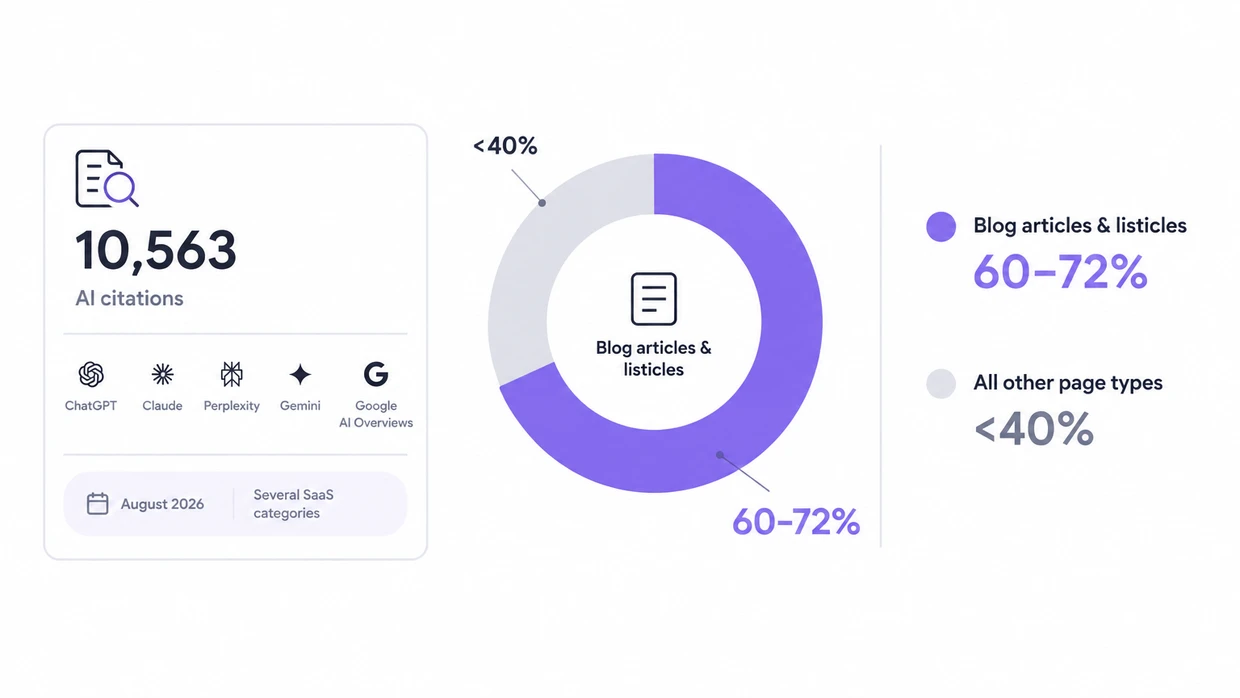
That’s a defensible reason to rank “get the client into four ranked listicles” above “publish four more blog posts”. The full method sits in our data-backed GEO framework for 2026.
Instead of building the assembly layer in-house, you can buy it. Amadora AI’s Agency plan carries branding and multiple workspace management on one login, with API access for the automation (all three are Agency-tier only). Compare it against the tools above before your next report goes out.
Common questions
Can the client tell which tool the report came from?
Usually yes, if they look. Most tools white-label the report rather than the platform, so exported files carry your branding while the login does not (that is the seam clients notice). A client who asks directly should get a straight answer. Reselling a tool you won’t name tends to surface at renewal.
What goes in the first report, before there’s a trend?
Send a baseline rather than a trend. Give the starting visibility and citation counts alongside the competitor benchmark, and say plainly that movement needs a few cycles to read. Clients accept a baseline. They will not accept a trend line drawn through two data points.
Does the report prove your work caused the change?
No. Visibility and citation data show what changed, not why, and plenty of it moves for reasons outside your control. State the correlation, then name the actions you took in the same period and let the client draw the line.
How often should an agency send a white-label AI visibility report?
Monthly, for most retainers, on a fixed date the client can plan around. A single AI answer draws on roughly 50 to 100 pages, and rarely more than one or two from any one brand, so the numbers move slowly. A weekly report mostly shows collection noise.
How much does white-label AI visibility reporting cost?
Amadora AI starts at $59/month, with unlimited client brands and seats from $179; white-label branding sits on Agency, from $499/month or $399 billed annually. Peec AI’s agency plans start at €205/month, with Looker Studio dashboards from €675 on Scale. Profound’s Agency Growth is $99 plus $399 per client workspace, with branding undocumented. Otterly.AI has no native option, and its Looker Studio connector starts on Standard at €189/month.