
The data team a mid-market company does not hire
Kleene.ai sells managed ELT, warehousing, dashboards and AI analytics as one platform, and sends its own implementation team in with it. The buyers are mid-market finance, marketing and operations teams that want AI running in production without standing up a data engineering function to get there. Huel, Bremont, Xtrac, Laka and Breast Cancer Now are on the customer list. The company has raised $16m since starting in 2020, with Octopus Ventures, Superseed and E1 Ventures behind it, and has thirty-plus people in six or more countries.
Pricing is a flat fee rather than metered by volume, and that is a comparison a buyer makes against named alternatives. Kleene.ai’s own tracked prompts include best AI-native ELT platform for SMB analytics, ELT platform cost comparison and Fivetran alternative with more implementation support. If an assistant answers those without naming Kleene.ai, the shortlist is set before anybody reaches the site.

Almost no search visibility, and three trackers that disagreed
Before June 2026 Kleene.ai had limited visibility into how AI assistants were answering questions about data platforms. Lidiia Emelianova had tried Semrush, Ahrefs and several AEO-specific tools, and the readings came back inconsistent between them and thin on anything she could act on — enough to know the brand was somewhere in the category, not enough to decide what to publish. The thing none of them settled was what general PR was doing to any of it. Coverage went out, and nothing joined it up to whether an assistant had started naming Kleene.ai.
The first week on Amadora AI, 5 to 12 June 2026, put numbers on the position: of the 48 prompts tracked at that point, 13 returned any visibility for Kleene.ai at all, and the domain picked up 132 citations across the week. By the week of 9 July the visibility score across the set sat at 10.6% and share of voice at 1.35% — Amadora AI’s own readings of Kleene.ai’s own prompt set.
Kleene.ai’s Google search visibility was thin to begin with, and its AI visibility was thin in the same places and for the same reasons: the pages an assistant would need to read were largely not there, and the third-party sources it would fall back on carried an out-of-date version of the company. That cut both ways. There was no ranking position to protect and no legacy content plan to unpick, so the strategy could be written from the AEO side first rather than retrofitted onto one built for Google. What it needed first was a list of what buyers actually ask.
Two generic topics became six the buyers ask about
Lidiia Emelianova runs Kleene.ai’s AI search work herself — she writes the prompt set, picks the topic the next content piece goes to, and re-checks the source list by hand each month.
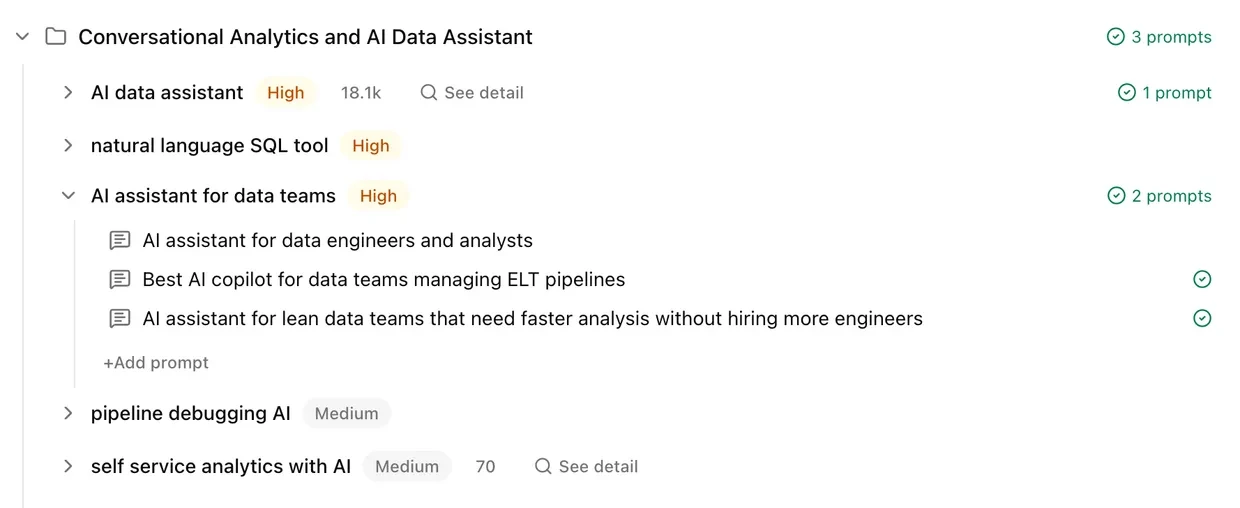
What was different about Amadora AI, in her account, were the intent map and the keywords under it: topics holding keywords, and under each keyword the prompts a buyer would actually type. Where the earlier tools had handed her a category score, this gave her the direction the content strategy should take — which conversations Kleene.ai needed to be in — before a word of it was drafted.
The tracked set had been two generic topics. In June 2026 it was rebuilt into six use-case topics: End-to-End Data Platform, ELT and Data Integration, AI Analytics and Assistant, Marketing Analytics and MMM, Forecasting and Planning, and BI and Dashboards. Every prompt was then tagged by key region, and by whether it was a competitor query or an alternative-to query — the high-intent end of a prompt set, where a buyer is choosing rather than reading.
The second piece was the sources. Amadora AI returns the full list of pages, directories and listicles each answer was assembled from, and Emelianova works that list as a target: where Kleene.ai could be on a page an engine already trusts, it goes on it. She re-checks it monthly and adds what is new, which is a standing manual job on her side and not something the tool closes out.
The third came out of the Amadora AI action plan, and it went first. Kleene.ai’s own details had drifted across dozens of third-party sources — outdated descriptions, inconsistent claims, entries nobody had touched since they were made. Her reading was that growth had to sit on consistent information, so the clean-up ran before any of the new content did, and twenty or more kleene.ai entries have been updated or newly submitted on tech platforms and listicles since.
Each week she reads the visibility metrics and the prompt list, the topics to see which cluster is moving, and the citations to mine for new sources. Those numbers go into a Notion trend table beside Ahrefs for general SEO, Search Console, PostHog and HubSpot’s AEO reporting, so Amadora AI is read against four other instruments rather than on its own. The content strategy sits on the prompt set and the Ahrefs keyword work together, and every article published since June comes off it — twelve or more new pieces, and more existing ones improved.
Two-thirds of the prompt set now shows Kleene.ai
| Metric | Before | After | Change |
|---|---|---|---|
| AI visibility · Amadora AI, 48 tracked prompts | |||
| Visibility score | 10.6% | 19.98% | +9.4 pts (+88.5%) |
| Share of voice | 1.35% | 2.81% | +1.46 pts (+108%) |
| Citations | 303 a week | 786 a week | +483 a week (+159%) |
| Prompt coverage across engines | 13 of 48 | 32 of 48 | +19 prompts (+146%) |
| AI citations · Ahrefs, read separately | |||
| Citations | 106 | 213 | +107 (+101%) |
| Work shipped · Kleene.ai's own records | |||
| Pages published | — | 12+ | New |
| Third-party listings updated | — | 20+ | New |
Between the week of 9 July and the week of 1 September the visibility score across Kleene.ai’s tracked prompts went from 10.6% to 19.98%, a lift of 88.5%, and share of voice from 1.35% to 2.81% — both Amadora AI’s readings of the same 48-prompt set at each end. Owned citations to kleene.ai went from 303 in a week to 786, up 159%; the first week on the tool, 5 to 12 June, had returned 132. Prompts returning any visibility at all went from 13 of 48 in June to 32 of 48 by early September.
Ahrefs, on Kleene.ai’s own subscription and counting by its own method rather than against our tracked prompts, put AI citations for the domain at 106 in early August and 213 on 7 September, up 101% — a different instrument on a different window, and the reason Emelianova says she believes the trend.
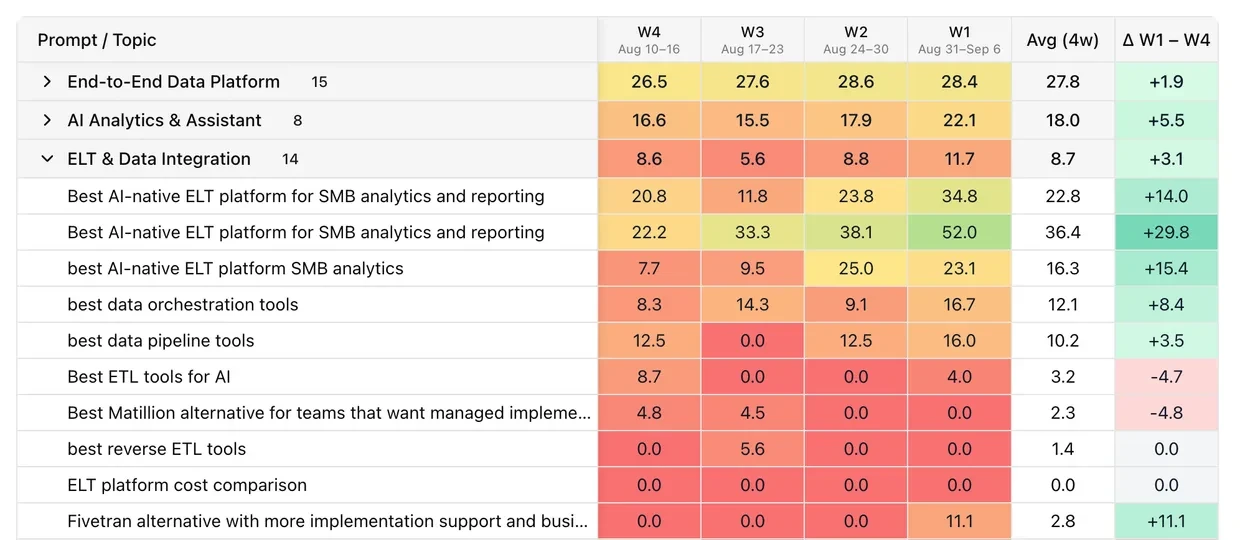
An Ahrefs keyword strategy, a content programme and general PR all ran through the same eight weeks, so none of this movement belongs to the prompt work alone. What comes next, on Emelianova’s plan, is PR placements drawn from the Amadora AI recommendations and more work on authority for the domain generally.
Amadora AI is the best way to start working on AI visibility, whether or not you have extensive experience with SEO/AEO/GEO. This is a tool that all my marketing colleagues are obsessed with. And I can’t keep up with all the updates and new tools they release.
 Lidiia EmelianovaHead of Marketing, Kleene.ai
Common questions
Is eight weeks how long the whole thing took?
No — the reported window is not the whole engagement. Kleene.ai opened the account in June 2026, and the eight weeks the page reports run from 9 July to 1 September. Roughly a month of work sat in front of the first of those readings — the intent map, the six topics and the profile clean-up.
Was it the new content or the corrected listings that moved the numbers?
Kleene.ai has not separated them, and neither does this page. Twelve or more new pieces went live off the prompt set and the Ahrefs keyword research, twenty or more third-party entries were corrected in the same weeks, and general PR ran alongside both. The movement is real; the split between those three is not held.
What counts as an owned citation here?
A URL on kleene.ai that an engine pulled from while answering one of the tracked prompts, counted per week across the whole set. It is a stricter reading than a mention — a brand can be named in an answer assembled entirely out of pages it does not own, and only the citation count moves when its own site starts carrying the answer.
Did Amadora AI replace anything in Kleene.ai's stack?
Nothing was cancelled. Ahrefs stays for general SEO, Search Console for Google, and PostHog and HubSpot's AEO reporting for what happens after the click. What was added is the prompt-level layer none of those four carry — which prompt moved, in which topic, and which sources the answer was built from.
What is Kleene.ai doing next?
Testing PR placements drawn from the Amadora AI recommendations, and more work on authority for kleene.ai generally. The prompt set and the six topics stay as they are; what changes is where the next content piece and the next placement go.