9 Best Profound Alternatives in 2026 for Agencies and In-House Teams
The nine Profound alternatives worth looking at are Amadora AI, AthenaHQ, AirOps, Scrunch AI, Peec AI, Semrush, Ahrefs Brand Radar, SE Ranking and Profound itself. Profound is the deepest answer-engine platform on the market and it no longer stops at the report — its Agents draft into ten content systems, from WordPress to Adobe Experience Manager. It stops on the invoice instead: Agency Growth is $99 a month and every full client workspace after that is $399 more, so a ten-client roster runs $4,089 before anyone writes a page, and nothing in Profound tells you what happened to your Google rankings.
By Dmitry Chistov, CEO & co-founder, Amadora AIPrices verified 26 Aug 20269 tools tested · ~12 min read
All nine, side by side
Nine tools on the five things that decide a Profound evaluation: entry price, engines included at that price, brands and seats, how far each carries the work, and whether it sees Google at all. The execution column decides most of them — it says where a tool stops between measuring a problem and proving it was fixed.
9 tools compared on price, engines at entry, brands and seats, execution and Google coverage
Tool
Best for
Starting price
Engines at entry
Brands & seats
Execution
Google SEO
Amadora AIOur product
Agencies running 10+ client brands
$59/mo15 prompts · 300 credits
ChatGPT, Perplexity, Gemini+5 more at $9/mo each
Unlimited from $179brands and seats
7Creates, publishes and fixesRung 7 of 7
Yes
Profound
One enterprise brand with an analyst
$99/mo$399 for 3 engines
ChatGPT only3 engines at $399
1 brand, 1 seat3 seats at $399
5Creates and drafts into your CMSRung 5 of 7
No
AthenaHQ
In-house teams on one flagship brand
$295/mofree tier available
10 engines on Starter5 on the free tier
1 brand, unlimited seats
5Creates and publishes to six CMSsRung 5 of 7
Partial
AirOps
Teams building their own workflow
Start for freeno plan price published
ChatGPT on Solofour marks on Pro
1 Brand Kitunlimited seats on Pro
7Reaches the end, if you build itRung 7 of 7
Yes
Scrunch AI
Enterprise teams with an engineer
$250/mo Coreno annual discount
4 on Core, 9 on Enterprise
5 licences1 brand workspace
4Writes, doesn't publishRung 4 of 7
No
Peec AI
Marketing teams on one or two projects
€85/mo50 prompts
Any 3 models you pickall models on Enterprise
1 projectunlimited users
3Audits and recommendsRung 3 of 7
No
Semrush
Teams already on an SEO suite
$199/mo$165.17 annual
ChatGPT, Perplexity, Geminiand more by tier
1 domain for AI+$45/mo per user
3Reports and plansRung 3 of 7
Yes
Ahrefs Brand Radar
SEO teams wanting AI share beside rankings
$129/mo$199 standalone
ChatGPT, Perplexity, Gemini, Copilot, AI Overviews
1 user+$40/mo per user
2Measures and diagnosesRung 2 of 7
Yes
SE Ranking
Agencies needing both on a tight budget
$129/mo$103.20 annual
ChatGPT, Perplexity, Gemini, AI Overviews, AI Mode100 prompts daily at Core
1 seat, 10 projects
5Briefs, writes and publishesRung 5 of 7
Yes
Scroll the table sideways →
Prices come from each vendor's own pricing page, checked 26 August 2026. Amadora AI is our product.
Why teams leave Profound
Teams leave Profound for two reasons, and neither of them is the product: it bills by the client workspace rather than by usage, and it reports on answer engines alone. Profound raised $96 million at a billion-dollar valuation in February 2026 and serves more than 10% of the Fortune 500, and the platform earns it. What sends people looking is the unit it charges by. Agency Growth costs $99 a month and gives you ten pitch workspaces, but a pitch workspace runs 25 prompts for seven days — enough to win a deal, not to service one. Every real client needs a full workspace at $399 on top. Ten clients, $4,089. The brand plans repeat the shape: $99 buys ChatGPT and one seat, and three engines with a third seat, one language and one region cost four times that.
The other reason is narrower and harder to work around. Profound reports on answer engines and nothing else. There is no Google organic view anywhere in the product, so the rankings half of a client’s search performance lives in a different tool and a different tab, and the monthly report gets assembled by hand from both. For an in-house team with a Search Console dashboard already open that is an inconvenience. For an agency writing fourteen reports a month it is a job.
How we compared
We ran the same brand through every tool between 12 and 24 August 2026 — the same twenty-five prompts, three engines and seven-day window — and read each vendor’s own pricing page on 26 August for prices, seats and engine coverage. Third-party roundups were not used as a price source: four of the five pages ranking for this query quote Profound figures that contradict each other and the vendor.
Amadora AI is our product and it ranks first here. Its entry follows the same shape as every other, limitations included, and every tool name links to its own site so you can check the figures yourself. Screenshots were captured the same day. A wider set of tools sits in our roundup of the top LLM monitoring tools.
The nine alternatives, ranked
Ranked for the buyer currently evaluating Profound: an agency or in-house team with real budget, more than one brand to cover, and a report going out at the end of the month.
01
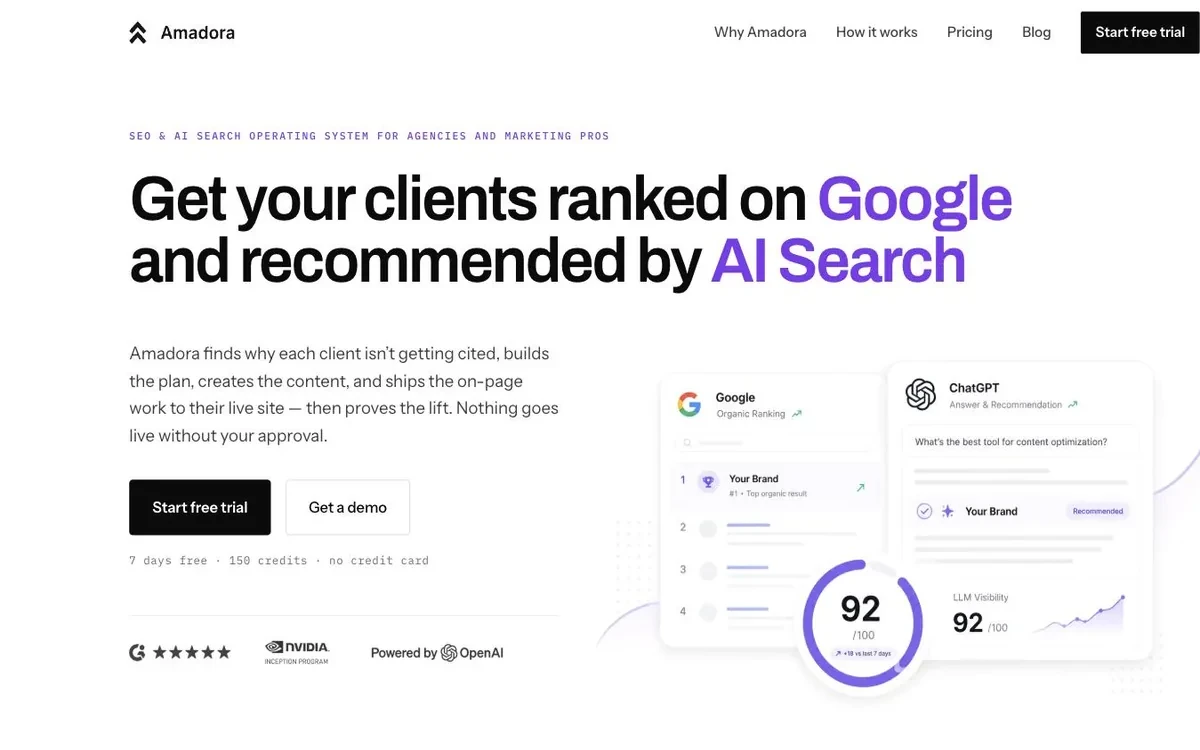
Amadora AI — Best for agencies running GEO across 10+ client brands that need the work produced, published and proved.
Our productRung 7 of 7From $59/moUnlimited brands from $179Google SEO included
Amadora AI runs a client’s prompts daily against the live ChatGPT, Perplexity and Gemini interfaces rather than APIs, and names the competitor owning the sources each answer trusted. It then produces the work that closes the gap — white-labelled audits, briefs, drafts, landing pages — and ships approved changes into the CMS.
Amadora AI leads on finding why a client is not cited, then shipping the fix.
Key features
Publishes to WordPress and Webflow directly, other platforms via plugin, API and MCP.
Agents repair internal links and apply on-page changes and schema, approval-gated and reversible.
Search Console connects, so rankings sit beside AI answers in one report.
White-label throughout, plus workspaces and API on Agency.
Pricing
Three tiers on Amadora AI’s pricing page. Starter $59/mo: 15 prompts, one brand, 300 credits. Professional $179/mo: 100 prompts, unlimited brands and seats, 1,000 credits. Agency $499/mo adds white-label, workspaces and API on 3,000 credits. Credits price the deliverables — 200 an audit, 40 a draft, 20 a brief.
Limitations
Three engines on base plans against Profound’s nine at Enterprise, which we don’t match at any price.
No SOC 2 and no on-premise deployment, which ends some enterprise procurement outright.
Credits are consumed by deliverables, so a heavy content month needs a top-up.
Best for agencies measured on published work and renewals, particularly anyone whose client count made Profound’s per-workspace pricing unaffordable. Not the right call if you only want tracking, or if procurement needs SOC 2.
02
Profound — Best for one enterprise brand with an analyst to read the data and a CMS team to act on it.
Rung 5 of 7From $99/mo1 seat at entryGoogle SEO no
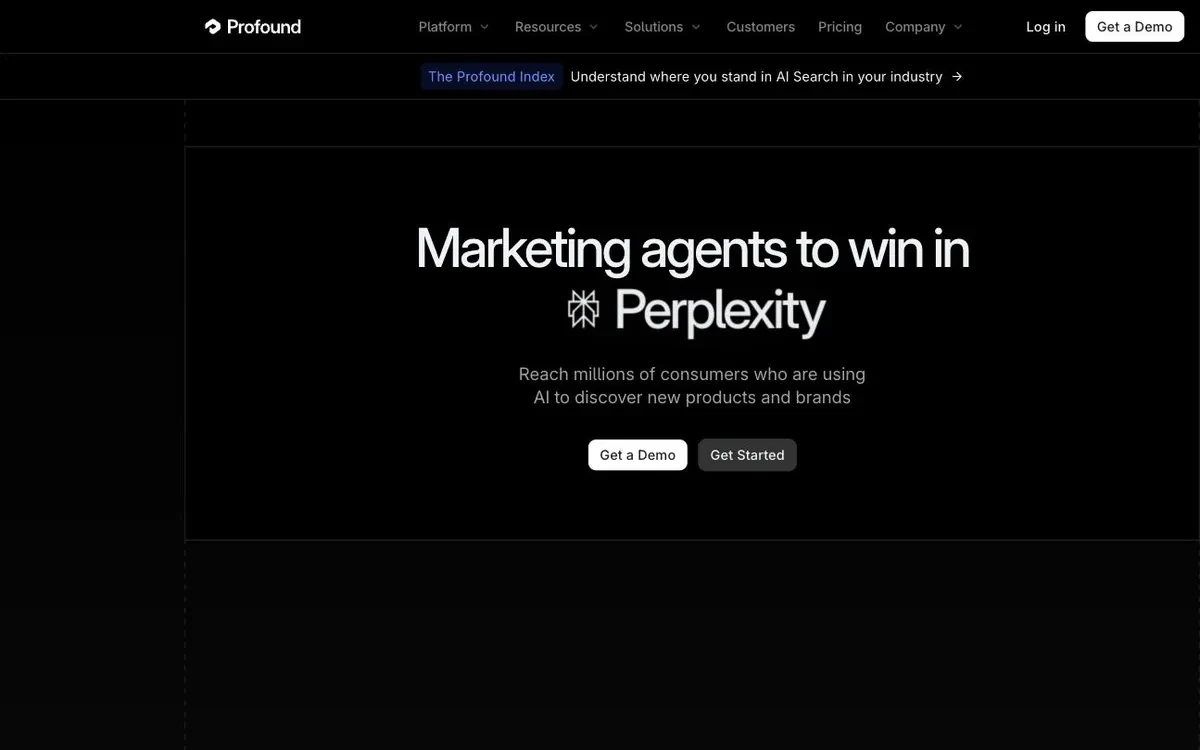
Profound is the most heavily funded company in the category — $96 million at a $1 billion valuation in February 2026 — and the depth shows: prompt-level volume estimates, citation analysis, crawler traffic read from Cloudflare and Fastly, and Agents that draft into ten content systems. Nothing else here explains AI search as completely.
Profound now sells marketing agents rather than answer-engine analytics alone.
Key features
The deepest citation analysis here, down to the pages an engine actually pulled from.
Agent Analytics tracks AI crawler traffic across unlimited domains, via Cloudflare, Fastly and Vercel.
Agents draft and update entries in ten CMSs, queued for review rather than pushed live.
Nine engines on Enterprise, including Claude, Grok and DeepSeek, with SSO/SAML and SOC 2.
Pricing
Starter $99/mo: ChatGPT only, 50 prompts, one seat, one region. Growth $399/mo: three engines, 100 prompts, 400 credits, three seats. Enterprise on quote for nine engines. Agencies pay $99/mo plus $399 per full client workspace, with two months free on annual billing.
Limitations
No Google organic view anywhere, so rankings and clicks live in a second tool.
One language and one region on both self-serve plans; international is an Enterprise conversation.
Agency cost scales with client count — ten clients is $4,089/mo before any work is done.
Best for a single large brand with an analyst who will use the depth and a CMS on the integration list. Not for an agency billing per client, or a team that needs Google in the same report.
03
AthenaHQ — Best for in-house teams on one flagship brand that want the widest engine coverage and drafts that reach the CMS.
Rung 5 of 7From $295/moUnlimited seatsGoogle SEO partial
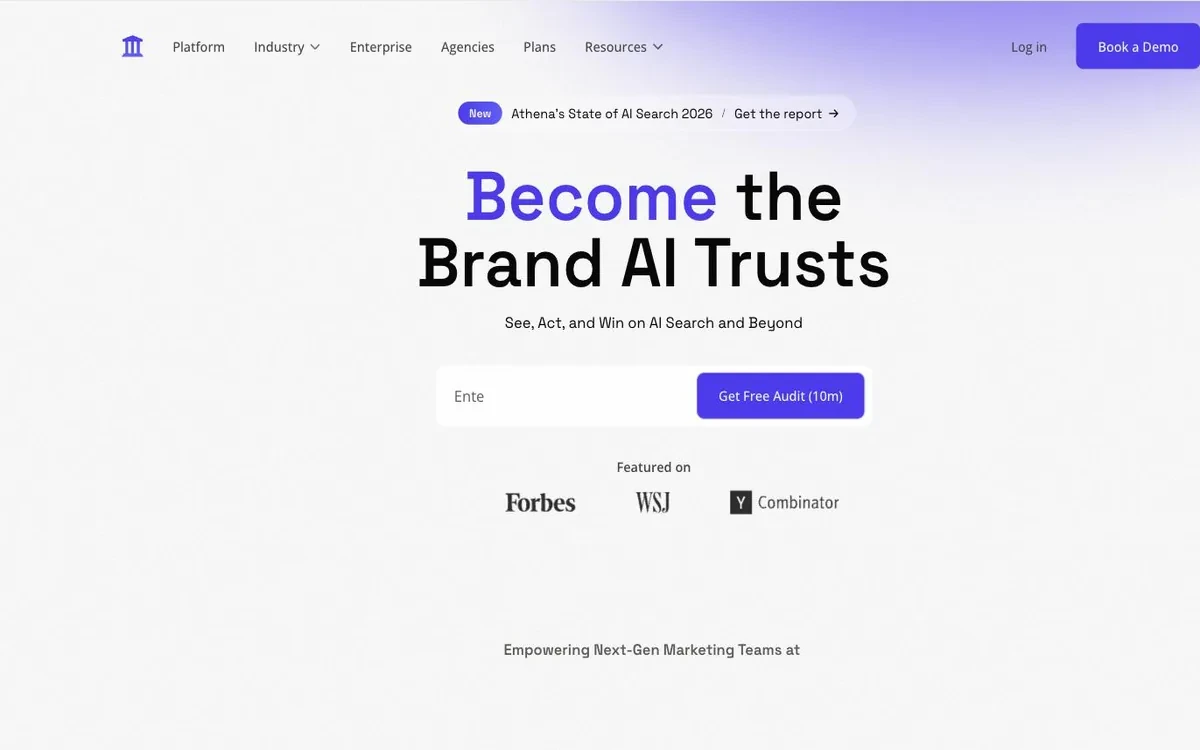
AthenaHQ splits into Monitor, Insights and an Action Center, and the third part separates it from the trackers: an opportunity becomes an article draft that publishes into WordPress, Webflow, Shopify or three more, or an outreach list aimed at the sources shaping an answer. Ten engines at $295 is the widest coverage here at a self-serve price.
AthenaHQ leads on agents that see, act and win on AI search.
Key features
Ten engines on Starter, including Claude, Grok, DeepSeek, Copilot and Meta AI.
Action Center turns opportunities into drafts, then publishes them into six content systems.
Brand-voice enforcement and multi-step approval on generated work.
Unlimited seats on every plan, and a real free tier with $25 of credit.
Pricing
Essential is free with 300 credits. Starter is $295/mo with 3,600 credits, ten engines, CSV export and the Action Center; API access and extra credits are add-ons on top. Enterprise is on quote and adds SAML SSO, audit logs and multi-region tracking.
Limitations
Publishing reaches six CMSs, but no on-page repair follows the article onto the site.
Credits are the real ceiling; 3,600 a month is monitoring plus modest Action Center output.
Search Console gives clicks and impressions but no rank tracking, and a roster is priced website by website.
Best for an in-house team on one flagship brand that wants engine breadth and a draft it can hand to an editor. Not for agencies needing consolidated billing, or anyone who needs the site repaired after the article lands.
04
AirOps — Best for technical content teams that want to own the pipeline from opportunity to published page.
Rung 7 of 7No published price1 engine at entryGoogle SEO yes
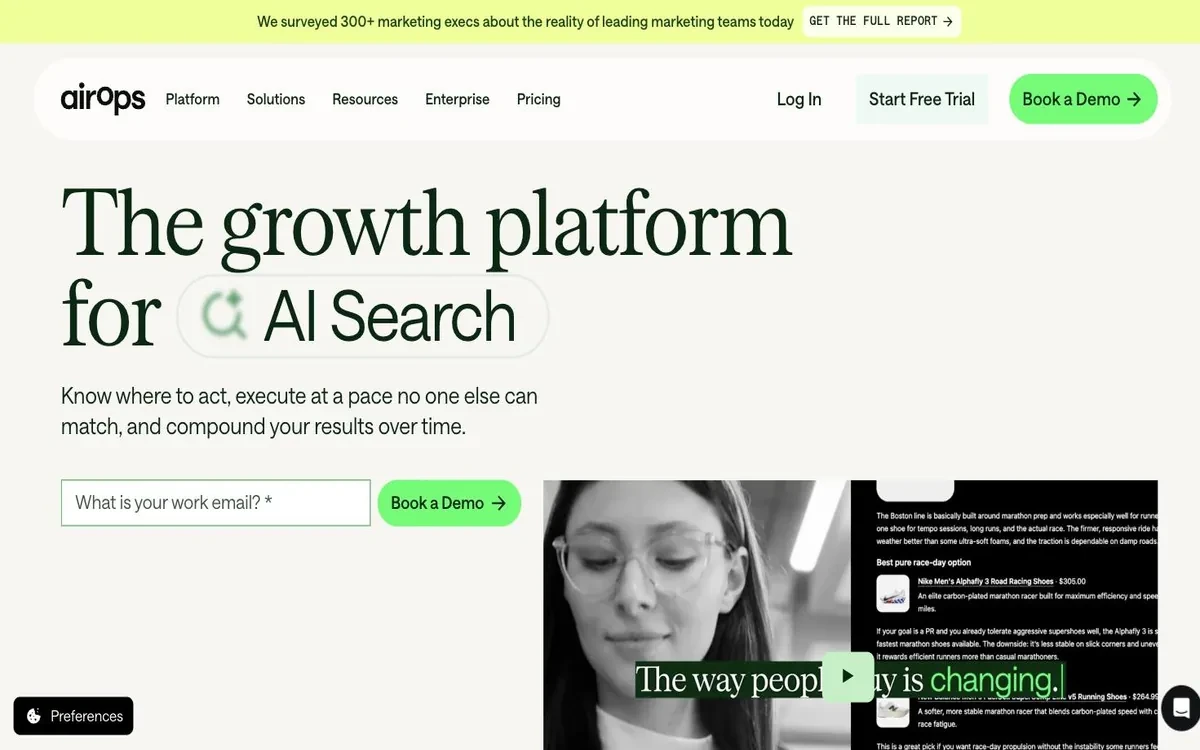
AirOps is a workflow builder that grew an AI-search product on top, and it climbs further than anything else here: refreshed pages written back over live CMS items, Search Console positions beside citation rates. Monday.com, Webflow and Ramp run content operations on it. The trade is that the loop is yours to assemble and maintain.
AirOps positions itself as a growth platform rather than a tracker.
Key features
Task-based content production at volume — 100,000 tasks a month on Pro, across 30+ models.
CMS, SEO, AEO and social integrations on Pro; basic CMS and SEO on Solo.
Grid templates that add internal links, refresh meta tags and generate page schema.
Unlimited seats on Pro, with Brand Kits keeping output consistent.
Pricing
No plan carries a price. Solo and Pro both read “Start for free” and Enterprise reads “Work with us”, with Solo overage at $0.025 a task. Solo includes 35,000 tasks, one Brand Kit, one seat and ChatGPT alone; Pro includes 100,000 tasks and unlimited seats.
Limitations
No published plan prices, which turns budgeting into an email exchange.
Solo covers ChatGPT alone; multi-engine insight starts at Pro.
Anything past the templates is build-it-yourself, so month one is engineering.
Best for a technical content team that wants to own its pipeline and has someone who enjoys building it. Not for an agency needing a working loop on day one, or a marketer expecting deliverables.
05
Scrunch AI — Best for enterprise teams with an engineer who needs AI crawler and extractability diagnostics.
Rung 4 of 7From $250/mo5 user licencesGoogle SEO no
Scrunch comes at the problem from the infrastructure end rather than the marketing end: what AI crawlers see when they reach your site, how pages render and extract, and where a technical decision is quietly costing citations. Pricing went public during 2026 and has since collapsed to a single $250 Core tier with five licences, which removes the reason agencies skipped it.
Scrunch opens on the crawler problem: humans do not visit your site, AI does.
Key features
Seven engines: ChatGPT, Claude, Gemini, Perplexity, Google AI Mode, AI Overviews and Meta.
350 custom prompts plus 1,000 industry prompts on Starter, doubling on Growth.
Page audits framed as technical work items, five on Starter and ten on Growth.
Persona-based tracking, three personas on Starter and five on Growth.
Pricing
Starter is $250/mo billed annually, $300 monthly, with three seats. Growth is $417/mo annually, $500 monthly, with five. Extra seats cost $25/mo each. Enterprise adds SSO and a data API. A seven-day Starter trial runs without a card.
Limitations
Page audits are capped low — five a month on Starter is one site, not a roster.
Findings need an engineer to become shipped changes; nothing is produced or published.
No Google organic view and no white-label layer for client reporting.
Best for a large site where the AI visibility problem is genuinely technical and an engineering team exists to act on what it finds. Not for agencies without an engineer, or anyone who needs the content made as well as diagnosed.
06
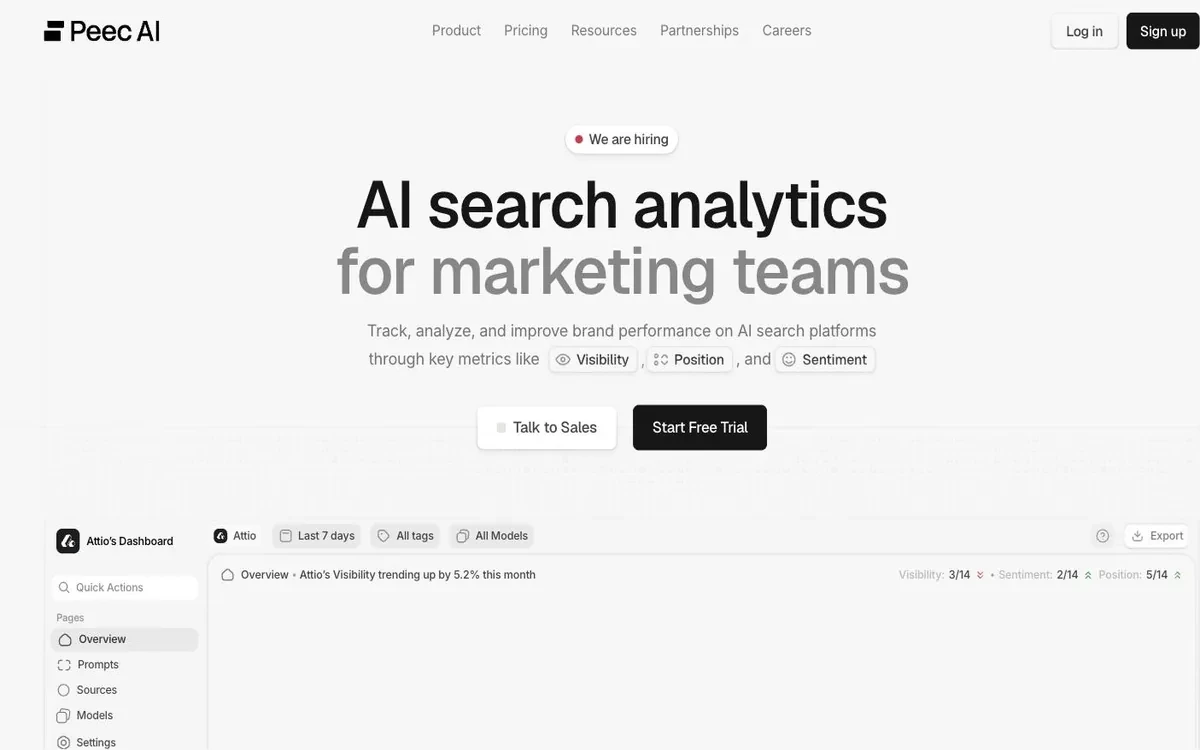
Peec AI — Best for marketing teams that want clean, exportable AI visibility data and already know what to do with it.
Rung 3 of 7From €85/moUnlimited usersGoogle SEO no
Peec is the cleanest pure-analytics product in the category, and it charges by project rather than by seat — unlimited users on every plan, including the €70 entry. Visibility, position and sentiment across three models you choose, with citation tracking that names the pages behind an answer. Its recommendations name the source types worth chasing; everything after that it expects your stack to do.
Peec AI sells analytics for marketing teams, and says so in the first line.
Key features
Unlimited users on every plan, with projects rather than seats as the billing unit.
Visibility, position and sentiment daily, with prompts tagged by persona and funnel stage.
Citation tracking that names the pages an engine pulled from.
Data out through CSV, Looker Studio, a REST API and MCP.
Pricing
Starter €85/mo: 50 prompts, three models, one project. Pro €205/mo: 150 prompts, two projects. Advanced €425/mo: 350 prompts, five projects and multi-country. Annual billing saves 15%, taking the three to €70, €180 and €360. Enterprise on quote.
Limitations
Recommendations name sources and gaps; nothing is briefed, drafted or published.
Projects are the billing unit, so a roster past five brands means an Enterprise quote.
Three models per plan below Enterprise, and no Google organic view.
Best for a marketing team that wants the numbers clean, cheap and exportable into a dashboard it already runs. Not for anyone who needs the work made rather than named — the Peec AI alternatives comparison covers the tools that do.
07
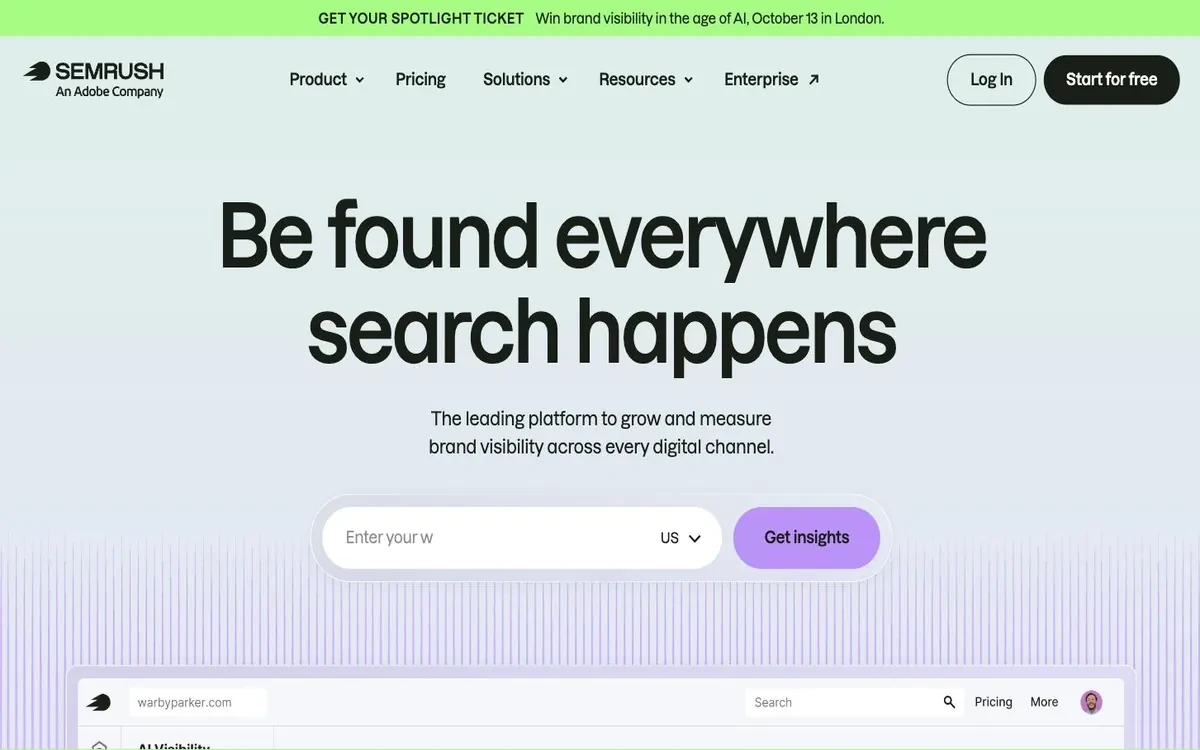
Semrush — Best for teams already paying for an SEO suite that want the AI number beside the rankings.
Rung 3 of 7From $199/mo1 domain for AIGoogle SEO yes
Semrush folded AI visibility into its plan structure rather than selling it as a bolt-on, which makes it the cheapest way to see AI answers and Google rankings on one screen. The catch is in the fine print: AI brand performance covers one domain, and the $139 SEO plan has no AI tracking.
Semrush, now an Adobe company, sells visibility across every channel.
Key features
AI visibility from the $199 Starter tier — 50 prompts and 300 AI visibility reports a day.
ChatGPT, Perplexity, Gemini and further engines by tier, plus an AI-ready site audit.
The classic toolkit alongside: position tracking, site audit and keyword research.
Content optimisation and keyword cannibalisation analysis from Pro+ at $299.
Pricing
SEO $139/mo has no AI search tracking. Starter $199/mo, or $165.17 annually, adds 50 prompts a day and one domain for AI brand performance. Pro+ $299/mo covers 100 prompts; Advanced $549/mo covers 200 plus API. Extra users are $45/mo each.
Limitations
One domain for AI brand performance at entry, so an agency prices by client domain.
Citation and source analysis is shallow next to the GEO-native tools.
Seats are charged separately, and nothing is produced or published.
Best for a team already inside Semrush that wants AI visibility in the report it already sends, with no new vendor and no new login. Not for an agency covering many client domains — the Semrush alternatives page works through that arithmetic.
08
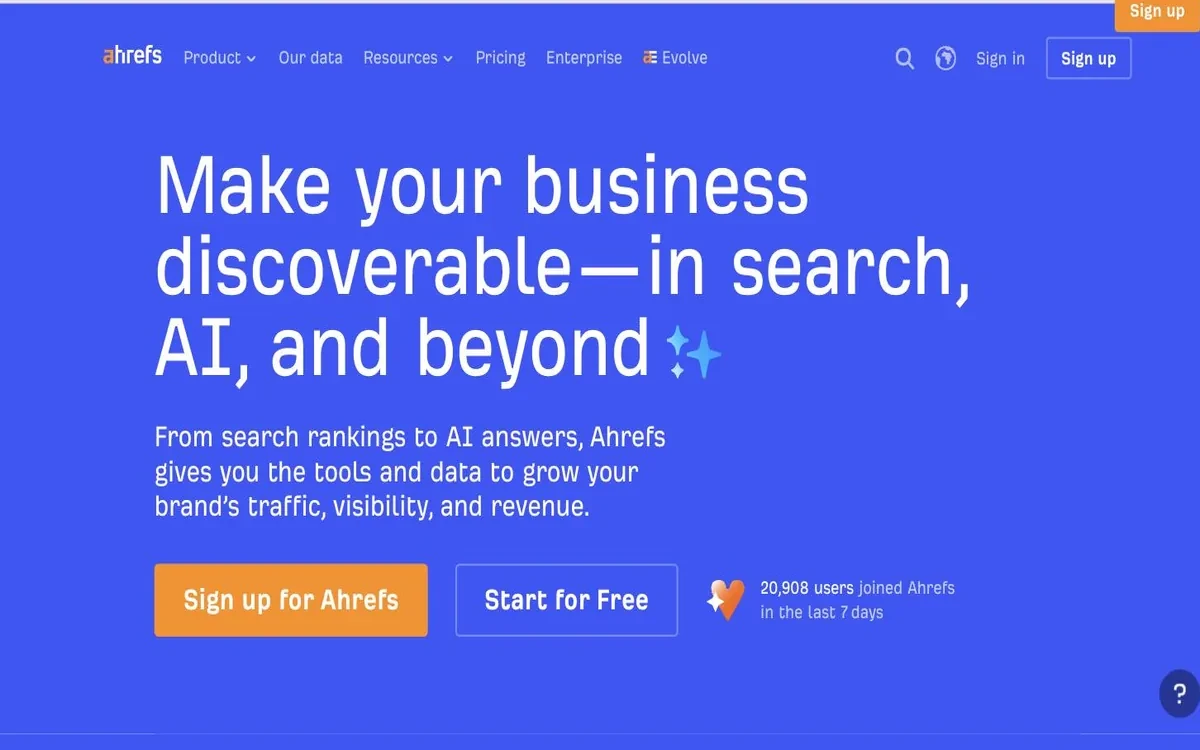
Ahrefs Brand Radar — Best for SEO teams already on Ahrefs that want AI share of voice next to links and rankings.
Rung 2 of 7From $129/mo1 user includedGoogle SEO yes
Brand Radar is Ahrefs’ AI visibility module and it inherits what Ahrefs is good at: a very large index of prompts people actually typed, rather than a synthetic set. It reports share of voice across five AI surfaces beside the link and keyword data an SEO team lives in.
Brand Radar sits inside the wider Ahrefs platform, not beside it.
Key features
Five surfaces: ChatGPT, Perplexity, Gemini, Copilot, and Google AI Overviews and AI Mode.
An index of 474M+ organic prompts, plus custom prompt tracking.
Bundled into every Ahrefs plan, so an existing subscriber pays nothing extra.
Available standalone from $199/mo for teams that don’t want the whole suite.
Pricing
Lite $129/mo includes 150 Brand Radar checks and one user. Standard $249/mo includes 300, Advanced $449/mo 600, Enterprise $1,499/mo annually 2,500 or more. Extra users run $40 to $100/mo. Standalone Brand Radar is $199 to $699/mo.
Limitations
Checks are the real ceiling, and 150 a month on Lite goes quickly.
One user per plan, with every additional seat charged.
No recommendations, no content, no publishing — it reports share of voice and stops.
Best for an SEO team already paying for Ahrefs that wants AI share of voice beside rankings and links at no extra cost. Not for anyone who needs the tool to explain the gap or close it.
09
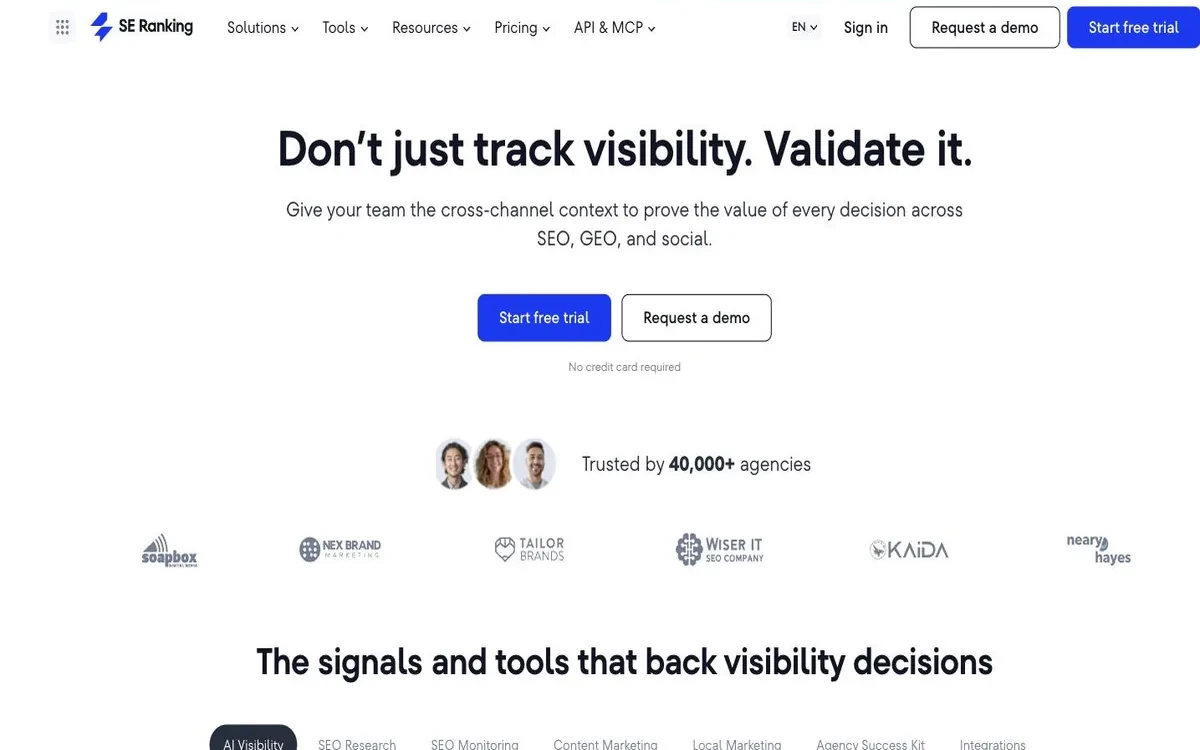
SE Ranking — Best for agencies that need Google and AI reporting across a client list on the smallest possible bill.
Rung 5 of 7From $129/mo10 projectsGoogle SEO yes
SE Ranking answers the same brief Semrush does, for less: rank tracking, site audit and AI visibility from one login, with AI tracking inside the base Core plan rather than above it. Its content editor briefs, drafts and publishes to WordPress. Ten projects on the entry plan make it the cheapest per-client option here.
SE Ranking sells SEO, GEO and social in one cross-channel view.
Key features
Ten projects on Core and thirty on Growth, so a roster fits without an enterprise quote.
ChatGPT, Perplexity, Gemini, AI Overviews and AI Mode tracked from Core, with sentiment.
100 prompts tracked daily at Core and 250 at Growth, inside the plan.
Content Editor briefs, AI Writer drafts, and WordPress publishes them live.
Pricing
Core $129/mo, or $103.20 billed annually, with one manager seat and ten projects. Growth $279/mo, or $223.20 annually, with three seats and thirty projects. The $69/mo Agency Pack adds ten client seats and white-label reporting, on annual billing only.
Limitations
Client seats and the API exist only as annual-billing add-ons, so a monthly team can’t buy them.
Citation and source analysis is thin next to the GEO-native tools.
One manager seat at Core, and nothing is applied to the site itself.
Best for an agency reporting on Google and AI across a long client list that accepts a shallower read on why answers land where they do. Not for a monthly-billing team that needs client logins.
Best by job
Agencies billing more than one client brand
Amadora AI. Unlimited brands and seats from $179/month, with white-label deliverables and consolidated billing. Every per-workspace, per-domain or per-project tool here becomes your largest software line around client four.
One enterprise brand with an analyst and a CMS team
Profound. Nothing here gives an analyst more to work with, and its Agents write into ten content systems. You will still need a separate answer for the Google half of the report.
Teams already paying for an SEO suite
Semrush or Ahrefs Brand Radar. Neither is the strongest AI tool here, but both put the number beside data you already report on, with no new vendor and no new login.
When Profound is still the right choice
You need nine answer engines on one contract — Claude, Grok, DeepSeek, Copilot and ChatGPT Shopping among them — which we don’t cover at any tier.
You want server-level visibility into AI crawler traffic through Cloudflare, Akamai, Fastly, Vercel or Netlify. Agent Analytics has no equivalent here, ours included.
Procurement requires SOC 2, SSO/SAML and an enterprise MSA. That line ends the conversation with us, and Profound clears it for more than 10% of the Fortune 500.
The execution ladder
The execution ladder is seven steps from measuring an AI visibility problem to proving it was fixed: measure, diagnose, plan, produce, publish, fix, prove. Engine counts and prompt limits miss the thing it captures, which is how much work lands back on your team. Every platform here climbs the same seven steps and each stops somewhere.
The seven execution rungs and which of the listed tools reach each one
Rung
What it means
Which tools reach it
1 · Measure
Tracks prompts, mentions, citations and share of voice
All nine
2 · Diagnose
Names why the citation went elsewhere and which source the engine trusted
All nine
3 · Plan
A prioritised, client-ready action list with reasoning attached
Amadora AI, Profound, AthenaHQ, AirOps, Scrunch, Peec, Semrush, SE Ranking
Amadora AI, SE Ranking, Profound, AthenaHQ, AirOps, Scrunch
5 · Publish
Agents ship approved work into the live CMS
Amadora AI · AthenaHQ, into six CMSs · SE Ranking, to WordPress · Profound, as drafts across ten · AirOps if you build it
6 · Fix
On-page SEO, internal links, broken-link repair and schema — executed, not recommended
Amadora AI · AirOps, through Grid templates you assemble · Profound covers schema and FAQ injection only
7 · Prove
Week-over-week movement in AI answers and Google rankings, in one report
Amadora AI · AirOps, Search Console positions beside citation rate
Scroll the table sideways →
Rung placements reflect what each vendor documents publicly, re-read 28 August 2026. SE Ranking moves from 3 to 5: its Content Editor builds briefs, its AI Writer generates articles and its WordPress integration publishes them live. AirOps was re-read on 8 September 2026 and moves from 5 to 7: its Grid templates add internal links, refresh meta tags and generate page schema, its CMS export writes the revision back over the live item, and Insights prints Search Console positions beside citation rates — assembled rather than shipped. Peec reaches rung 3 through the recommendations its documentation describes. Scrunch moves from 3 to 4 — its Core tier now includes basic content generation and a monthly page optimisation.
Four of the nine stop at rung 3 or below, which is no criticism — a prioritised action list is a real product worth paying for. What moved this year is the top of the ladder: Profound publishes now and AirOps reaches the end of it, so the old line that trackers can’t execute stopped being true around February. What’s left is narrower. AirOps is the one other tool here that applies on-page work across a site, and it does it as a pipeline you assemble; four of the nine — Profound among them — can’t see Google organic at all, so the AI number and the rankings number arrive from different vendors and get stapled together by whoever writes the report.
Migrating off Profound
Your prompt list carries over in full. Export it as CSV — available from the Growth plan up, not on Starter — and paste it in, or let us generate a fresh set from the client’s site and competitors and compare the two. Competitor sets and brand configuration move the same way. Historical visibility data doesn’t transfer in either direction, because each vendor samples and scores differently enough that the numbers wouldn’t be comparable. Saved views get rebuilt in under an hour. Anything Profound Agents already published stays put — it lives in your CMS, not theirs.
Expect first data within twenty-four hours of adding a domain and a usable trend line at about two weeks. Profound’s annual billing carries two months free, so a mid-term switch leaves money on the table; the clean sequence is to start the trial while the contract runs, migrate one client, and move the roster at renewal. Each full client workspace bills separately at $399, so dropping them one at a time often beats waiting for the account to lapse.
Common questions
−
How much does Profound cost?
Profound starts at $99/month for ChatGPT-only tracking with 50 prompts and one seat (vendor pricing page, August 2026). Growth is $399/month for three engines, 100 prompts and three seats, and Enterprise is on quote for up to nine engines. Agencies pay $99/month plus $399 for every full client workspace, with two months free on annual billing.
+
Does Profound have a free trial?
Yes, on the Growth plan — its pricing page carries a "Try for free" button, while Starter signs up directly and Enterprise goes through a demo. Agencies get ten pitch workspaces a month on Agency Growth, each running 25 prompts for seven days with an option to extend.
+
What is the best Profound alternative for agencies?
Amadora AI, on the pricing unit alone: unlimited client brands and unlimited seats from $179/month, against $399 per full client workspace at Profound. A ten-client roster costs $499/month on our Agency plan and $4,089/month there. SE Ranking is the cheaper choice at $129/month for ten projects, if one manager seat is enough.
+
Which Profound alternatives track Google rankings too?
Amadora AI, Semrush, Ahrefs Brand Radar and SE Ranking all report Google organic alongside AI answers. Profound, Scrunch AI and Peec AI don't cover Google at all, and AthenaHQ reads Search Console for clicks without reporting a position. Amadora AI connects Search Console directly, so rankings and AI citations land in the same week-over-week report.
+
Does Profound publish content to my CMS?
Into ten of them: WordPress, Webflow, Contentful, Sanity, Drupal, Adobe Experience Manager, Framer, Payload, Directus and Basehub. Profound Agents create and update entries and inject FAQs, stats and schema, but queue the result as drafts for editorial review rather than pushing it live.
+
Can I move my prompts from Profound to another tool?
Yes. Export the prompt list as CSV — available from the Growth plan up, not on Starter — and import it; Amadora AI, Peec AI and most others accept a paste. Historical visibility data doesn't transfer in either direction, because each vendor samples and scores differently.
Last updated
This comparison is current as of , with every price, engine count, seat limit and prompt allowance verified against each vendor's own pricing page on that date.