Guide · GEO
Citation gap analysis: how to find what AI cites instead of you

A citation gap analysis compares the domains AI engines cite for a topic against the domains that carry your brand, then sizes the difference as mention share. Here’s the method, run by hand, on one tracked topic at a time.
We ran it on ourselves first, on data we pull daily from the logged-out ChatGPT, Perplexity and Gemini interfaces. On the topic this page was planned for, one tracked competitor held 76.27% mention share across 213 tracked citations. Our own share was 1.69%, across 7 (Amadora AI tracked data, 7–13 August 2026). That’s a 45x gap.
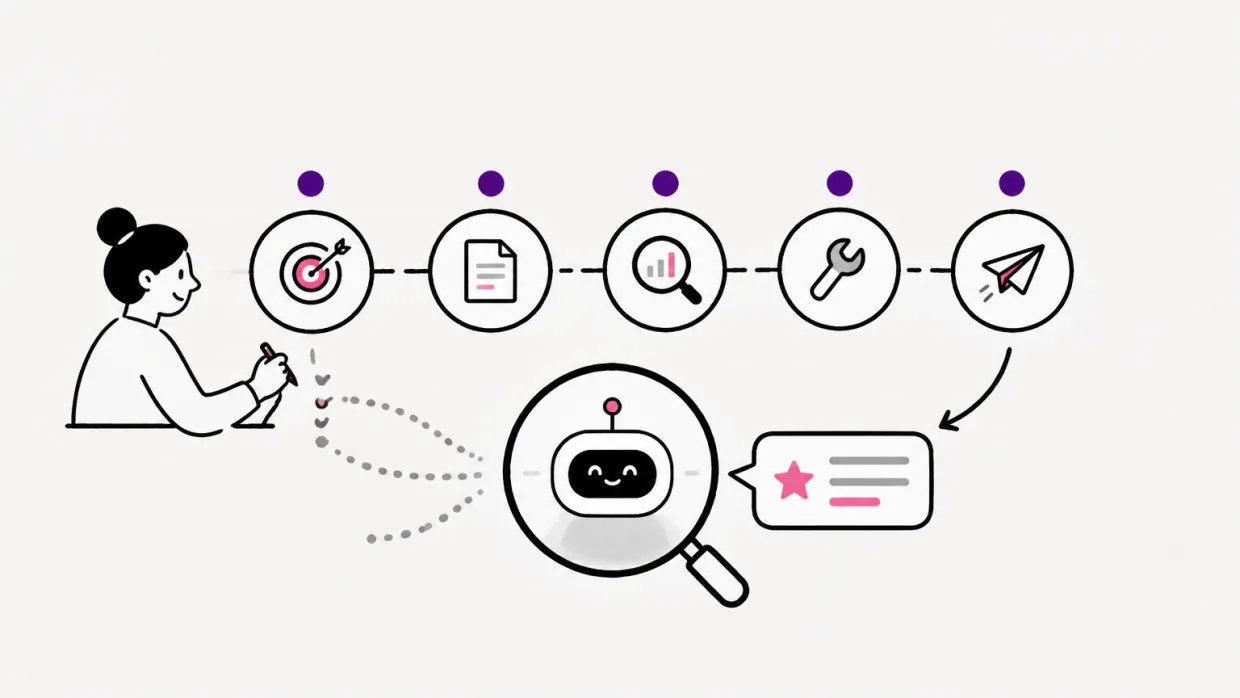
A citation gap analysis has five steps. Pull every citation your tracked prompts returned, define one competitor set inside one topic, compute each brand’s mention share, read the domain type and page type behind the citations you lost, then map each gap type to one action. Run it per topic. An account-level number hides where the gap actually sits.
What a citation gap actually measures
A citation gap is measured in mention share, and mention share is not the same thing as mention count.
Mention share (also called citation share) is the percentage of tracked brand mentions for one topic that name one brand. It turns “we aren’t cited” into a number you can move and compare. A citation gap is the distance between that share and the share held by the brands engines cite instead of you.
Most AI search analytics dashboards lead with a visibility score. Visibility answers a different question: how often did any answer to my prompts name me?
But it says nothing about who took the space. That is the part you can act on.
Four metrics get confused with each other. They measure different things.
| Metric | What it counts | What it misses | Read it when |
|---|---|---|---|
| Visibility score | Share of answers naming your brand | Who got named instead | You need a single trend line |
| Mention share | Your share of all brand mentions in a topic | Which pages carried the mention | You are sizing a competitive gap |
| Citation count | URLs the engine actually used | Whether your brand was named at all | You are auditing source coverage |
| Domain influence | How often your domain appears as a source | Mentions that came from someone else’s page | You are judging owned-content reach |
Being cited and being mentioned are separate states. An answer can cite your blog post and recommend a competitor. It can also recommend you while citing a review site you’ve never touched. AI citation analysis that collapses the two produces a number nobody can act on.
Step 1: Pull your tracked citations
Step 1 is a data pull: a table of every citation your tracked prompt set returned, one row per citation.
Four fields carry the analysis: the prompt it answered, the cited URL, the brands mentioned in that answer, and whether the URL is yours. Engine and capture date make it sortable later.
Without the is-owned flag you can’t separate your citations from your mentions. Those are the two halves of a gap.
Capture from the logged-out consumer interfaces, not the APIs. We query ChatGPT, Perplexity and Gemini daily without an account, history or memory. Replies and cited sources diverge between the interface and the API. An API-measured gap describes a surface your buyers never touch.
Google needs a pull of its own. AI Overviews and AI Mode assemble an answer through a query fan-out. The engine issues related searches across subtopics first. Google states that robots.txt directives for Googlebot are the control site owners hold over access.
Check yours before concluding you have a citation gap. A blocked crawler returns the same zero.
You can automate the pull described here, or export it and work in a sheet. The arithmetic doesn’t change.
Step 2: Define your competitor set and market segment
Define the competitor set inside one tracked topic, never across your whole account.
A market segment, for this analysis, is one tracked topic plus the brands appearing in its answers. Defining it that way keeps the comparison like-for-like: brands competing for the same intent, measured on the same prompt set, over the same window.
Don’t type in a competitor list from memory.
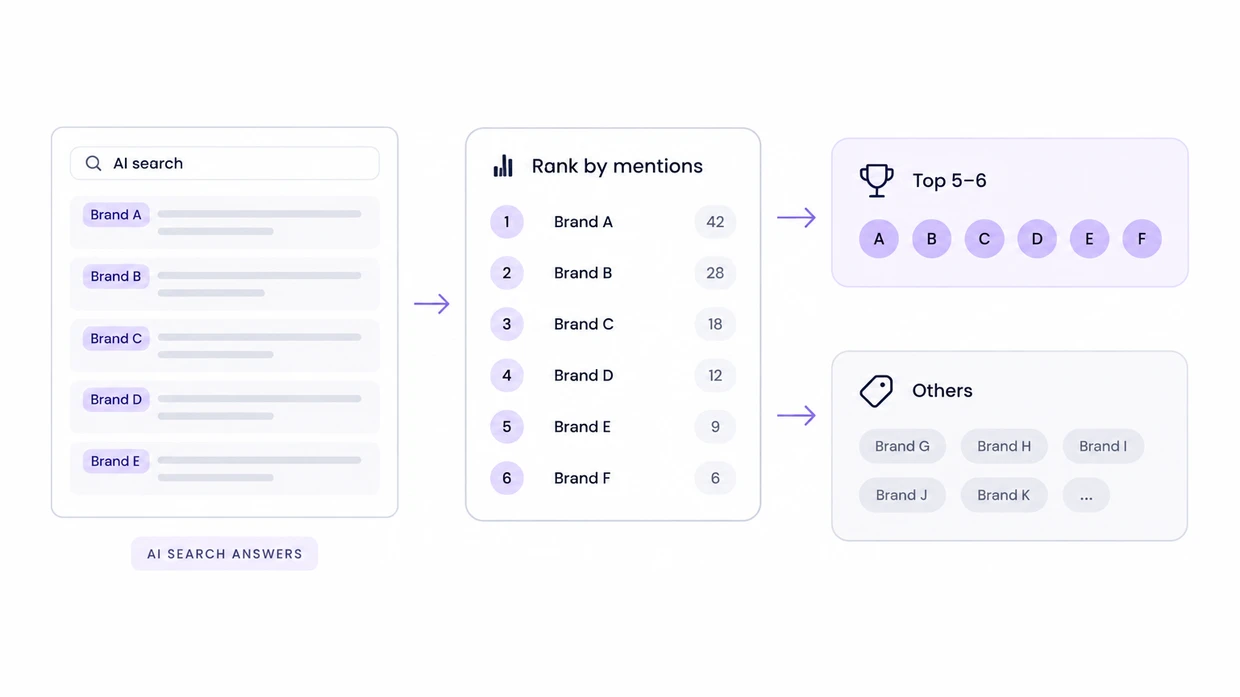
But the engines have already named your real competitors. That list differs from the one in your pitch deck. Take every brand the answers mention inside the topic. Rank by mention count, keep the top five or six, and tag the rest so they stay out of the metrics.
One caution on how you cut the segment. The same brand often scores very differently on a general topic and on an enterprise one, because third-party sources describe it differently for each intent. Merge those topics and both numbers disappear.
Then benchmark competitors by segment rather than against your whole tracked account.
Step 3: Calculate the mention-share gap
Your mention-share gap is the distance between your share of a topic’s brand mentions and the leader’s, expressed twice: as points, and as a multiple. The arithmetic is deliberately plain:
Your mentions in topic ÷ all brand mentions in topic × 100 = your mention share
Run it for every brand in the segment.
Here’s ours. On this topic, a competing AI visibility platform held 76.27% mention share across 213 tracked citations, against our 1.69% across 7 (7–13 August 2026 window). The gap is 74.58 points, or roughly 45x.
The multiple matters more than the points. Points tell you how far behind you are. The multiple tells you what closing it would take, and 45x is a positioning problem rather than a content-calendar one.
Widen the frame before acting. Across the nine topics we track for ourselves, that competitor’s mention share ran 49.9% to 72.2% while ours ran 0.4% to 1.7% (content-plan pull, 12 August 2026). A gap holding across every topic is structural. A gap in a single topic is usually coverage, and coverage you can fix directly.
Step 4: Diagnose why competitors win those citations
Diagnosing a citation gap means reading the domain type and page type behind the citations you lost, not counting them.
Sort the citations you lost by two attributes: the domain type of the citing site, and the page type of the citing page. Those two columns tell you where the mentions actually live.
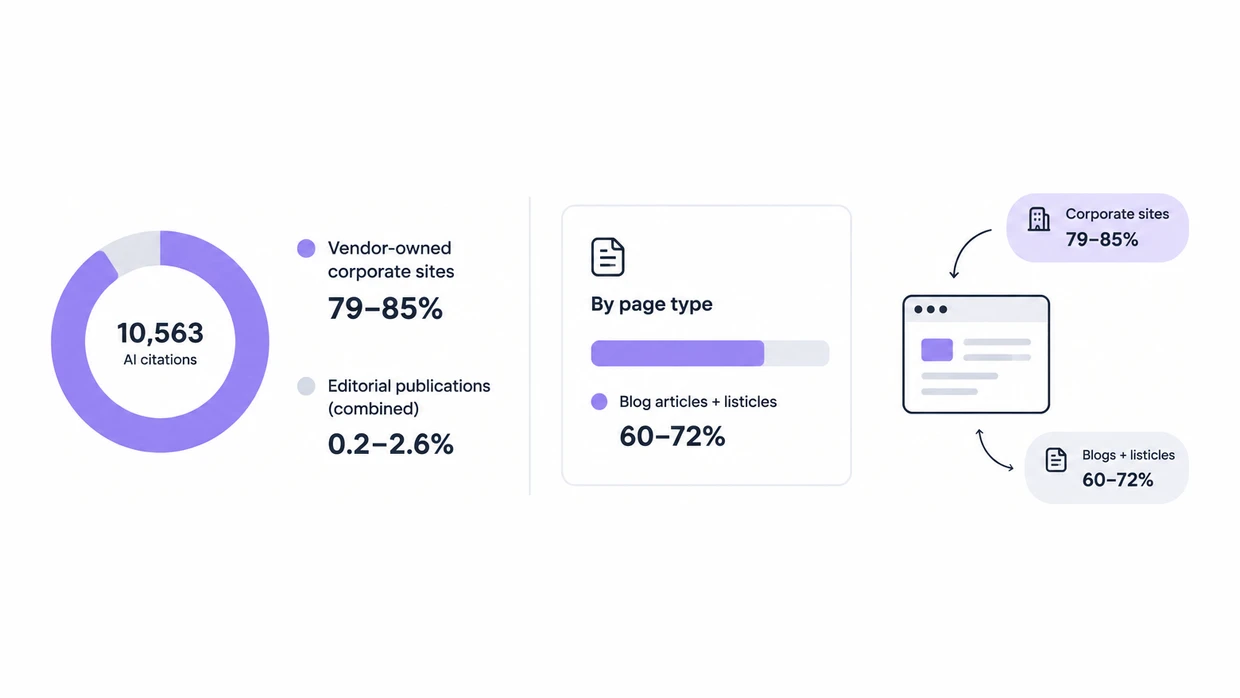
The distribution is lopsided in a way most teams guess wrong. In our analysis of 10,563 AI citations across five engines, vendor-owned corporate sites held 79–85% of the citation surface. Editorial publications combined held 0.2% to 2.6%. By page type, blog articles and listicles together took 60–72% of that same dataset.
In practice, that usually means:
- Your competitor’s mention share is sitting on somebody else’s blog post, not on a press placement.
- The listicle you’re absent from is worth more than the feature article you’re chasing.
- A domain-authority-shaped outreach list will aim at the wrong 2%.
- Editorial coverage is brand work, and it gets measured somewhere else.
Is a citation gap the same as a backlink gap?
No. A backlink is a persistent edge in a link graph. A citation is a source used once, at answer time, for one question. The same page can be cited for one prompt and ignored for the next.
The mechanism is retrieval, not authority transfer. In our tracked projects one reply is assembled from roughly 50 to 100 analyzed pages, and engines avoid pulling repeatedly from the same source (Amadora AI tracked projects, May to July 2026). A brand therefore contributes at most one or two of its own pages to any given answer.
Publishing your way out of a citation gap has a ceiling built into it.
Step 5: Turn the gap into optimization actions
An optimization action is the specific fix applied once a gap is located: a source to get listed on, a page to rewrite, an outreach target to pitch, a comparison to publish. Reporting the gap is analysis. The action is what you do about it.
Each gap type has one first move.
| What the diagnosis shows | Gap type | First action |
|---|---|---|
| Competitors cited from domains you appear on nowhere | Source gap | Get listed on those domains, ordered by citation count |
| Your page is retrieved but rarely cited | Extraction gap | Rewrite it so each answer is liftable in isolation |
| The topic is won by listicles you are absent from | Format gap | Pitch inclusion, or publish the comparison yourself |
| Answers name you but cite someone else’s page | Attribution gap | Publish the primary source for the claim being repeated |
For the extraction gap there is tested guidance. In a controlled experiment presented at KDD 2024, the methods that raised visibility most were source citation, quotation addition and statistics addition, at a 30–40% relative improvement on one visibility metric against an unoptimized baseline.
But that result predates the current engines. Treat it as direction, not as a rate you’ll reproduce.
Order the work by citation count on the target domain, rather than by how easy each item looks. The domains carrying the most citations are already inside the answers.
Why your gap number can lie
Four things make a citation gap read bigger or smaller than it is.
Branded prompts. A prompt containing your brand name returns close to 100% visibility by construction. We strip branded prompts before reading any gap, because leaving them in lifts the average without a single new mention. Pad the prompt set and the number climbs on its own.
Thin samples. A topic resting on 7 tracked citations, like ours above, gives you a directionally honest share and a fragile one. One new citation moves it by whole percentage points.
Engine mix. Each engine draws its sources from a different pool, which is why the same prompt returns different citations in each one. A gap measured on a single engine will not always appear on another. Compute the share per engine before you act on it.
Window length. Two pulls, two windows, two numbers. The topic-level and account-level figures above differ for exactly that reason, and each carries its own date.
So report per topic and per engine. A single headline gap number is the easiest thing to move and the least worth moving.
Keep the gap re-checking itself
A citation gap analysis is a standing measurement that you re-run on a fixed cadence.
Fix the pull: same prompt set, same topics, same engines, same day of the week. Changing the prompt set between pulls changes the denominator, and the trend line stops meaning anything.
Watch two leading indicators rather than the headline share. Your own citation count moves with content and technical work. Your brand mention count moves with third-party placement. Those two typically tell you which lever is working weeks before the share number confirms it.
Set the alert on the competitor set as well as on yourself. A new brand entering a topic’s top five is the earliest signal the segment is shifting.
Re-run monthly on active topics, and immediately after any placement lands. If you’d rather that pull happened daily, run this analysis on your own tracked topics on a schedule.
Common questions
How is a citation gap analysis different from a share-of-voice report?
A share-of-voice report tells you how much of the conversation you hold. A citation gap analysis tells you which specific domains and pages hold the rest, so the output is an outreach and content list rather than a percentage. Same input data, different deliverable.
How many tracked prompts do I need before the numbers mean anything?
Enough that one new citation can’t move your share by several points. Ten prompts per topic is a workable floor, with seven days of daily capture before you read a trend. Below that you are reading noise.
Can I run this without a tracking tool?
Yes, for one topic. Run your prompts manually in each engine, record the cited URLs and the brands named, and the arithmetic is identical. It stops being practical at roughly ten prompts across several engines, repeated weekly.
How long does it take to close a citation gap?
Nobody can predict that, and any timeline promised to you is a guess. It depends on the niche and on whether your existing pages are extractable at all. Track your citation count and your mention count as leading indicators instead of committing to a target share.