Guide · GEO
How to Rank in Google AI Overviews: A Practical Guide

Ask how to rank in AI Overviews and you’ll get answers about ranking. That’s the first mistake.
A page gets cited in an AI Overview when two things are true at once. It’s indexed and eligible to be shown in Search with a snippet, and it carries a short self-contained passage that answers the exact sub-question the Overview is assembling. Google states there are no extra requirements and no special markup for these features. Ranking still matters, because the candidate pool is drawn from pages Search already surfaces.
Across Amadora AI’s own tracked keyword set, 72% to 92% of keywords triggered an AI Overview between April and August 2026, with the most recent readings at 88% to 92%. Over the same set, only about one keyword in twelve ranked in the organic top 10. So for most of those queries the Overview is the result rather than a feature sitting on top of one.
Our position is that on a keyword which triggers an Overview, rank position stops being the measure that matters. Pew Research Center’s browsing-panel study found people clicked a traditional result on 8% of visits where an AI summary appeared, against 15% of visits without one, and clicked a link inside the summary on just 1% (900 US adults, March 2025).
What actually gets a page cited
Overviews cite passages, not pages. Google’s system decomposes a query into sub-questions, gathers candidate documents, and lifts the specific chunk that resolves each part, which is why a 4,000-word guide can rank well and never get cited while a 90-word definition on a thinner page does.
An AI Overview is Google’s generative answer box: a synthesized answer shown above the organic results, with links to the sources it drew from. A retrieval signal is what the system uses to pick a passage for that answer, and it works differently from a classic ranking signal.
Common advice is to publish the most comprehensive page on the topic. While true, it’s too simplistic. In Amadora AI’s citation data, a single AI reply is assembled from roughly 50 to 100 analysed pages, and engines avoid pulling repeatedly from one source, so a brand contributes at most one or two of its own pages to any given answer (tracked projects, May to July 2026).
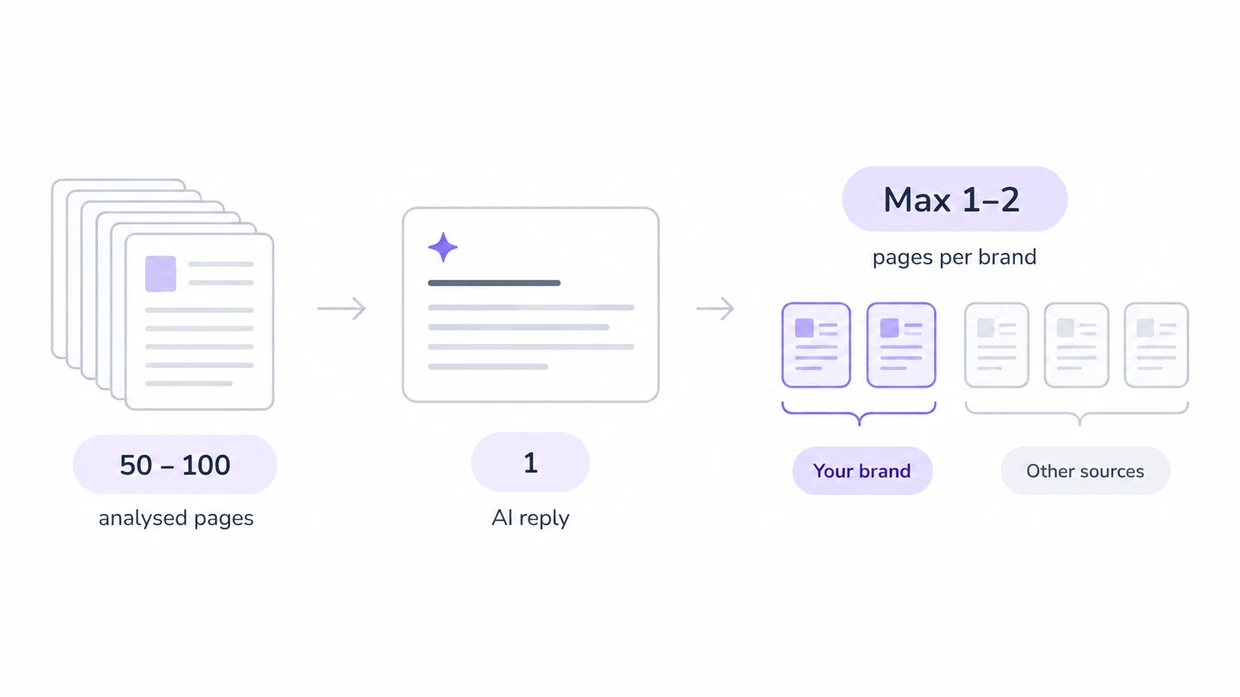
But that doesn’t make coverage hopeless. It changes the unit you’re optimizing from the page to the passage, and it means five pages each owning one sub-question usually beat one page trying to own all five.
What counts as a liftable passage
Four properties separate a passage that gets lifted from one that gets skimmed past.
- It stands alone. Read out of context, with no heading and no preceding paragraph, it still makes sense.
- It names its entities plainly. Products, standards, methods and places are written out rather than referred to as “it” or “the platform.”
- It carries something checkable. A number, a date, a threshold, a named source.
- It adds what the other candidates don’t. Identical phrasing to the four pages already cited gives the system no reason to swap one of them out for you.
The floor underneath all of this is mechanical. Google’s documentation states that to be eligible as a supporting link in an AI Overview or AI Mode, a page must be indexed and eligible to be shown in Google Search with a snippet (Google Search Central). A page blocked from snippets can’t be cited, however well written the passage is. Format-level detail sits in our breakdown of which page types AI engines actually cite.
Does schema markup move the needle?
No, not as a citation lever. Google’s guidance is explicit that you don’t need to create new machine-readable files or markup to appear in these features, and that there’s no special schema.org structured data to add.
Schema markup is code in a page’s source, usually JSON-LD, that labels what the page’s content means for machines. It earns its place for the reasons it always did: rich-result eligibility in classic Search, and a machine-readable statement of what the page is about.
But there’s a version of this that does matter, and it isn’t the markup itself. Google asks that structured data be accurate and match the visible page text. Markup describing content a reader can’t find on the page is a quality problem, and quality problems reach the same systems that pick sources.
So should you bolt FAQPage or HowTo markup onto a page to chase a citation? No. Add it where it describes what’s genuinely there, and put the time you saved into the passage.
AI Overviews and featured snippets select differently
A featured snippet is a single passage lifted from one ranking page and shown above the organic results. An Overview is recombined from several. The selection logic diverges from there.
| Featured snippet | AI Overview | |
|---|---|---|
| What is selected | One passage from one page | Passages from several pages, recombined |
| How many sources | One | Three or more in 88% of the summaries studied by Pew |
| What triggers it | A query answerable from an existing passage | A query the system splits into sub-questions, then fans out |
| What you optimize | The ranking page, then its snippet-shaped passage | Each sub-question, on whichever page answers it best |
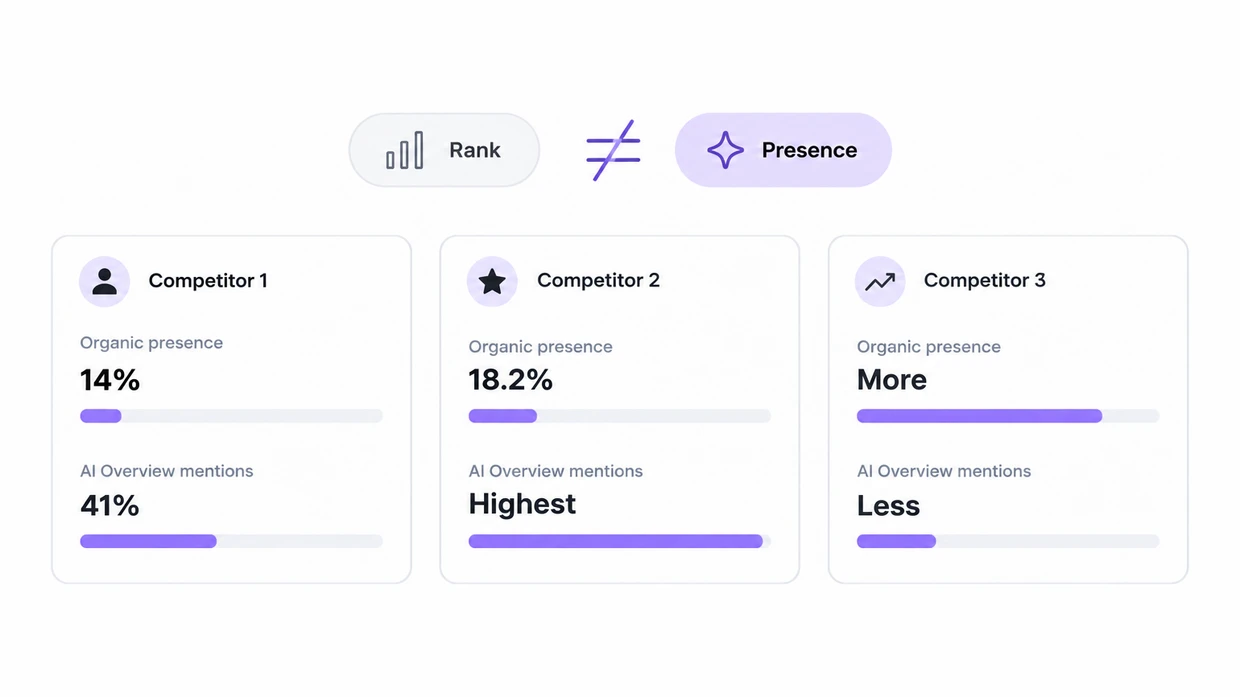
The consequence the table can’t hold is that rank stops predicting presence. In Amadora AI’s tracking of the AI-visibility tool category (US, June to July 2026), one competitor held about 14% organic presence with a 41% AI Overview mention rate. Another held 18.2% organic presence and the highest average Overview visibility of any brand tracked. A third ran the other way, with more organic presence than Overview mentions.
Winning snippets is still worth doing, because a snippet-shaped passage is already a well-formed Overview candidate. It just isn’t the same competition, and it can’t be measured with the same report.
How to tell if you’re being cited
Start with Search Console, then plan around what it won’t tell you.
- Open the Generative AI report. Google announced dedicated Search Generative AI performance reports in June 2026, giving impressions inside generative AI features on Search, including AI Overviews and AI Mode (Google Search Central). Access rolled out in stages before reaching site owners broadly.
- Read it as a presence signal, not a performance one. At launch it carries impressions only, split by page, country, device and date. No clicks, no click-through rate, no query data. Its history starts in mid-May 2026 and isn’t backfilled, so there’s no comparison against last year.
- Sample the SERP by hand for the queries you care about. Query in a logged-out window with the location set to your market, then record two things: whether an Overview appeared, and whether your domain is one of the linked sources. Mention and citation are separate states, and both need logging.
- Repeat on a schedule, because one check is a coin flip. Overview presence moves week to week on the same keyword, so a single observation tells you almost nothing about a trend.
Citation tracking is exactly that record: query by query and date by date, whether an Overview appeared and whether your domain was one of the sources it linked.
But hand-sampling stops scaling somewhere around a dozen queries, and the gap Search Console leaves is precisely the one that matters, which query produced the impression and who else was cited alongside you.
Why pages lose citations and how to recover
A lost citation is a smoke alarm that has gone quiet. The battery may be dead, or there may be no smoke. Those need opposite responses, and most recovery advice assumes the first without checking.
Run the diagnosis before you touch the page
- Did the Overview stop triggering at all? Trigger rates move, and Google trims Overviews on queries it decides are better served by links. No Overview means nothing was lost from one.
- Did the page drop out of the candidate set? Check classic rank first, because a page that stops ranking stops being a candidate.
- Did a competing passage win the slot? Read the Overview and find which source now answers your sub-question. Usually the winner is more specific, more current, or carries a number yours doesn’t.
- Did crawler or snippet access break? A
nosnippetdirective, a tightenedmax-snippetvalue, or a robots.txt change can remove eligibility without touching rank.
That order isn’t academic. Amadora AI ran the same sequence for a personal-injury firm convinced that AI had taken its traffic. Its main keywords ranked well and none of them triggered an Overview at all, so the decline was diagnosed as ordinary organic erosion and treated as such (one client engagement, June 2026).
Recovery follows the diagnosis. Restore eligibility first, then rewrite the passage that got beaten rather than the whole page. Republish and wait for a recrawl. When the four checks come back inconclusive, a structured AI visibility audit is the next step rather than another rewrite.
How long citation actually takes
Days to a few weeks on a query you already rank for. Much longer, sometimes indefinitely, on one where you’re still climbing.
Three steps set that range. Google has to recrawl the page, reindex it, and then regenerate an Overview that happens to select your passage, and only the first two are on a schedule you can influence. On a page that already ranks and already gets crawled often, a rewritten passage can appear in an Overview within days.
New pages are slower, because the page has to earn its way into the ranking set before it can be a candidate at all. That part is ordinary SEO, at ordinary SEO speed.
Those are typical ranges rather than guarantees. Nobody outside Google can promise a citation date, and any tool that offers one is selling a number it doesn’t control. Set your own baseline in the week you make the change, since Search Console can’t show you a comparison predating its own start.
Common questions
Do small domains get cited in AI Overviews?
Yes. Eligibility is mechanical rather than reputational: the page needs to be indexed, eligible for a snippet, and in the candidate set for the query. Domain size correlates with citation because it correlates with ranking, not because Google applies a size threshold.
Can blocking AI crawlers cost me a citation?
For Overviews the rule is about Search access: no index and no snippet eligibility means no citation, whatever your AI-crawler directives say. Across the wider AI answer surface it does bite. One client we tracked, a dental clinic, sat at zero visibility in AI search after its robots.txt disallowed the assistant crawlers, which left them nothing to check before recommending it.
Does an AI Overview citation bring traffic?
Rarely on its own. In the browsing-panel study quoted in the article, readers clicked a link inside an AI summary on one visit in a hundred. Treat a citation as presence inside the answer rather than as a traffic channel, and measure it as presence.
Should you still target featured snippets?
Yes. A passage written to win a snippet, one self-contained answer of roughly 40 to 60 words sitting directly under a question heading, is the same shape an Overview lifts. You are building one asset that two different systems can select.