9 Best AirOps Alternatives in 2026 for Enterprise Marketing Teams
The nine AirOps alternatives worth looking at are Amadora AI, AthenaHQ, Gradial, Goodie, Writesonic, Conductor, Evertune, Quattr and AirOps itself. AirOps climbs higher than anything else here: its Grid templates add internal links, refresh meta tags and generate page schema, its CMS export writes the revision back over the live item, and Insights prints Search Console positions beside citation rates. What it will not tell you is the price. Solo and Pro both read "Start for free", Enterprise reads "Work with us", and every rung it reaches is a pipeline your team assembles and maintains.
By Dmitry Chistov, CEO & co-founder, Amadora AIPrices verified 8 Sept 20269 tools tested · ~12 min read
All nine, side by side
Nine tools on the five things that decide an AirOps evaluation: what a plan costs, which engines that buys, the brands and seats included, how far each carries the work, and whether Google comes back.
9 tools compared on price, engines at entry, brands and seats, execution and Google coverage
Tool
Best for
Starting price
Engines at entry
Brands & seats
Execution
Google SEO
Amadora AIOur product
Teams who want the loop running in week one
$59/mo15 prompts · 300 credits
ChatGPT, Perplexity, Geminion every plan, +5 at $9/mo
Unlimited from $179brands and seats
7Creates, publishes and fixesRung 7 of 7
Yes
AirOps
Teams with an engineer who wants to own the pipeline
Start for freeno plan price published
ChatGPT only on Solofour marks on Pro
1 Brand Kit, 1 seatunlimited seats on Pro
7Reaches the end, if you build itRung 7 of 7
Yes
AthenaHQ
Single-brand teams wanting wide coverage at a printed price
$295/moper website · 3,600 credits
Ten on Starterfive on the free tier
Unlimited seats1 website per subscription
5Publishes into six CMSsRung 5 of 7
Partial
Gradial
Global brands on Sitecore or Adobe Experience Manager
Quote only/pricing returns a 404
Five, Claude includedno per-tier list published
Not publishednothing is
6Updates the live pageRung 6 of 7
No
Goodie
One enterprise brand wanting a metered closed loop
$399/mo$999 Pro · 10 actions
Five, both Google surfaceseight on Pro, twelve on Enterprise
1 brand, 3 seats2 countries, 2 languages
4Generates content, prioritises fixesRung 4 of 7
Partial
Writesonic
Teams whose bottleneck is article volume
$99/mo$79 yearly · $499 Growth
Three on every paid tierten only on Enterprise
1 project, 1 seatextra seats $50/mo
5Publishes to WordPressRung 5 of 7
Partial
Conductor
Enterprises wanting AEO inside a full SEO suite
Quote onlythree tiers, no figures
ChatGPT, Perplexity, Gemini, Copilotsame set on every tier
Not seat-based3 websites at Essentials
4Writes and scores, changes nothingRung 4 of 7
Yes
Evertune
Advertisers measuring AI visibility at sample scale
$800/modemo required
Eleven AI models100,000 prompts tracked
Not publishedno seat count on either tier
4Writes articles, buys adsRung 4 of 7
No
Quattr
Teams unifying organic and AI answers in one platform
Quote onlya demo form
Five, AI Mode includedno per-tier list published
Not publishednothing is
4Drafts and links inside the platformRung 4 of 7
Yes
Scroll the table sideways →
Prices come from each vendor's own pricing page, read on 8 September 2026, and are monthly list where a figure exists at all — four of the nine publish none. Amadora AI is our product.
Why teams leave AirOps
Teams leave AirOps over the two things a marketing director has to defend: the number and the calendar. There is no number. Solo and Pro are both fronted by a “Start for free” button and neither card carries a figure, so a budget line starts with a sales conversation rather than the $295 or $399 printed on a rival’s page. And the meter is shared. Under combined task billing an Insights answer debits the same balance as a drafted article, so a month spent watching engines is a month of production capacity spent.
The calendar is the other half. AirOps hands you Opportunities, and taking action means exporting them into a Grid, adding Playbook or Workflow columns that create, refresh, review and publish the work, then adding a Track Content Update step after the publish step so Measurement can see what happened. Each piece is well built and documented. Together they are a system somebody has to design, wire and keep working every time an engine or a CMS moves — and the tier with one Brand Kit, one seat and ChatGPT alone is not the tier it runs on.
How we compared
We read every vendor’s own pricing page on 8 September 2026 for prices, seats, engine coverage and plan limits, and each vendor’s documentation for what it does with the work it produces. Four of the nine publish no figure at all, which is why the price column says “quote only” rather than guessing. AirOps was read in a browser, its engine and CMS rows counted mark by mark rather than off the copy above them.
Amadora AI is our product and ranks first here. Its entry follows the same shape as every other, limitations included, and every tool name links to its own site so you can check the figures. A wider set sits in our roundup of LLM monitoring tools.
The nine alternatives, ranked
Ranked for the buyer currently evaluating AirOps: a marketing team that wants AI search intelligence turned into published work, and needs to know what that will cost and who has to build it.
01
Amadora AI — Best for marketing teams that want the research-to-published-page loop working on day one rather than designed, wired and maintained in-house.
Our productRung 7 of 7From $59/mo3 engines on every tierGoogle SEO included
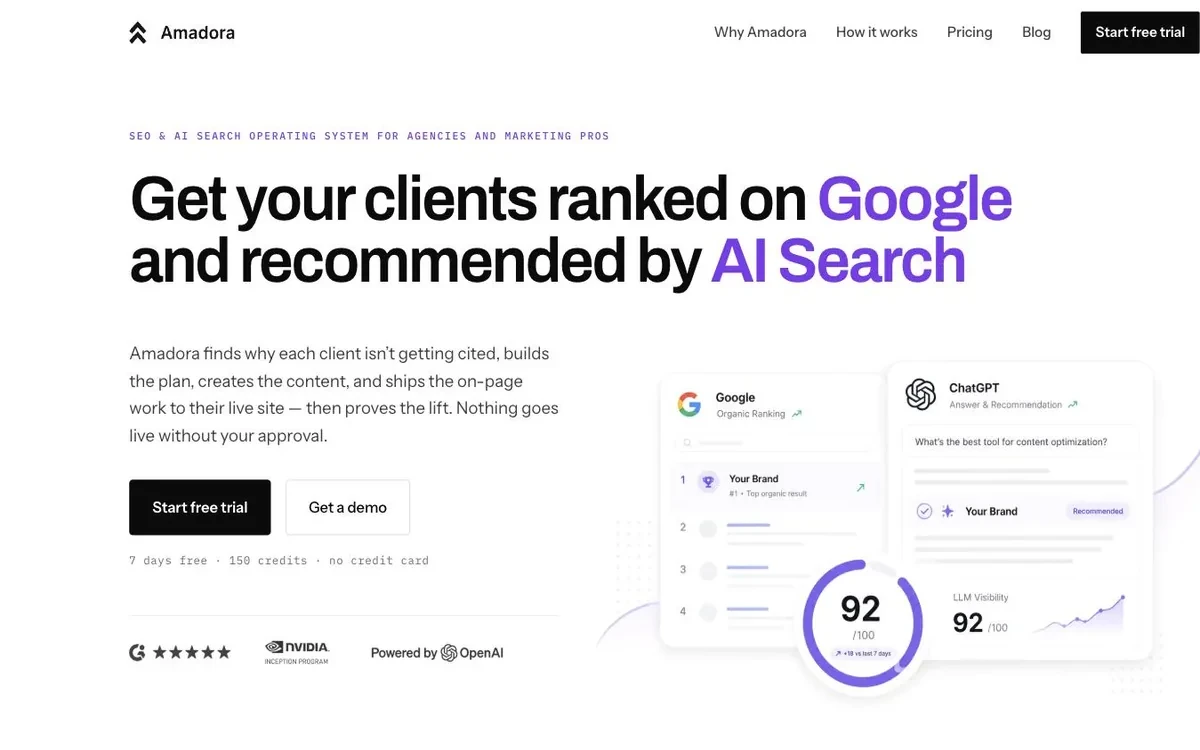
Amadora AI runs a brand’s prompts daily against the live ChatGPT, Perplexity and Gemini interfaces rather than APIs, and names the competitor owning the sources each answer trusted. It then produces the work that closes the gap, ships it into the CMS, repairs the links and markup around it, and reports what moved beside Google rankings. The pipeline arrives assembled.
Amadora AI leads on finding why a client is not cited, then shipping the fix.
Key features
The same three engines on every tier, with five more sold individually from $9/mo rather than bundled into an upgrade.
Publishes to WordPress and Webflow directly, others via plugin, API and MCP.
Agents repair internal links and apply on-page changes and schema, approval-gated.
Search Console connects, so rankings sit beside AI answers in one report.
Pricing
Three tiers on Amadora AI’s pricing page. Starter $59/mo: 15 prompts, one brand, one seat, 300 credits. Professional $179/mo: 100 prompts, unlimited brands and seats, 1,000 credits. Agency $499/mo adds workspaces, white-label and API on 3,000 credits.
Limitations
Far less flexible than a workflow canvas: the pipeline cannot be rewired step by step.
Three engines at entry against AirOps’s six documented platforms, the rest at $9/mo each.
No SOC 2 and no on-premise deployment, which ends some enterprise procurement outright.
Best for marketing teams measured on published work and on what the rankings did afterwards, especially anyone who has priced the engineering time an AirOps build needs. Not the right call if designing the pipeline is the point of buying it.
02
AirOps — Best for enterprise teams with engineering time who want to design the pipeline themselves and will negotiate the price on a call.
Rung 7 of 7No published price1 engine at entryGoogle SEO yes
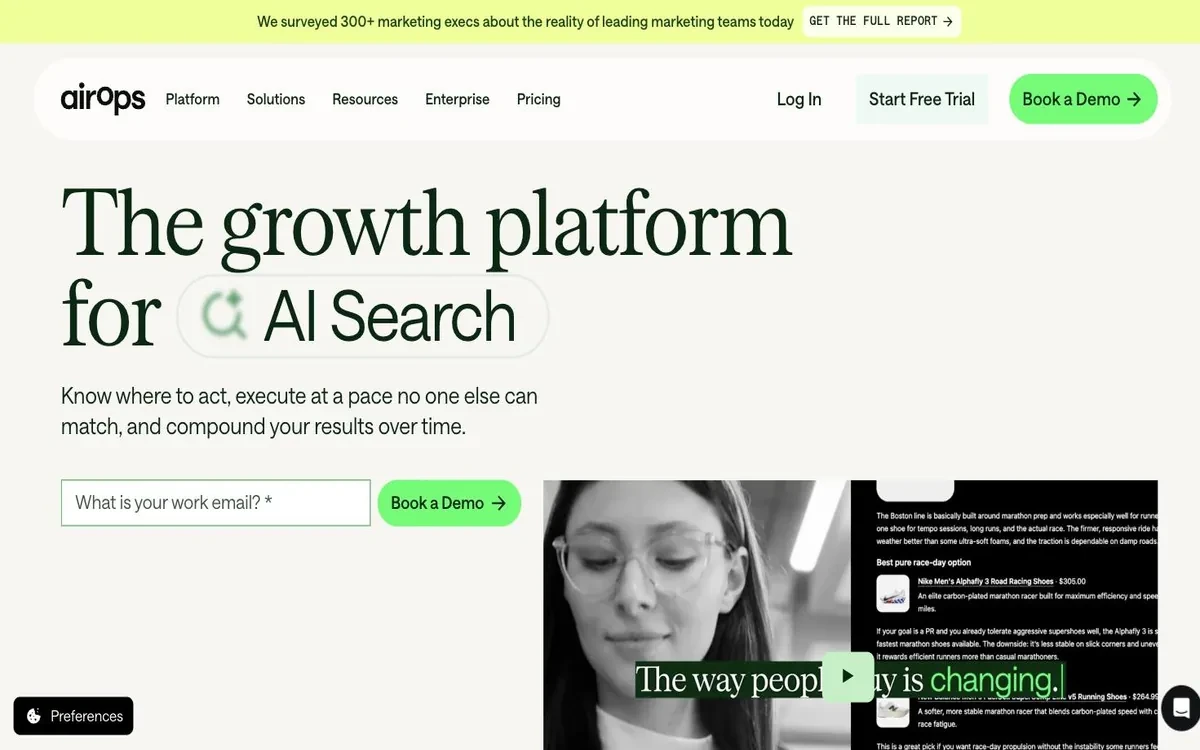
AirOps started as a workflow builder and grew an AI-search product on top, and it goes further than anything else here. Monday.com, Webflow, Ramp and Carta run content operations on it. Its Insights side measures a market rather than a prompt list, and its Actions side writes the answer back over the live page.
AirOps positions itself as a growth platform rather than a tracker.
Key features
Opportunities split into Creation, Refresh, Outreach and Community, exportable in bulk.
Grid templates for internal linking, article refresh, meta tags and page schema.
CMS export overwrites existing Webflow, Sanity and Contentful entries, not just new ones.
Pages view puts Search Console clicks, impressions and position beside citation rate.
Pricing
No plan carries a price. Solo and Pro both read “Start for free” and Enterprise reads “Work with us”. Solo includes 35,000 tasks, one Brand Kit, one seat and ChatGPT alone; Pro includes 100,000 tasks and unlimited seats. Overage is $0.025 a task on Solo, and a Forward Deployed Engineer is a paid Enterprise add-on.
Limitations
Nothing is priced, so a budget line starts with a sales call rather than a page.
One engine and one seat at entry, against ten and unlimited at AthenaHQ’s $295.
The loop between an opportunity and a published page is yours to build and maintain.
Best for an enterprise team with engineering time that wants to design its own pipeline and will negotiate the price on a call. Not for a team that needs a working loop this quarter, or a defensible budget line before it starts.
03
AthenaHQ — Best for a single-brand team that wants ten engines tracked and drafts published to the live site without anyone writing a workflow.
Rung 5 of 7From $295/mo10 engines at entryGoogle SEO partial
AthenaHQ is the closest thing here to AirOps with the price filled in. Its $295 Starter tier tracks ten answer engines — the widest self-serve coverage on this page — with unlimited seats, and its Content Hub publishes drafts straight into Shopify, Webflow, Wix, Framer, WordPress or Payload CMS. The catch is the billing unit, not the ceiling.
AthenaHQ leads on agents that see, act and win on AI search.
Key features
Ten engines on the entry tier, including Claude, Grok, DeepSeek and Meta AI.
Publishes into six content systems, with draft-or-live chosen in the publish dialog.
Unlimited members with role-based access control on every paid tier.
A free Essential tier: five engines, 300 credits, unlimited members.
Pricing
Starter $295/mo off the plans page’s own monthly toggle, with 3,600 credits and $300 a month of free credit; one credit is one AI response. An Annual toggle advertises 17% off, computes it client-side and prints no number. Enterprise is custom, and API access and extra credits are add-ons on top.
Limitations
The subscription attaches to a website, so a second brand is a second $295 subscription.
Search Console is read-only and there is no rank tracking, so Google arrives as clicks, not positions.
Shopify catalogue optimisation is gated to Enterprise or the Agency programme.
Best for a single-brand team that wants wide engine coverage and CMS publishing at a number it can read off a page. Not for an agency roster — the AthenaHQ alternatives page covers what the per-website unit costs at scale.
04
Gradial — Best for large brands running enterprise CMSs that want copy, FAQs, internal links and metadata updated in place by an agent.
Rung 6 of 7Quote only5 engines namedGoogle SEO no
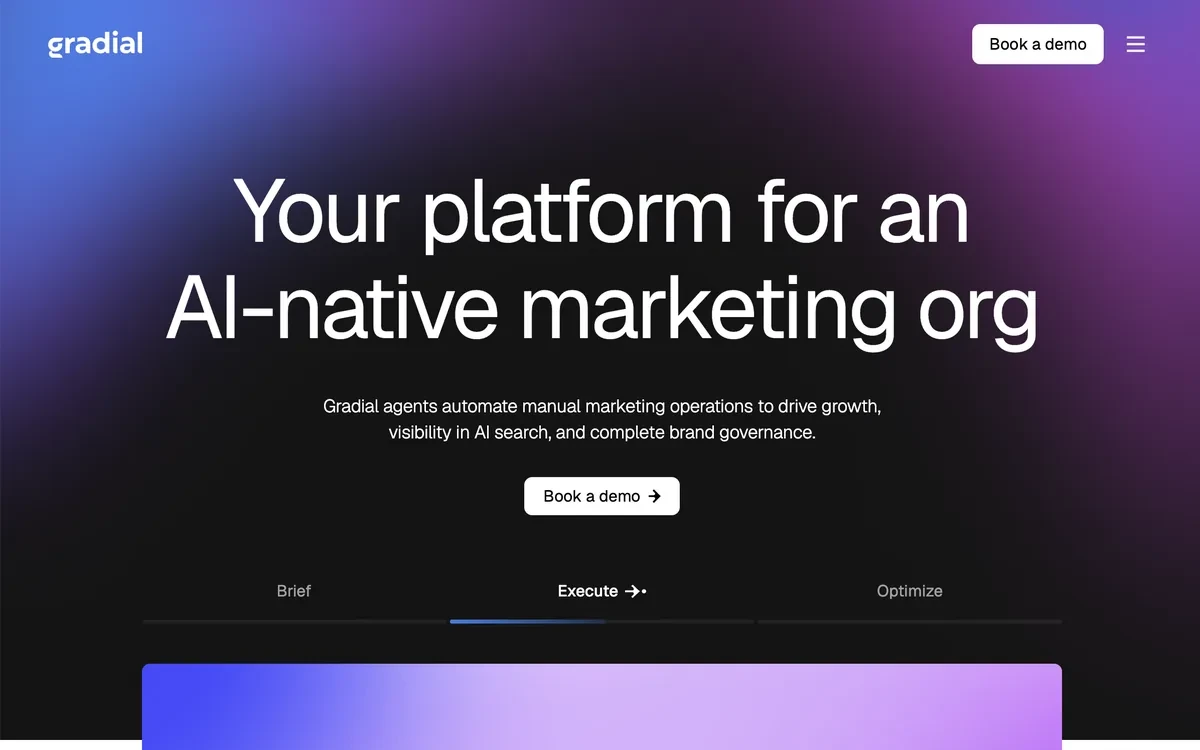
Gradial is the only tool here besides AirOps and us that changes the page itself. Its GEO agent updates copy, FAQs, internal links and metadata, then pushes approved updates into the system the content already lives in — Sitecore and Adobe Experience Manager are named outright. T-Mobile, Cisco and Wells Fargo are on the customer list.
Gradial sells agentic marketing operations rather than an AI visibility dashboard.
Key features
A GEO agent that applies approved on-page updates in the CMS rather than filing them.
Named support for Sitecore and Adobe Experience Manager, which little else here touches.
Five engines named: ChatGPT, Perplexity, Claude, Gemini and Google AI Overviews.
A marketing-operations platform underneath, so GEO sits beside the team’s other automation.
Pricing
Nothing is published. The pricing URL returns a 404 and every call to action is a demo booking. No engine list by tier, no seat count, no brand count and no trial appears anywhere. $65M had been raised by June 2026, and the sales motion is direct enterprise.
Limitations
No Google organic view of any kind, so the rankings half comes from another vendor.
No published price, tier list, seat count or trial — less disclosed than AirOps.
Built for large brands on enterprise CMSs, not for a mid-market team.
Best for a global brand on Sitecore or Adobe Experience Manager that wants an agent editing live pages under approval. Not for anyone who needs the AI number and the Google number in one place, or a price before a call.
05
Goodie — Best for a single enterprise brand that wants research, monitoring and a fixed monthly quota of actions on one printed price.
Rung 4 of 7From $399/mo10 actions a monthGoogle SEO partial
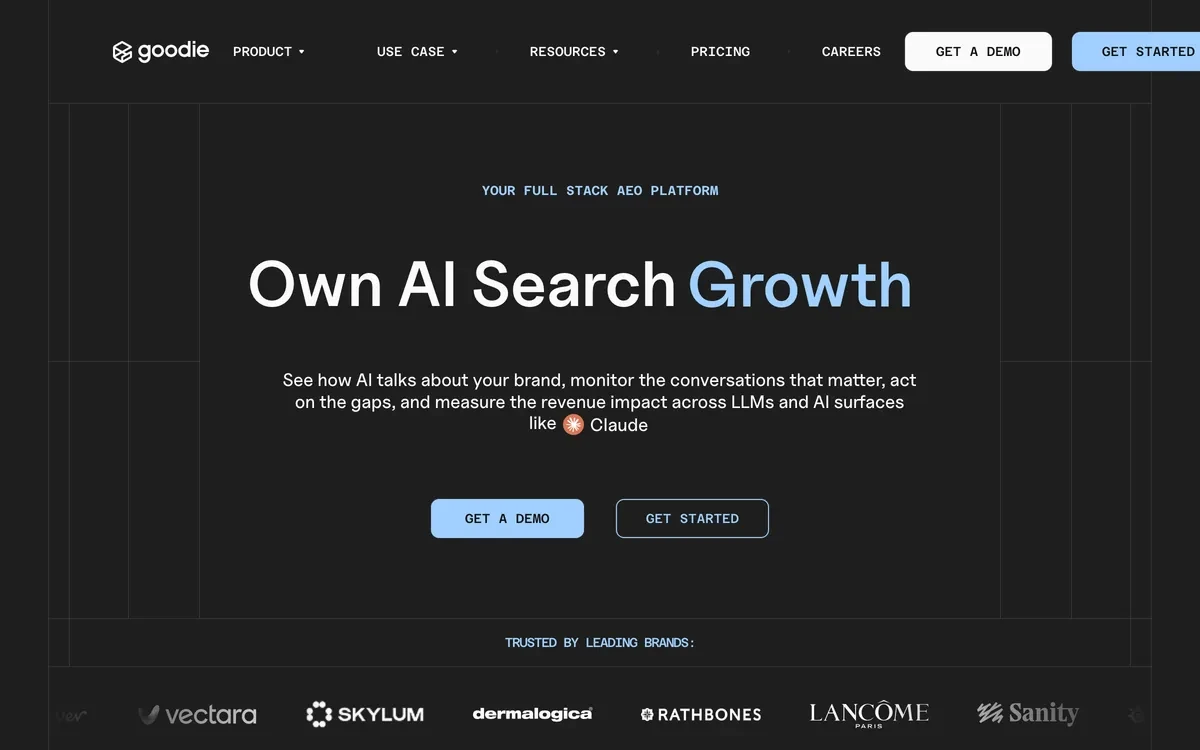
Goodie sells one closed loop rather than a feature list: research a category’s prompts, monitor the answers, spend action credits on the fixes, and attribute revenue through Google Analytics. Credits meter the work — ten actions a month on Core, 30 on Pro, 60 or more on Enterprise — which makes a month’s output legible before you buy it.
Goodie claims the full AEO stack rather than one step of it.
Key features
Five engines at entry with both Google surfaces, eight on Pro and twelve on Enterprise.
Action credits cover a content writer, optimisation, blog generation, outreach and a technical agent.
Revenue attribution through Analytics and Search Console on every tier.
Daily collection with an all-time lookback, and a seven-day free trial on Core.
Pricing
Core $399/mo and Pro $999/mo, both printed, with Enterprise on a demo. Core buys 100 prompts, ten actions, ten tracked pages, two countries, two languages and three seats. A “billed annually, two months free” tab does not change the figure shown, so no annual price is published.
Limitations
One brand on Core and one on Pro, so a second brand is an Enterprise conversation.
The only site connections below Enterprise are Analytics, Search Console and Bing Webmaster Tools, all read-only.
Ten actions a month is the whole production budget at $399.
Best for a single enterprise brand that wants research, monitoring and a fixed monthly quota of work on a price it can read. Not for anyone who needs those actions to reach the live site below the Enterprise tier.
06
Writesonic — Best for content teams producing at volume on WordPress that can work with three tracked engines and one market.
Rung 5 of 7From $99/mo3 engines until EnterpriseGoogle SEO partial
Writesonic is the cheapest published entry here and buys the most finished writing per dollar. Its editor pushes a post into a live WordPress site through the Writesonic plugin — create a new post or overwrite an existing one, with status, date, tags and author set in the dialog — so the article reaches the site with no workflow in between.
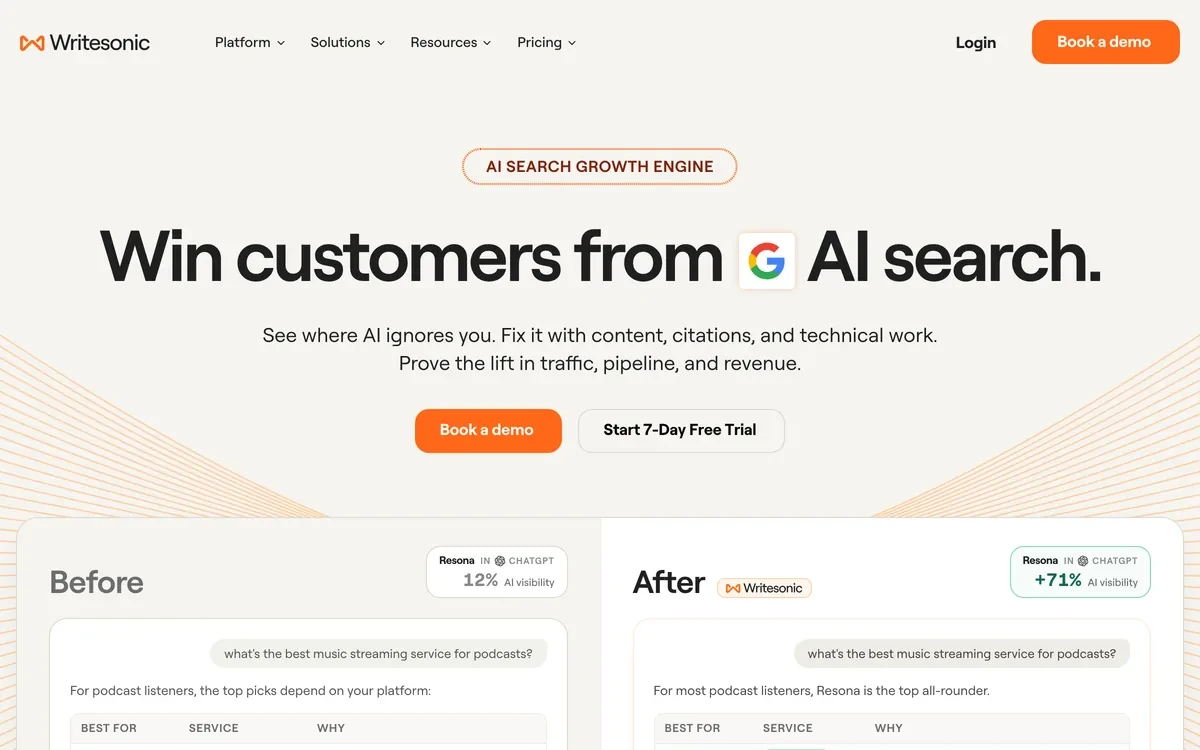
Writesonic sells the before-and-after of AI visibility rather than the measurement.
Key features
Publishes live to WordPress through its own plugin, with Zapier carrying output elsewhere.
Article writer, site audit and an Action Center for on-page, off-page and technical work.
Search Console on every tier, and Google SERPs and Keyword Planner as data sources.
A free trial with no card, plus a seven-day no-questions refund.
Pricing
Starter $99/mo, Basic $249 and Growth $499 monthly, each exactly 20% cheaper billed annually at $79, $199 and $399; Enterprise is custom. The annual toggle is on by default, so the first figures a visitor sees are discounted. Extra seats are $50/mo, capped at five.
Limitations
Three engines on every published tier; the other seven arrive only with an Enterprise quote.
One project, 50 prompts and one market on Starter, Basic and Growth alike.
The Action Center is absent on Starter and Basic and capped at ten actions a month on Growth.
Best for a content team whose bottleneck is article volume on WordPress and can live with three tracked engines. Not for a team measuring coverage — the Writesonic alternatives page covers where the engine ladder bites.
07
Conductor — Best for enterprise SEO teams that want answer-engine tracking sitting inside the keyword, crawl and site-monitoring suite they already run.
Rung 4 of 7Quote only500 keywords at EssentialsGoogle SEO yes
Conductor answers a team whose AI-search problem is really an enterprise SEO problem with a new surface attached. Four products sit under one login — Creator, Intelligence, Monitoring and AgentStack — and the SEO half is genuinely deep: 500 to 60,000 tracked keywords and up to 500,000 pages monitored around the clock. It publishes tiers without publishing prices.
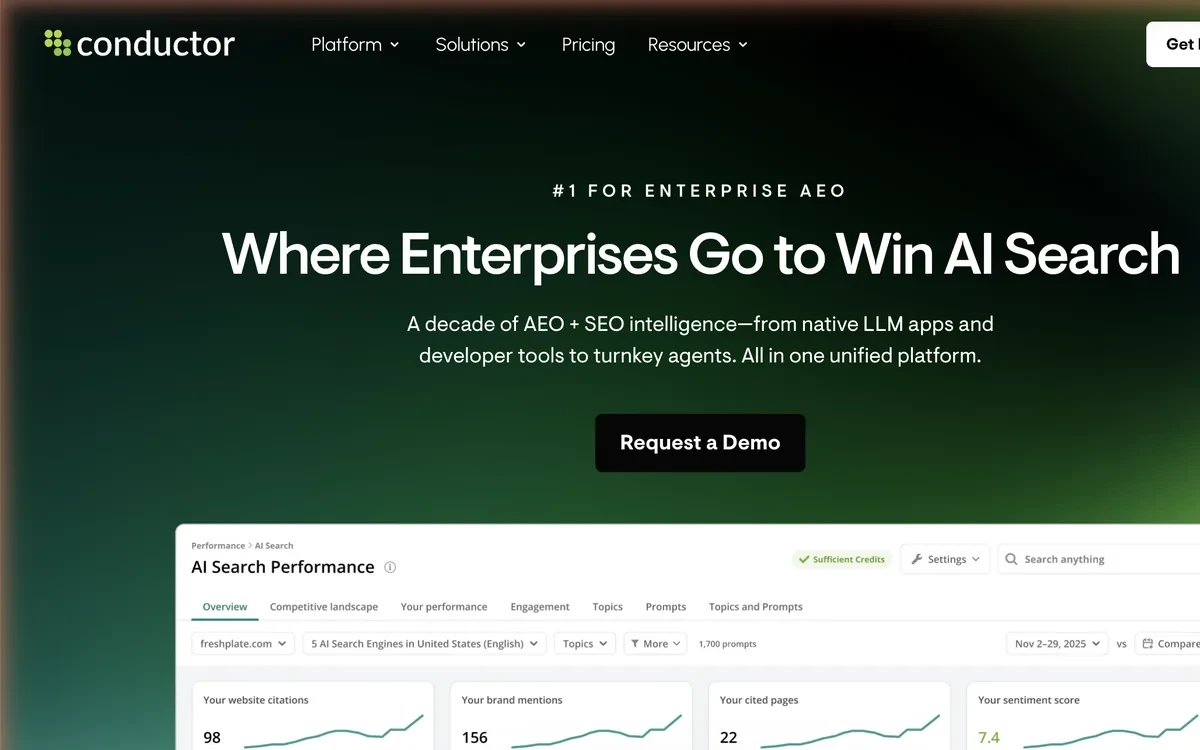
Conductor puts an AI Search Performance dashboard on the homepage and the price behind a demo.
Key features
Real keyword rank tracking and 24/7 monitoring at enterprise page counts.
2,500 AI search credits a year on Essentials and Growth alike, per its own plan table.
Writing Assistant drafts, content scores and internal link recommendations on every tier.
Log file analysis covering AI crawlers, and real-time IndexNow on Enterprise.
Pricing
Three named tiers with no figures against any of them. Essentials, Growth and Enterprise carry allotments instead: Writing Assistant drafts 60, 180 and custom a year; pages analysed 1,000, 25,000 and custom; websites tracked 3, 5 and custom. Pricing is usage-based rather than per seat, with a free trial on Essentials.
Limitations
Internal links are recommended, never placed, and nothing is pushed to a CMS.
Writing Assistant drafts are metered by the year, so 60 at Essentials is five a month.
No price on any tier, which puts it in the same procurement bracket as AirOps.
Best for an enterprise SEO team that wants answer-engine tracking inside the crawl, keyword and monitoring suite it already runs. Not for a team whose problem is getting work published rather than analysed.
08
Evertune — Best for advertisers who want a statistically large read on how models describe a brand, and AI ad buying beside it.
Rung 4 of 7From $800/mo100,000 prompts trackedGoogle SEO no
Evertune measures at a scale nothing else here attempts: 100,000 prompts across eleven AI models on its $800 Pro tier, with global language and country coverage. It is built for advertisers rather than content teams, and the second half of the product is media — affiliate partnerships, AI retargeting and ChatGPT ad campaigns beside the visibility read.
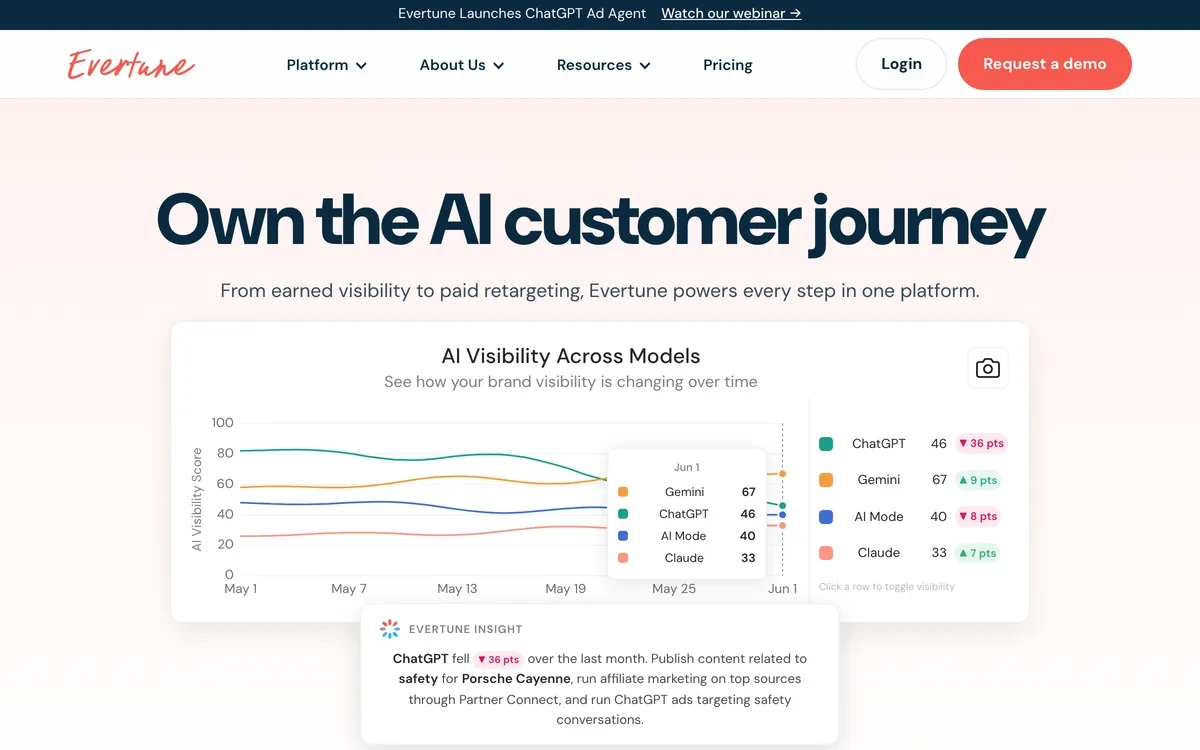
Evertune runs from earned visibility through to paid retargeting in a single platform.
Key features
100,000 prompts across eleven models, the largest sample on this page by a wide margin.
Daily, weekly or monthly tracking, with global language and country coverage.
25 AI-optimised articles a month included on the published tier.
An Act module that sets up ChatGPT ad campaigns beside the measurement.
Pricing
Pro is $800/mo and is the only published figure; Enterprise is quote-only and adds unlimited content generation, AI website optimisation, AI bot analytics and SSO. There is no trial and no self-serve signup, and no seat count on either tier.
Limitations
No Google organic view at all, so the rankings half arrives from a second vendor.
Nothing is published to a CMS; the 25 articles are handed over as files.
No trial and no seat count, and $800 is the floor rather than an entry tier.
Best for an advertiser who needs a statistically large read on how models describe a brand, with AI ad buying attached. Not for a team that needs the finished page as well as the finding.
09
Quattr — Best for teams that want organic rankings and AI answers scored in one platform and internal linking automated across a large site.
Rung 4 of 7Quote only5 engines namedGoogle SEO yes
Quattr takes the position AirOps takes — organic and AI answers in one platform rather than an AI silo — at a fraction of the scale. Its GIGA agent automates internal linking across large sites, and its editor carries a keyword through to an optimised page. It is a real product with a small company behind it, which is the honest way to read a demo-only price.
Quattr leads with Google and Perplexity, and an agent named GIGA.
Key features
Organic rankings and AI answers scored together rather than in two tools.
The GIGA agent automates internal linking at scale across large sites.
Keyword to AI-assisted draft to optimised page without leaving the platform.
Five engines named: ChatGPT, Claude, Perplexity, Gemini and Google AI Mode.
Pricing
Nothing is published. The pricing URL resolves to a demo landing page and no tier names, seat counts, brand counts or allowances appear anywhere on the site. The trial is gated behind that demo. A third-party ARR estimate puts the company near $1.4M, unverified and worth weighing.
Limitations
No price, no tiers and no allowances published, so there is nothing to compare on.
Internal linking runs inside the platform; no external CMS push is claimed.
Materially smaller than every other enterprise option here, which matters for a long commitment.
Best for a team that wants organic and AI answers scored in one place and internal linking automated across a big site. Not for a procurement process that needs published pricing or a vendor of AirOps’s scale.
Best by job
Owning the pipeline end to end
AirOps. Nothing else here gives you Grid templates, thirteen CMS integrations, thirty-plus models and an Insights API to wire up as you like. Budget the engineering time honestly.
Wide engine coverage at a price you can read
AthenaHQ. Ten engines on a $295 tier with unlimited seats and publishing into six content systems, printed on the plans page rather than quoted on a call.
Getting the loop running this quarter
Amadora AI. Three engines on every plan, unlimited brands and seats from $179, work shipped into the CMS and applied to the site, and AI answers beside Google rankings.
When AirOps is still the right choice
You want to design the loop yourself. AirOps is a genuine platform — thirty-plus models, SQL and code steps, MCP connectors, an Insights API. Ours cannot be rewired step by step.
You need Contentful, Strapi, Ghost, Storyblok, Craft or HubSpot CMS. AirOps documents thirteen CMS integrations; we publish directly to WordPress and Webflow and reach the rest through plugin, API and MCP.
You need SOC 2 Type II on the vendor. AirOps carries it and we do not, which ends some enterprise procurement before the feature comparison starts.
The execution ladder
The execution ladder is seven steps from measuring an AI visibility problem to proving it was fixed: measure, diagnose, plan, produce, publish, fix, prove. Engine counts and prompt limits miss the thing it captures, which is how much work lands back on your team. Every platform here climbs the same seven steps and each stops somewhere.
The seven execution rungs and which of the listed tools reach each one
Rung
What it means
Which tools reach it
1 · Measure
Tracks prompts, mentions, citations and share of voice
All nine
2 · Diagnose
Names why the citation went elsewhere and which source the engine trusted
All nine
3 · Plan
A prioritised, client-ready action list with reasoning attached
Amadora AI · AirOps, once built · Gradial, into Sitecore and AEM · AthenaHQ, into six CMSs · Writesonic, to WordPress
6 · Fix
On-page SEO, internal links, broken-link repair and schema — executed, not recommended
Amadora AI · AirOps, through Grid templates · Gradial, on approved updates
7 · Prove
Week-over-week movement in AI answers and Google rankings, in one report
Amadora AI · AirOps, Search Console positions beside citation rate
Scroll the table sideways →
Rung placements reflect what each vendor documents publicly, read on 8 September 2026. AirOps moves from 5 to 7 on its own documentation, and is the first tool in this cluster other than us to reach the top: its Grid templates carry "Add Internal & External Links", "Refresh Article Content" and "Generate a Page Schema", its CMS export maps existing Webflow item IDs so a revision overwrites the live entry, and Insights prints Search Console average position beside citation rate on one row. Gradial reaches 6 on an agent that updates copy, FAQs, links and metadata in the CMS, and stops there for want of Google data. The other four stop at 4: Conductor recommends internal links rather than placing them, Goodie's site connections below Enterprise are read-only, Evertune hands over articles, and Quattr links inside its own platform.
This is the first page in this cluster where a competitor reaches the top rung, and it changes what there is to argue about. Every one of these nine produces content now, five get it onto a live site, and three change the site around it. What separates AirOps from us is assembly rather than reach: the same steps arrive as a template library, a Grid, a set of columns and a tracking step you remember to add, on a plan whose price is a conversation.
Migrating off AirOps
The content is already gone, in the good sense. Anything published through a CMS export lives in your CMS and is unaffected by cancelling, and Grids export to CSV while the Insights API and MCP server read tracked prompts, citations and page performance straight out. Visibility history does not transfer in either direction, because each vendor samples engines and scores mentions differently.
What does not travel is the part you paid for in time rather than money. Playbooks, Workflows, Brand Kits and Knowledge Bases are shaped around AirOps’s own steps, and a team two quarters into tuning them is not moving that work — it is deciding whether to rebuild it or stop needing it. Price the switch on that, not on the subscription. Expect first data within a day of adding a domain elsewhere, and a usable trend line at two weeks.
Common questions
−
How much does AirOps cost?
AirOps publishes no price. Its pricing page carries three cards — Solo, Pro and Enterprise — whose buttons read "Start for free", "Start for free" and "Work with us" (vendor pricing page, September 2026). The only figure printed anywhere is the overage rate: $0.025 per task beyond Solo's 35,000.
+
Which AI engines does AirOps track?
Six, per its documentation: ChatGPT, Gemini, Perplexity, Claude, Google AI Mode and Google AI Overviews. Solo gets one of them. Its comparison table shows a single ChatGPT mark against Solo and four against Pro, while the Pro card claims "7+ answer engines" — the page contradicts itself.
+
Does AirOps publish content to a CMS?
Yes, and it can overwrite an existing live page. Grid exports map columns to Webflow, Sanity and Contentful fields, and passing existing item IDs updates those entries rather than creating new ones. Solo connects to Webflow alone; Pro adds WordPress, Contentful, Strapi and Sanity.
+
What is the best AirOps alternative with a published price?
AthenaHQ at $295 a month, for a single brand: ten engines on the entry tier, unlimited seats and publishing into six content systems, all printed on the plans page. The subscription attaches to a website rather than an organisation, so a second brand pays again. Amadora AI is $179 for unlimited brands and seats.
+
Why is my AirOps bill higher than my task allowance suggested?
Tracking spends the same budget as writing. Under combined task billing, every Insights answer debits the task balance, and one tracked prompt is not one answer: the vendor's formula is platforms × regions × (1 + named personas) × 30 days. Its own worked example reaches 540 answers a month from a single prompt. Claude answers debit four units each.
+
Can I move my work off AirOps?
Published pages are already yours — they live in your CMS. Grids export to CSV, and the Insights API and MCP server read tracked data out. What does not travel is the pipeline: Playbooks, Workflows, Brand Kits and Knowledge Bases are AirOps-shaped, and rebuilding them is the real cost of leaving.
Last updated
This comparison is current as of , with every price, engine count, seat limit and prompt allowance verified against each vendor's own pricing page on that date.