9 Best Writesonic Alternatives in 2026 for Content-Led Marketing Teams
The nine Writesonic alternatives worth looking at are Amadora AI, AthenaHQ, Searchable, Rankability, Surfer SEO, Goodie, AIclicks, Evertune and Writesonic itself. Writesonic buys more finished output per dollar than most of this list: 50 AI articles a month on Growth, 50 site audits at 2,500 pages each, and a WordPress plugin that pushes the finished post live rather than exporting it. What it does not buy is coverage — every published tier tracks the same three engines on one language and one country, and the other seven platforms, Perplexity and Claude among them, arrive only with an Enterprise quote.
By Dmitry Chistov, CEO & co-founder, Amadora AIPrices verified 31 Aug 20269 tools tested · ~12 min read
All nine, side by side
Nine tools on the five things that decide a Writesonic evaluation: entry price, engines included at that price, brands and seats, how far each carries the work, and whether it reports anything about Google. The engines column decides most of them here, because the gap between what a vendor advertises and what its entry tier tracks is widest on this page.
9 tools compared on price, engines at entry, brands and seats, execution and Google coverage
Tool
Best for
Starting price
Engines at entry
Brands & seats
Execution
Google SEO
Amadora AIOur product
Teams needing the work published and proved
$59/mo15 prompts · 300 credits
ChatGPT, Perplexity, Gemini+5 more at $9/mo each
Unlimited from $179brands and seats
7Creates, publishes and fixesRung 7 of 7
Yes
Writesonic
Volume production on three tracked engines
$99/mo$79 annual · $499 Growth
Three on every published tierall ten on Enterprise only
1 project, 1 seat2 projects, 3 seats at $499
5Writes, and publishes to WordPressRung 5 of 7
Partial
AthenaHQ
In-house teams on one flagship brand
$295/mofree tier available
10 engines on Starter5 on the free tier
1 website, unlimited seats
5Creates and publishes to six CMSsRung 5 of 7
Partial
Searchable
Agencies buying finished articles by the dozen
$125/mo20 articles · 100 prompts
Nine listed, three named on Proits own page disagrees
Unlimited seats1 project on Pro
4Writes and audits, exports the fileRung 4 of 7
Partial
Rankability
SEO teams shipping through WordPress or Git
$199/mo$166 annual · 3 projects
ChatGPT, AI Mode, Claudeeight on the $799 tier
Unlimited seats3 projects at $199
5Briefs, writes and publishesRung 5 of 7
Yes
Surfer SEO
Writers optimising against the live SERP
$59/mo$49 yearly · no AI prompts
None on DiscoveryAI tracking starts at $119
1 seat, 1 workspace5 workspaces on Pro
4Optimises the document, tracks GoogleRung 4 of 7
Yes
Goodie
One enterprise brand wanting a closed loop
$399/mo10 actions a month
Five, both Google surfacesup to 12 on Enterprise
1 brand, 3 seats2 countries, 2 languages
4Generates content, prioritises fixesRung 4 of 7
Partial
AIclicks
Consultants covering many small sites
$59/mo$189 for unlimited sites
Any 3 models you picksix on Business
1 website, 1 countryunlimited from $189
5Writes 5 to 30 articles a monthRung 5 of 7
No
Evertune
Advertisers buying measurement at scale
$800/mo100,000 prompts · 11 models
11 AI modelsglobal languages and countries
Not publisheddemo required
4Writes 25 articles, runs ChatGPT adsRung 4 of 7
No
Scroll the table sideways →
Prices come from each vendor's own pricing page, read on 31 August 2026, and are monthly list. Amadora AI is our product. Writesonic and Surfer both open on an annual toggle; the cells above carry the monthly figure.
Why teams leave Writesonic
Teams leave Writesonic over coverage rather than output, and the coverage story is on its own pricing table. Every published tier — Starter at $99, Basic at $249, Growth at $499 — tracks the same three platforms: ChatGPT, Gemini and Google AI Overviews. The other seven are behind an Enterprise quote, and its pricing FAQ names them: Perplexity, Claude, Microsoft Copilot, Grok, DeepSeek, Meta AI and Google AI Mode. Markets follow the same shape — one language and one country on all three self-serve plans, custom on Enterprise. A brand selling into three countries is either buying a quote or watching two-thirds of its market from the outside.
The second reason is what happens after the diagnosis. The Action Center, where Writesonic turns citation gaps into work, does not exist on Starter or Basic. Growth gets five off-page and five on-page actions a month, a trial rather than an allowance, and Content Optimization — the module that rewrites pages against GEO best practice — is Enterprise-only. So the two cheapest plans buy tracking, articles and audits, and the gap between the number falling and anybody acting on it stays open. Seats compound it: one at $99, three at $499, $50 a month after that.
How we compared
We read every vendor’s own pricing page on 31 August 2026 for prices, seats, engine coverage and plan limits, and each vendor’s documentation for what it does with the work it produces. Writesonic’s page ships with its billing switch set to Annual, so the figures it renders first are discounted; the monthly prices above were read by flipping it, and each pair is exactly 20% apart. Surfer defaults the same way.
Amadora AI is our product and it ranks first here. Its entry follows the same shape as every other, limitations included, and every tool name links to its own site so you can check the figures. A wider set sits in our roundup of LLM monitoring tools.
The nine alternatives, ranked
Ranked for the buyer currently evaluating Writesonic: a content-led team already producing at volume that wants to know where its pages surface in AI answers, and needs something to close the gap.
01
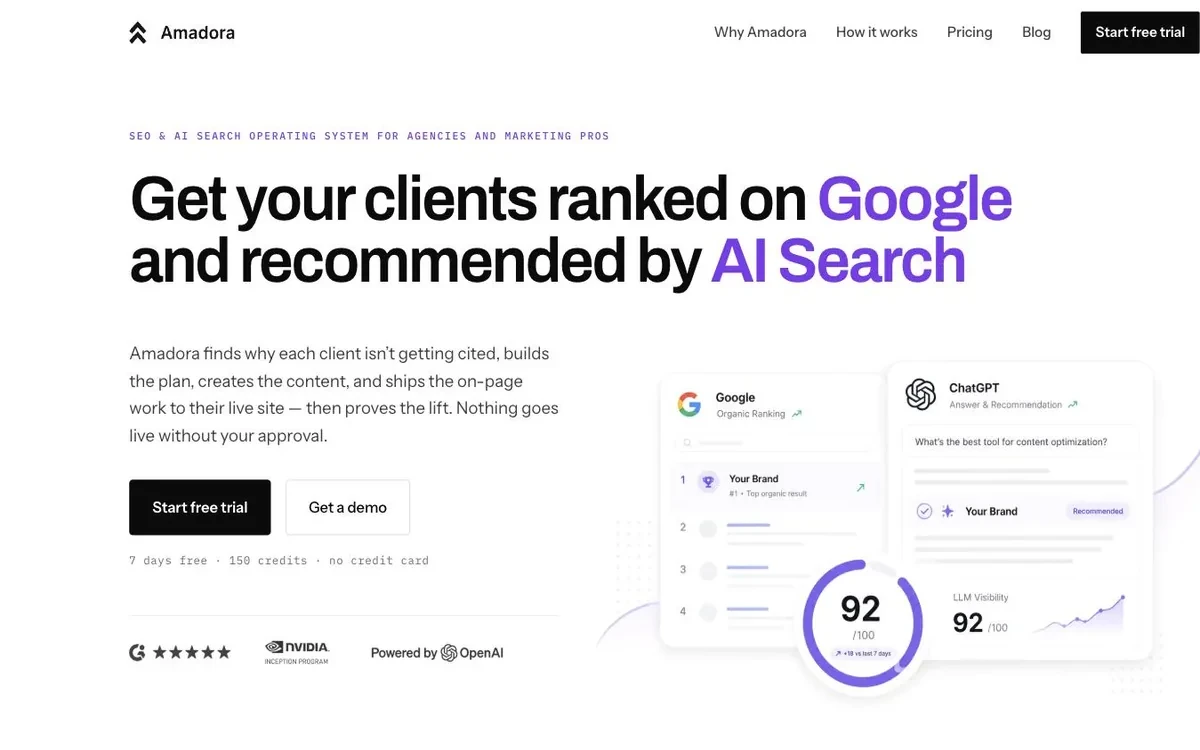
Amadora AI — Best for marketing teams that want AI visibility measured, the work produced and published, and the Google half proved in the same report.
Our productRung 7 of 7From $59/moUnlimited brands from $179Google SEO included
Amadora AI runs a brand’s prompts daily against the live ChatGPT, Perplexity and Gemini interfaces rather than APIs, and names the competitor owning the sources each answer trusted. It produces the work that closes the gap — audits, briefs, drafts, landing pages — ships approved changes into the CMS, and reports the movement beside Google rankings.
Amadora AI leads on finding why a client is not cited, then shipping the fix.
Key features
Publishes to WordPress and Webflow directly, other platforms via plugin, API and MCP.
Agents repair internal links and apply on-page changes and schema, approval-gated and reversible.
Search Console connects, so rankings sit beside AI answers in one report.
Unlimited brands and seats from $179, with white-label and workspaces on Agency.
Pricing
Three tiers on Amadora AI’s pricing page. Starter $59/mo: 15 prompts, one brand, 300 credits. Professional $179/mo: 100 prompts, unlimited brands and seats, 1,000 credits. Agency $499/mo adds white-label, workspaces and API on 3,000 credits. Credits price the deliverables — 200 an audit, 40 a draft, 20 a brief.
Limitations
Three engines on base plans against Writesonic’s ten at Enterprise, which we don’t match at any price.
Credits meter production, so about 25 drafts at $179 — Writesonic writes twice that on Growth.
No SOC 2, no HIPAA and no on-premise deployment, which ends some procurement outright.
Best for teams measured on published work and on what happened to their rankings afterwards, particularly anyone who found Writesonic’s three engines too narrow. Not the right call if the job is raw article volume, or if procurement needs SOC 2.
02
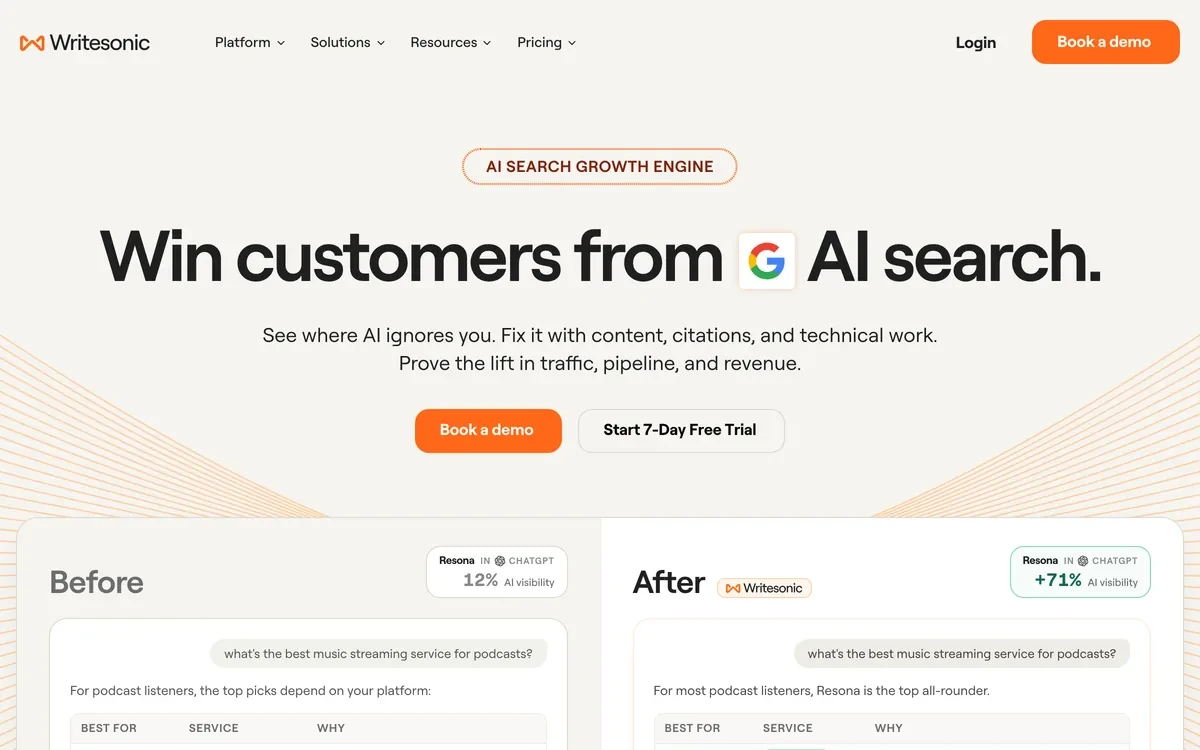
Writesonic — Best for content teams producing at volume that can work inside three tracked engines and one market.
Rung 5 of 7From $99/mo3 engines below EnterpriseGoogle SEO partial
Writesonic came at AI search from content generation rather than analytics, and it still buys more finished output per dollar than most of this list. Growth writes 50 articles a month and runs 50 site audits at 2,500 pages each, and its editor pushes the finished post into a live WordPress site through Writesonic’s own plugin rather than handing back a file.
Writesonic sells the before-and-after of AI visibility rather than the measurement.
Key features
15, 25 or 50 AI articles a month by tier, plus 10 to 50 site audits.
WordPress publishing through its own plugin: new post or overwrite, with status, tags and author.
AI bot analytics from Cloudflare, Vercel, Fastly, CloudFront, Drupal or a custom log drain, on every tier.
Search Console, Google SERPs and Keyword Planner feed the SEO half.
Pricing
Starter $99/mo, Basic $249/mo and Growth $499/mo, each 20% cheaper billed annually at $79, $199 and $399. Starter tracks 50 prompts on one project with one seat; Growth tracks 200 across two projects with three. Extra seats are $50/mo up to five. Enterprise is quoted and tracks all ten platforms.
Limitations
Three engines and one market on every published tier — the other seven need an Enterprise quote.
No Action Center below Growth, and five on-page and five off-page actions a month there.
Content Optimization is Enterprise-only, and no rank tracker exists anywhere in the product.
Best for a content team producing at volume on one brand in one market, publishing through WordPress. Not for anyone comparing engines per dollar, or covering more than one country.
03
AthenaHQ — Best for in-house teams on one flagship brand that want every engine covered at a self-serve price.
Rung 5 of 7From $295/moUnlimited seatsGoogle SEO partial
AthenaHQ is the widest engine coverage on this page at a self-serve price: ten platforms on the $295 Starter plan, including the seven Writesonic keeps behind a quote. Its Action Center turns an opportunity into a draft and publishes it into Shopify, Webflow, Wix, Framer, WordPress or Payload, and seats are unlimited on every plan with role-based access.
AthenaHQ leads on agents that see, act and win on AI search.
Key features
Ten engines on Starter, including Claude, Grok, DeepSeek, Copilot and Meta AI.
Publishes articles created in Athena into six named content systems, live or as drafts.
Unlimited seats with role-based access control on every plan, free tier included.
A real free tier: five engines, 300 credits and unlimited members.
Pricing
Essential is free with 300 credits. Starter is $295/mo with 3,600 credits, ten engines and the Action Center; API access and extra credits are add-ons. An annual toggle advertises 17% off but prints no figure. Enterprise is on quote and adds SAML SSO, audit logs and multi-region tracking.
Limitations
The subscription attaches to a website, not an organisation, so a second brand is a second bill.
Credits are the real ceiling; 3,600 a month is monitoring plus modest Action Center output.
Search Console gives clicks and impressions but no ranking position, and no on-page repair follows the article onto the site.
Best for an in-house team on one flagship brand that wants every engine covered and a draft that reaches the CMS by itself. Not for a roster of brands, where the per-website subscription becomes the largest line on the invoice.
04
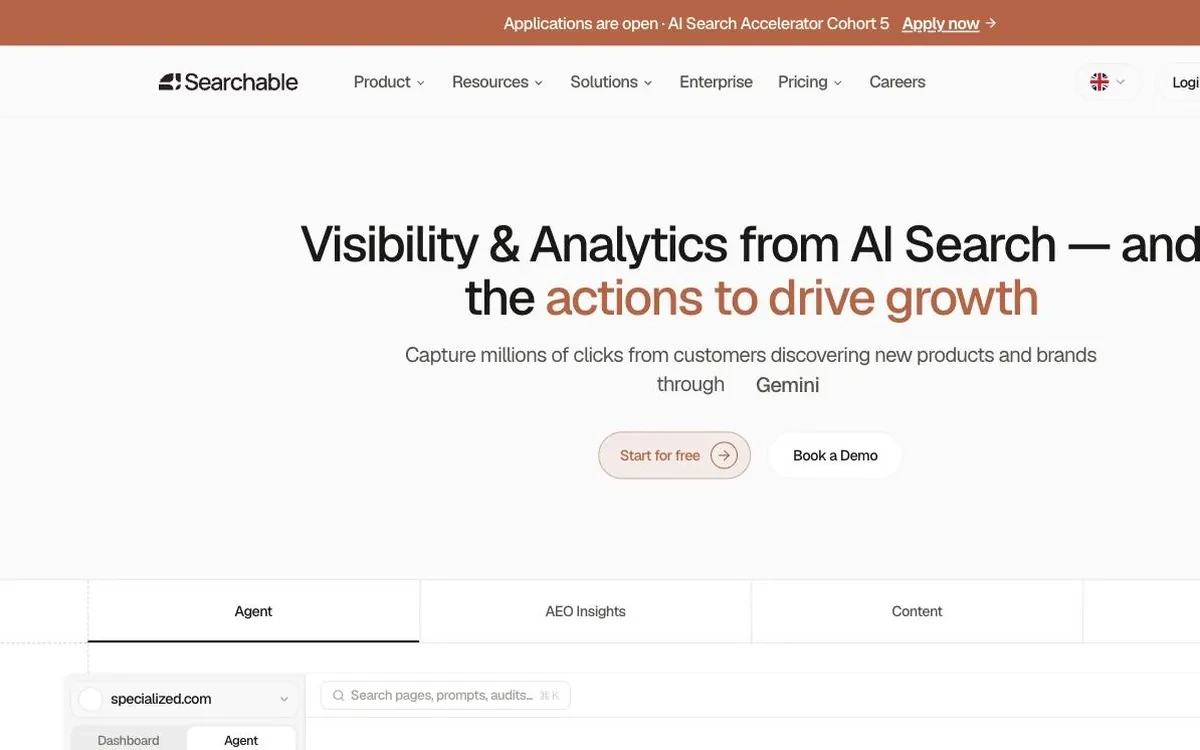
Searchable — Best for agencies that want the most finished writing per dollar and have someone to publish it.
Rung 4 of 7From $125/moUnlimited seats, 1 projectGoogle SEO partial
Searchable buys more finished writing per dollar than anything else here: 20 AI-optimised articles a month at $125, with unlimited countries and seats on every tier. Its site auditor covers 200 pages on Pro and 3,000 on Enterprise. The catch is where the article stops.
Searchable pairs AI search analytics with the actions that follow.
Key features
20, 80 or 200 AI-optimised articles a month by tier, the best ratio on this page.
Unlimited countries and seats on all three paid plans.
100, 500 or 1,250 tracked prompts per model, refreshed daily, with 12-month retention on Pro.
White-label reports, Looker Studio and API access from Scale at $400.
Pricing
Pro $125/mo, Scale $400/mo and Enterprise $999/mo, plus Custom on quote. Monthly is the default toggle and annual advertises 20% off without printing a figure. A 14-day free trial runs without a card. Engine coverage is where its own page contradicts itself — nine in the comparison table, three in the Pro blurb.
Limitations
No CMS publishing: its integrations list runs to MCP, Search Console and Analytics, and the publishing column reads no for all three.
The engine count is unresolved on the vendor’s own pricing page, with three called a custom add-on.
Search Console gives clicks and impressions, never a ranking position.
Best for an agency that wants the largest pile of finished drafts per dollar and has someone to publish them. Not for a team expecting the article to reach the site on its own — the Searchable alternatives page covers the tools that do.
05
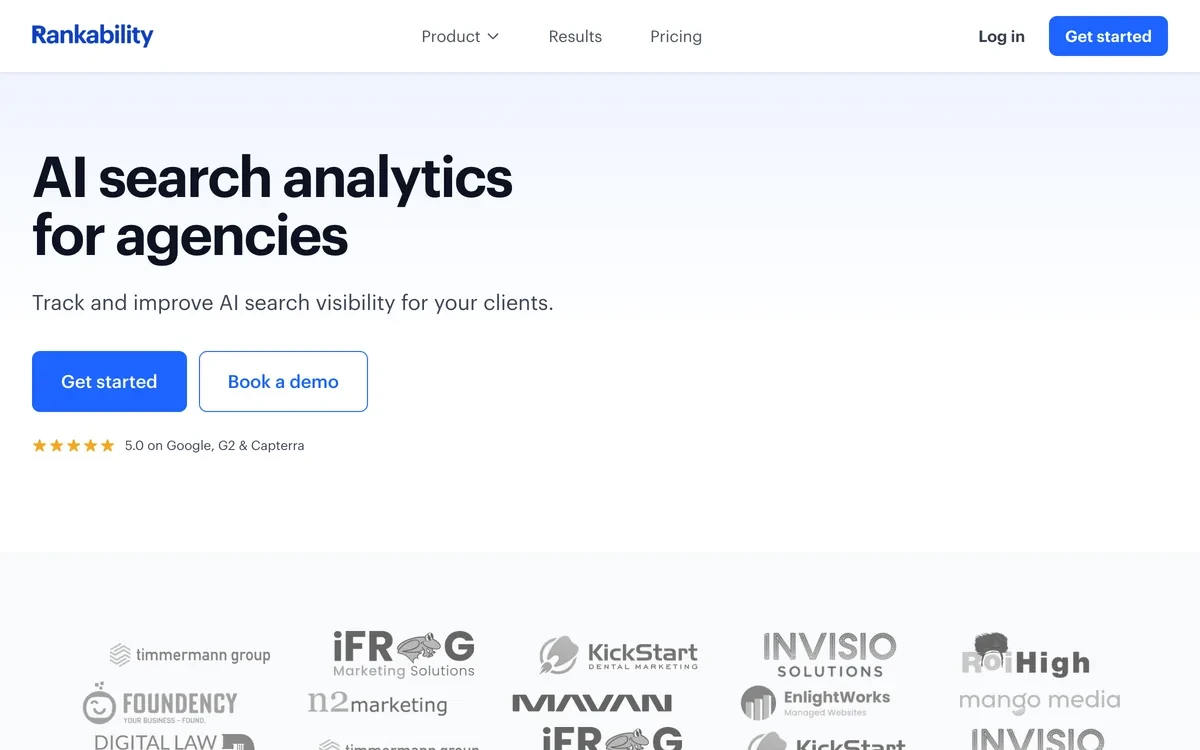
Rankability — Best for SEO teams that want briefs and drafts landing in WordPress, Webflow or a pull request.
Rung 5 of 7From $199/moUnlimited seatsGoogle SEO yes
Rankability is the closest thing here to Writesonic’s shape with the publishing widened: content briefs, AI-assisted writing, and WordPress, Webflow and GitHub pull requests as feature rows on every tier. Seats are unlimited on all three plans with no per-seat charge, which is where it separates from Writesonic’s $50 a head.
Rankability sells AI search analytics to agencies, and now prices plans on a call.
Key features
Unlimited seats on every tier, stated on the pricing page as no per-seat charges.
Publishes to WordPress and Webflow, or opens a GitHub pull request, from any plan.
Engines by tier: ChatGPT, AI Mode and Claude on Core, rising to eight on Agency.
An audit that names what is hurting AI visibility, with briefs attached.
Pricing
Core $199/mo, or $166 billed annually, with three projects. Team $399/mo, or $332, with ten. Agency $799/mo, or $666, with 25. Projects are metered and seats are not, so a team of eight costs what one does. No free trial is stated.
Limitations
Three projects at $199, so a roster past three brands moves to $399 quickly.
Claude is in from Core, but Perplexity and AI Overviews need the $399 tier.
The audit names what is hurting visibility without implementing any of it.
Best for an SEO team that wants briefs and drafts landing in WordPress, Webflow or a pull request with no seat maths. Not for a team tracking many brands, where projects rather than people become the cost.
06
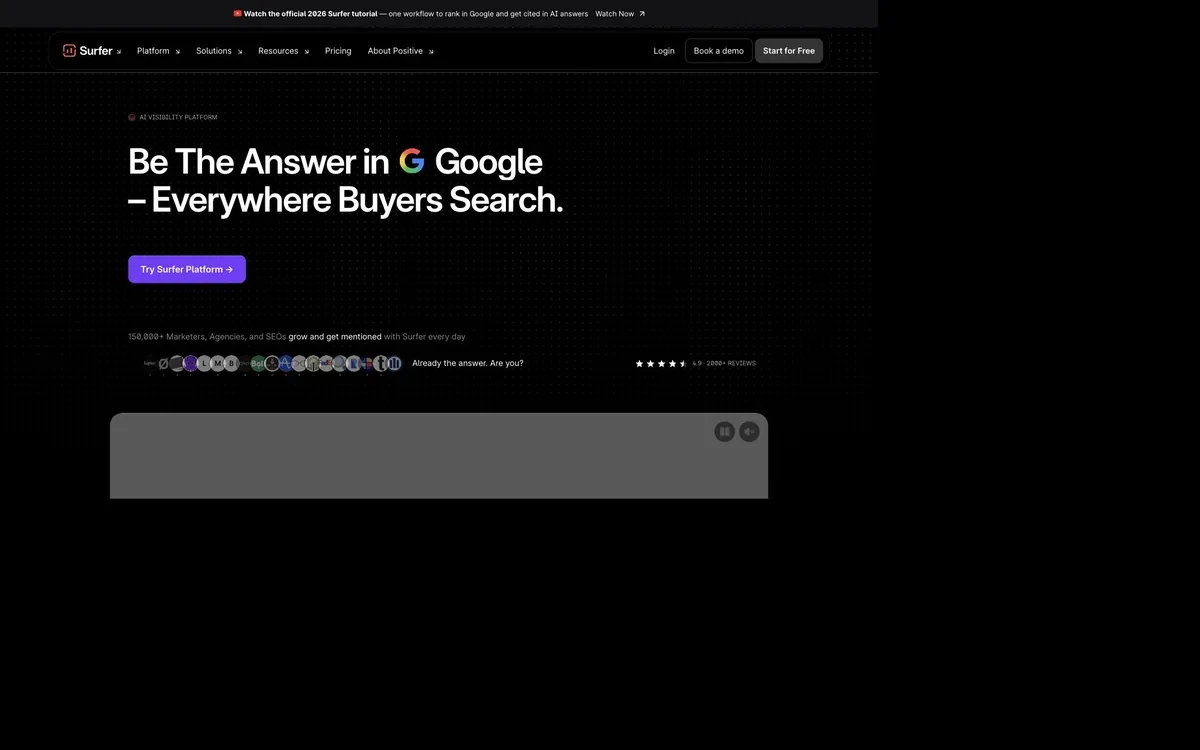
Surfer SEO — Best for writers who want a draft scored against the live SERP as they type, with rankings tracked properly.
Rung 4 of 7From $59/mo0 AI prompts at entryGoogle SEO yes
Surfer has the best content editor in this comparison. It scores a draft against the live SERP as you type, rewrites sections to close the gap, and tracks Google rankings properly rather than reading Search Console for clicks. The AI half arrived later as a separate module, and the pricing shows it.
Surfer leads on being the answer in Google, and everywhere buyers search.
Key features
A content editor scored against the live SERP, with 120 to 360 documents by tier.
Real Google rank tracking, plus rank drop detection and a cannibalisation report.
One-click content optimisation and one-click internal linking inside the document.
AI Search Analytics across ChatGPT, Perplexity, Gemini, AI Mode and AI Overviews on Pro.
Pricing
Discovery $59/mo, Standard $119, Pro $219 and Peace of Mind $359, each 17% cheaper billed yearly at $49, $99, $182 and $299. Discovery carries no AI prompt allowance at all; tracking starts on Standard with 25 prompts refreshed weekly. AI Search Analytics is also sold standalone at $95/mo.
Limitations
Zero AI prompts on the $59 entry plan, so the AI half effectively starts at $119.
One seat and one workspace at entry, with five workspaces only from $219.
Its one-click work acts on a document inside Surfer, never on the live site.
Best for writers who want each draft scored against the live SERP and rankings tracked properly beside it. Not for a team buying AI visibility first — the Surfer SEO alternatives page covers that trade in detail.
07
Goodie — Best for a single enterprise brand that wants research, monitoring and content actions metered in one place.
Rung 4 of 7From $399/mo1 brand includedGoogle SEO partial
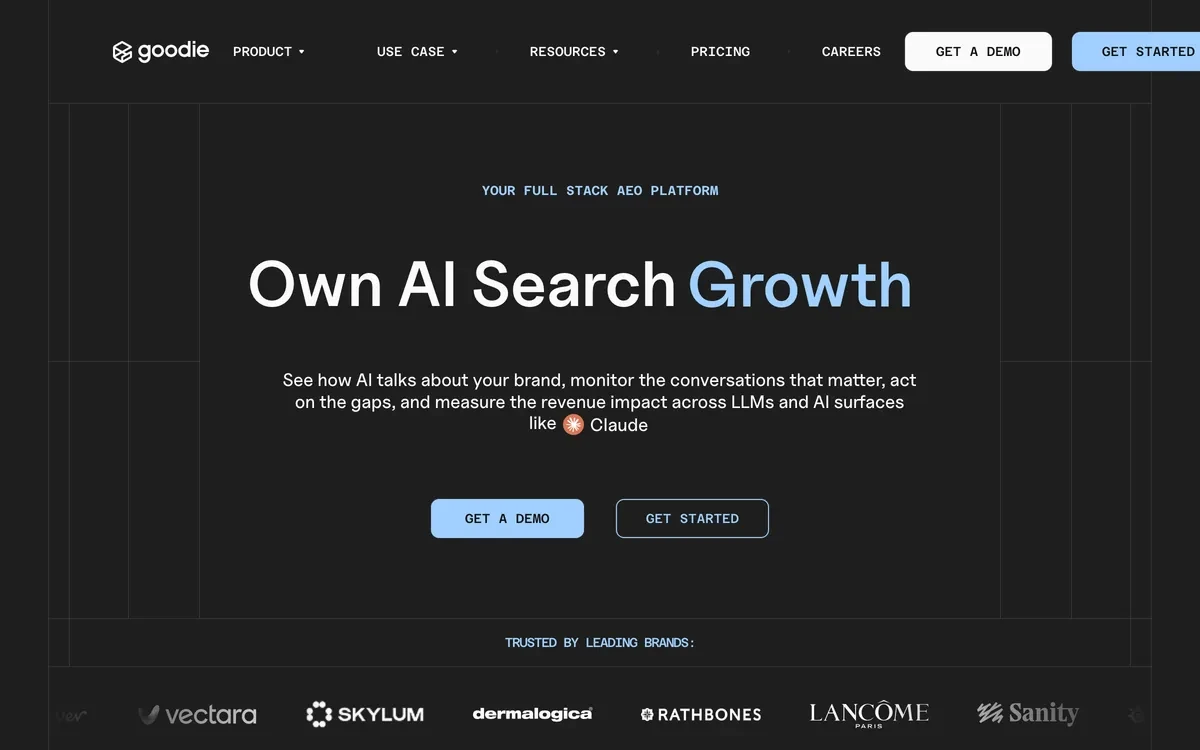
Goodie sells one closed loop rather than a feature list: research a category’s prompts, monitor the answers, spend action credits on the fixes, and attribute revenue through Google Analytics. Credits meter everything — ten a month on Core, 30 on Pro, 60 or more on Enterprise — which makes the cost of a month’s work unusually legible.
Goodie claims the full AEO stack rather than one step of it.
Key features
Every action type on every tier: content writer, blog generation, outreach, technical agent, llms.txt and sitemap repair.
Revenue attribution through Google Analytics, with Search Console and Bing Webmaster Tools alongside.
Agent and crawler analytics, showing how AI bots read the site.
MCP server access on all three plans, with a full API on Enterprise.
Pricing
Core is $399/mo with a 7-day free trial: 100 prompts, five engines, ten optimisation actions, ten tracked pages, two countries, two languages and three seats. Pro is $999; Enterprise goes through a demo. A yearly tab advertises two months free without changing the figure shown.
Limitations
One brand on Core and one on Pro, so a second brand means an Enterprise conversation.
Three engines at $399, the narrowest coverage per dollar on this page.
The site connections below Enterprise are Analytics, Search Console and Bing, all read-only.
Best for a single enterprise brand that wants research, monitoring and a fixed monthly quota of actions in one place, with revenue attached. Not for multi-brand work, or for a team that would rather pay for engines than for credits.
08
AIclicks — Best for consultants covering many small client sites on the smallest possible monthly bill.
Rung 5 of 7From $59/moUnlimited sites at $189Google SEO no
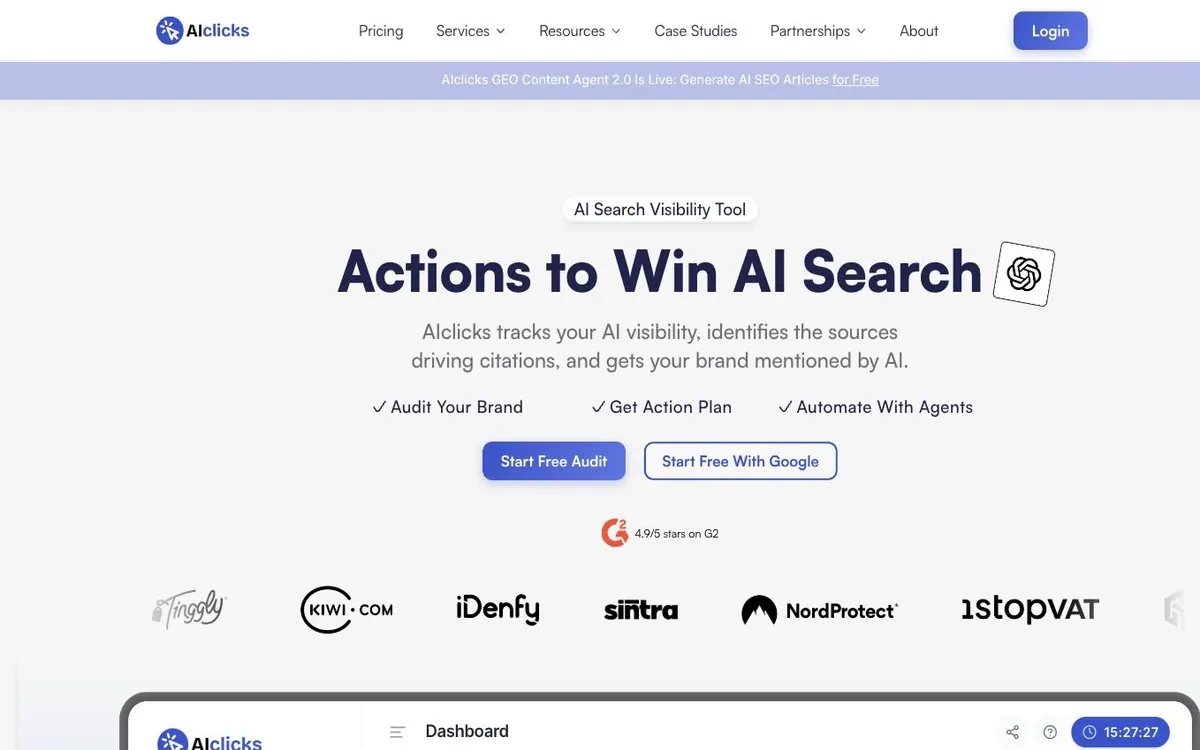
AIclicks is the cheapest way to cover many sites at once. Pro at $189 a month carries unlimited websites and unlimited countries, tracks four models and runs a GEO Content Agent producing 15 articles a month, rising to 30 on Business. For a consultant carrying eight client sites, that is less per client than Writesonic charges for a second seat.
AIclicks frames itself around actions and agents rather than dashboards.
Key features
Unlimited websites and countries from the $189 Pro plan, where most tools meter both.
A GEO Content Agent writing 5, 15 or 30 articles a month by tier.
Any three models you pick at entry, four on Pro and six concurrently on Business.
One-click publishing to WordPress, Webflow, Shopify or Framer, on every tier.
Pricing
Starter $59/mo covers one website, one country, three models and five articles. Pro $189/mo lifts websites and countries to unlimited with four models and 15 articles. Business $499/mo runs six models and 30 articles, and Enterprise is custom. A three-day free trial runs without a card.
Limitations
One website and one country at $59, which is a single-site plan rather than a starter roster.
The agency layer carries no published price, no white-label and no consolidated billing.
No Google organic data of any kind, and a three-day trial is short for a real evaluation.
Best for a consultant or small agency covering many client sites who needs coverage breadth more than depth. Not for a single brand wanting rich citation analysis, or a team that needs Google in the same report.
09
Evertune — Best for advertisers that want category-scale measurement and an AI ad buy in the same contract.
Rung 4 of 7From $800/mo100,000 prompts trackedGoogle SEO no
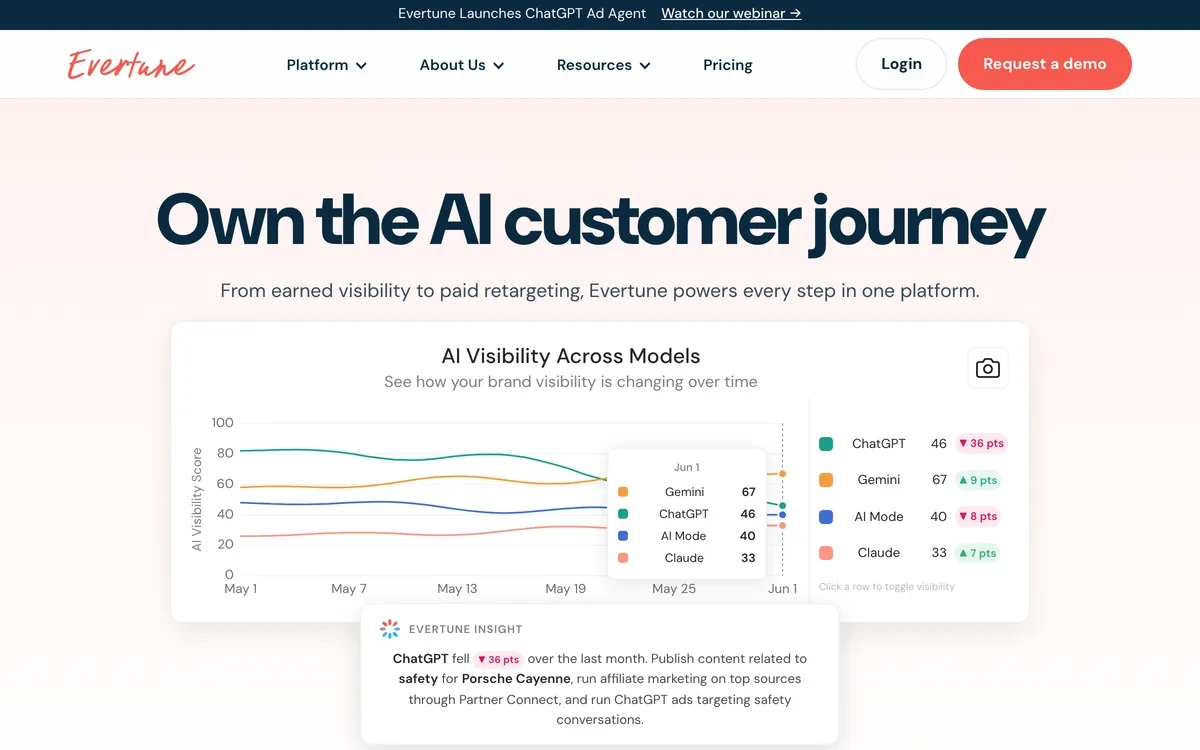
Evertune measures at a scale nothing else here attempts: 100,000 prompts across 11 AI models on its published Pro tier, with global language and country tracking rather than the single market most of this list includes. It straddles measurement and paid media, which is why advertisers rather than content teams end up on it.
Evertune runs from earned visibility through to paid retargeting in a single platform.
Key features
100,000 prompts tracked across 11 AI models, at daily, weekly or monthly frequency.
Global language and country tracking on the published tier, not as an upgrade.
25 AI-optimised articles a month, plus affiliate advertising partnerships and AI retargeting.
Three dedicated onboarding sessions included on Pro.
Pricing
Pro is $800/mo, published but demo-gated — there is no self-serve signup and no free trial. Enterprise is on quote and adds unlimited content generation, AI website optimisation, AI bot analytics for your domain and SSO. Seat counts are published on neither tier.
Limitations
$800 is the floor, eight times Writesonic’s entry price for no content advantage.
No free trial and no self-serve signup; every route starts with a demo.
No Google organic view, and no seat count published on either plan.
Best for an advertiser that wants category-scale measurement and an AI ad buy on one contract, with the budget to match. Not for a content team, and not for anyone who needs to try the product before buying it.
Best by job
Brands tracking more than one country
AthenaHQ or Evertune. Writesonic includes one market on every published tier; both of these cover several without a quote — AthenaHQ across ten engines at $295, Evertune globally at $800.
Buying the most finished writing per dollar
Searchable. Twenty articles a month at $125, with unlimited seats, beats every ratio here. You will need someone to publish them, because nothing in Searchable reaches a CMS.
Teams measured on what happened after publishing
Amadora AI. Unlimited brands and seats from $179/month, changes applied rather than recommended, and AI answers reported beside Google rankings in one place.
When Writesonic is still the right choice
You need raw article volume: 50 a month at $499, plus 50 site audits at 2,500 pages each, is more than we meter at any tier — our credits buy roughly 25 drafts at $179.
You want AI bot analytics read from your own server logs — Cloudflare, Vercel, Fastly, CloudFront or a custom drain — on every plan. Nothing here matches that, ours included.
Procurement requires SOC 2 Type II, HIPAA, GDPR and SSO/SAML. Writesonic clears all four on Enterprise, and we clear none of them.
The execution ladder
The execution ladder is seven steps from measuring an AI visibility problem to proving it was fixed: measure, diagnose, plan, produce, publish, fix, prove. Engine counts and article allowances miss the thing it captures, which is how much work lands back on your team. Every platform here climbs the same seven steps and each stops somewhere.
The seven execution rungs and which of the listed tools reach each one
Rung
What it means
Which tools reach it
1 · Measure
Tracks prompts, mentions, citations and share of voice
All nine
2 · Diagnose
Names why the citation went elsewhere and which source the engine trusted
All nine
3 · Plan
A prioritised, client-ready action list with reasoning attached
Amadora AI · Writesonic, to WordPress · AthenaHQ, into six CMSs · Rankability, to WordPress, Webflow and a pull request
6 · Fix
On-page SEO, internal links, broken-link repair and schema — executed, not recommended
Amadora AI, of the nine here
7 · Prove
Week-over-week movement in AI answers and Google rankings, in one report
Amadora AI, of the nine here
Scroll the table sideways →
Rung placements reflect what each vendor documents publicly, read on 31 August 2026. Writesonic moves from 4 to 5: its editor publishes into a live WordPress site through the Writesonic plugin — create a new post or overwrite an existing one, with status, date, tags and author set in the dialog — and Zapier carries the same output elsewhere. It stops below 6 on its own documentation, where Content Optimization is Enterprise-only and the Action Center's one-click "Optimize" button is marked coming soon. Searchable stays at 4: its integrations list runs to three and the publishing column reads no for all of them. Goodie lists a technical agent and llms.txt repair on every tier, but the only site connections below Enterprise are Analytics, Search Console and Bing Webmaster Tools, all read-only.
All nine produce content, which is why rung 4 stopped being the dividing line this year. The split now falls at rung 5, where five of the nine get a finished page onto a live site and four hand back a file. No other tool here repairs internal links or applies on-page work and schema across a site — Writesonic advertises automatic fixes on every tier, but names no mechanism that reaches a live page and marks its own one-click button coming soon. And six of the eight never report a Google position, so the AI number and the rankings number arrive from different vendors and get stapled together by whoever writes the report.
Migrating off Writesonic
Your prompt list carries over in full: export it, or let us generate a fresh set from the brand’s site and competitors and compare the two. Competitor sets and brand configuration move the same way, and anything published through the WordPress plugin stays where it is, because it lives in your CMS rather than theirs. Historical visibility data doesn’t transfer in either direction — each vendor samples and scores differently enough that the numbers wouldn’t be comparable. Export anything still in the editor before the plan lapses.
Expect first data within twenty-four hours of adding a domain and a usable trend line at about two weeks. Annual billing is where the timing bites: Writesonic discounts it 20% and takes twelve months upfront, and the refund window is seven days from purchase, not pro-rata later. The clean sequence is to start a trial while the contract runs, move one brand, and switch the rest at renewal.
Common questions
−
How much does Writesonic cost?
Writesonic starts at $99/month for Starter, or $79 billed annually (vendor pricing page, August 2026). Basic is $249/month and Growth $499/month, both discounted 20% on annual billing, and Enterprise is on quote. Extra seats run $50/month each up to five, and Growth can add 20 articles for $100/month.
+
Does Writesonic have a free trial?
Yes. Its pricing FAQ says you can sign up with full access and no credit card, and every paid plan carries a 7-day no-questions-asked refund. Enterprise and both agency plans go through a demo instead, so the pitch-project workflow cannot be tried self-serve.
+
Which Writesonic alternatives track more than three AI engines?
AthenaHQ tracks ten on its $295 Starter plan and Evertune eleven on Pro at $800, the two widest here. Searchable's comparison table lists nine on every tier, though its own plan copy names three and its FAQ calls three more an add-on. Writesonic reaches ten only on Enterprise.
+
What is the best Writesonic alternative for agencies?
Amadora AI, on the billing unit: unlimited client brands and unlimited seats from $179/month. Writesonic's agency list is separate — Agency Starter is $250/month for 20 pitch projects that auto-pause after seven days, with each converted client $150/project/month on top. Searchable is the cheaper choice at $125 if you only need the writing.
+
Does Writesonic publish content to my CMS?
To WordPress, through its own plugin: open a document, choose Share, and either create a new post or overwrite an existing one, setting status, publish date, type, tags and author in the dialog. Zapier carries the same output to other destinations. No other CMS is documented as a direct integration.
+
Can I move my prompts and content off Writesonic?
Yes. Prompt lists paste into Amadora AI and most others, and anything already published through the WordPress plugin stays in your CMS rather than theirs. Historical visibility data does not transfer in either direction, because each vendor samples engines and scores mentions differently.
Last updated
This comparison is current as of , with every price, engine count, seat limit and prompt allowance verified against each vendor's own pricing page on that date.