9 Best BrightEdge Alternatives in 2026 for Enterprise SEO Teams
The nine BrightEdge alternatives worth looking at are Amadora AI, Conductor, Adobe Brand Visibility, Search Atlas, Gradial, Profound, Semrush, Quattr and BrightEdge itself. BrightEdge is the enterprise SEO suite that went furthest into execution: its Site Agent and Schema Agent change internal links and structured data on a live site with no person in the loop, and its AI Catalyst dashboards sit beside its rank reporting. The friction is how you get any of it. There is no price, no trial and no plan to pick — every page ends at a demo request, and each agent is added to the contract through customer success.
By Dmitry Chistov, CEO & co-founder, Amadora AIPrices verified 25 Sept 20269 tools tested · ~12 min read
All nine, side by side
Nine tools on the five things that decide a BrightEdge evaluation: whether a price is published at all, engines included at entry, brands and seats, how far each carries the work, and whether it sees Google. Five of the nine publish no price, which is the norm at this end of the market rather than an exception to it.
9 tools compared on price, engines at entry, brands and seats, execution and Google coverage
Tool
Best for
Starting price
Engines at entry
Brands & seats
Execution
Google SEO
Amadora AIOur product
Teams wanting the full loop on a published plan
$99/mo20 prompts · 15 articles
ChatGPT, Perplexity, GeminiGoogle and AI Overviews from $299
1 project, 1 seatunlimited seats on Growth
7Creates, publishes and fixesRung 7 of 7
Yes
BrightEdge
Enterprises already running BrightEdge for SEO
Quote only/pricing returns a 404
ChatGPT, Perplexity, Gemini, AI Overviews, AI Modeno tiers published
Not publishedsold by contract
7Fixes links and schema itselfRung 7 of 7
Yes
Conductor
Global organisations needing site-wide monitoring
Quote onlythree tiers, no figures
Eight on one meter
Not seat-based3 websites on Essentials
4Writes and recommendsRung 4 of 7
Yes
Adobe Brand Visibility
Adobe-stack enterprises fixing pages at the CDN
Quote onlytrial for Adobe customers
ChatGPT, Perplexity, Gemini, Copilot, AI Overviews, AI Modein the trial view
Not publishedbundles Semrush entitlements
6Fixes pages at the CDN edgeRung 6 of 7
Yes
Search Atlas
Teams wanting SEO fixes applied automatically
$99/moAI visibility from $199
None at $993 at $199, 5 at $399
1 project, 1 seat10 seats on Agency
6Executes fixes on the live siteRung 6 of 7
Yes
Gradial
Brands on AEM or Sitecore wanting governed edits
Quote onlyevery CTA is a demo
ChatGPT, Claude, Perplexity, Copilot, Gemini, AI Mode, Grok, DeepSeekGEO enabled on request
Not published
6Edits pages in enterprise CMSsRung 6 of 7
No
Profound
One enterprise brand with an analyst
$99/mo$399 for 3 engines
ChatGPT only9 on Enterprise
1 brand, 1 seat3 seats at $399
5Creates and drafts into your CMSRung 5 of 7
No
Semrush
Teams wanting research depth beside the AI number
$199/mothe $139 tier has no AI
ChatGPT, Perplexity, Gemini, Copilot and Google surfaces50 prompts daily
1 domain for AI+$45/mo per user
3Reports and plansRung 3 of 7
Yes
Quattr
Large sites wanting internal linking run for them
Quote onlyfree trial after a call
ChatGPT, Perplexity, Gemini, AI Modeprompted daily
Not published
5Drafts into your CMSRung 5 of 7
Yes
Scroll the table sideways →
Prices are monthly list, read off each vendor's own pages between 26 August and 25 September 2026. BrightEdge, Conductor, Adobe, Gradial and Quattr publish no price at any tier, so their cells say so. Amadora AI is our product.
Why teams leave BrightEdge
Teams leave BrightEdge over how it is bought, rarely over what it does. The product has been automating technical SEO for ten years, and the Site Agents Suite — Autopilot until this month’s rename — changes internal links and schema on a live site with no person in the loop. Getting there is the problem. There is no price anywhere on the site, the pricing URL returns a 404, and there is no trial; every product page ends at a demo request. The agents are not a plan you choose. A customer already running Site Agent who wants Schema Agent or Publishing Agent contacts customer success to have them added. Agent Edge, the layer serving AI crawlers a lighter page, needs CDN access and two 30-minute sessions with the customer’s IT team before it runs.
The second reason is what the automation leaves out. Publishing Agent pushes title tags, meta titles and H1s, and a person approves each one. Article bodies, briefs and drafts are outside it, so the content a visibility gap calls for still goes through your team’s own workflow. And AI Catalyst names five engines — ChatGPT, Perplexity, Gemini, AI Overviews and AI Mode — without saying which tier gets which, because there are no tiers to read.
How we compared
Every fact here comes from the vendor’s own pages. BrightEdge, Conductor, Adobe, Gradial and Quattr were read on 25 September 2026; Search Atlas on 24 September; Semrush’s pricing on 31 August and Profound’s on 26 August, both inside our ninety-day cycle. With five of the nine publishing no price, we compared on what vendors do document: which engines they name, what their agents change and at what level of approval, and how a buyer gets in.
Amadora AI is our product and it ranks first here. Its entry follows the same shape as every other one, limitations included, and each competitor links to its own site so the figures can be checked. A wider set of tools sits in our roundup of the top LLM monitoring tools.
The nine alternatives, ranked
Ranked for the buyer currently evaluating BrightEdge: an enterprise or large mid-market SEO team that wants AI visibility beside its rankings and wants the fixes made, not listed. Execution weighs heavily, and so does whether the product can be priced and started without a sales cycle.
01
Amadora AI — Best for enterprise and mid-market teams that want AI visibility produced, published and proved on a plan they can buy today.
Our productRung 7 of 7From $99/moUnlimited seats at $799Google SEO included
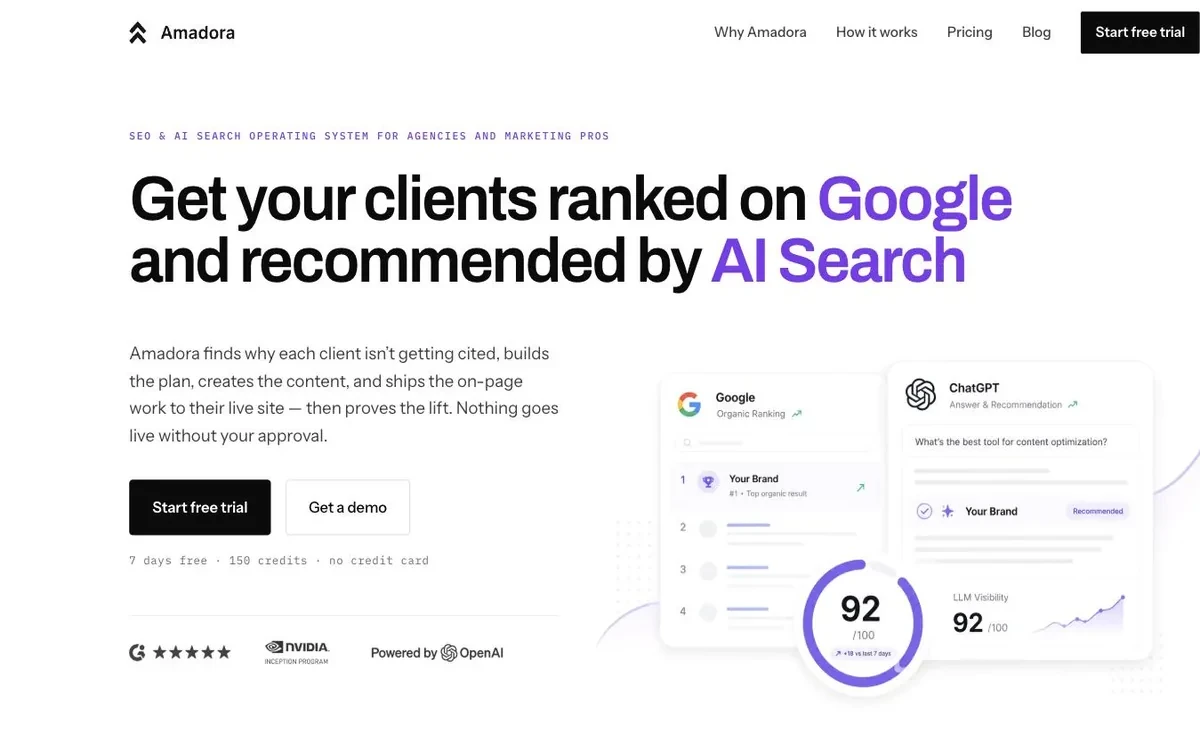
Amadora AI runs a brand’s prompts daily against the live ChatGPT, Perplexity and Gemini interfaces and names the sources each answer trusted. It then produces the work that closes the gap — briefs, drafts, landing pages — ships approved changes into the CMS, and repairs internal links and schema. Search Console connects, so the ranking and the AI answer arrive in one report.
Amadora AI leads on finding why a client is not cited, then shipping the fix.
Key features
Publishes to WordPress and Webflow directly, other platforms via plugin, API and MCP.
Agents repair internal links and apply on-page changes and schema, approval-gated and reversible.
Google and AI Overviews included from Pro, beside ChatGPT, Perplexity and Gemini.
Search Console connects, putting rankings and AI answers in one week-over-week view.
Pricing
Three plans on Amadora AI’s pricing page, billed monthly. Starter $99/mo: 20 prompts, 15 articles, one seat. Pro $299/mo: 100 prompts, 30 articles, five seats. Growth $799/mo: 300 prompts, 120 articles, three projects, unlimited seats. Two months free on annual billing; three days free, no card.
Limitations
Direct publishing reaches WordPress and Webflow; nothing changes what AI crawlers read at the CDN.
AI Mode, Grok, Copilot and Claude are add-ons, from $149 to $429 a month each at Growth’s 300 prompts.
Single sign-on is on the custom agency Enterprise plan only.
Best for a team that wants the whole loop on a plan it can buy this week, with the AI number beside the Google number. Not the right call if the fix has to reach AI crawlers at the CDN, or if procurement needs an enterprise contract.
02
BrightEdge — Best for enterprise SEO teams already on BrightEdge that want internal links and schema changed without a developer ticket.
Rung 7 of 7No published price5 AI engines namedGoogle SEO yes
BrightEdge is the incumbent enterprise SEO suite, and it has gone further into execution than most AI-first tools. Site Agent builds internal links and Schema Agent deploys JSON-LD, both in what BrightEdge calls Agent Mode: the tool makes the change and reports what it did. AI Catalyst tracks mentions, citations and sentiment by engine, and pins to the same dashboards as rank reporting.
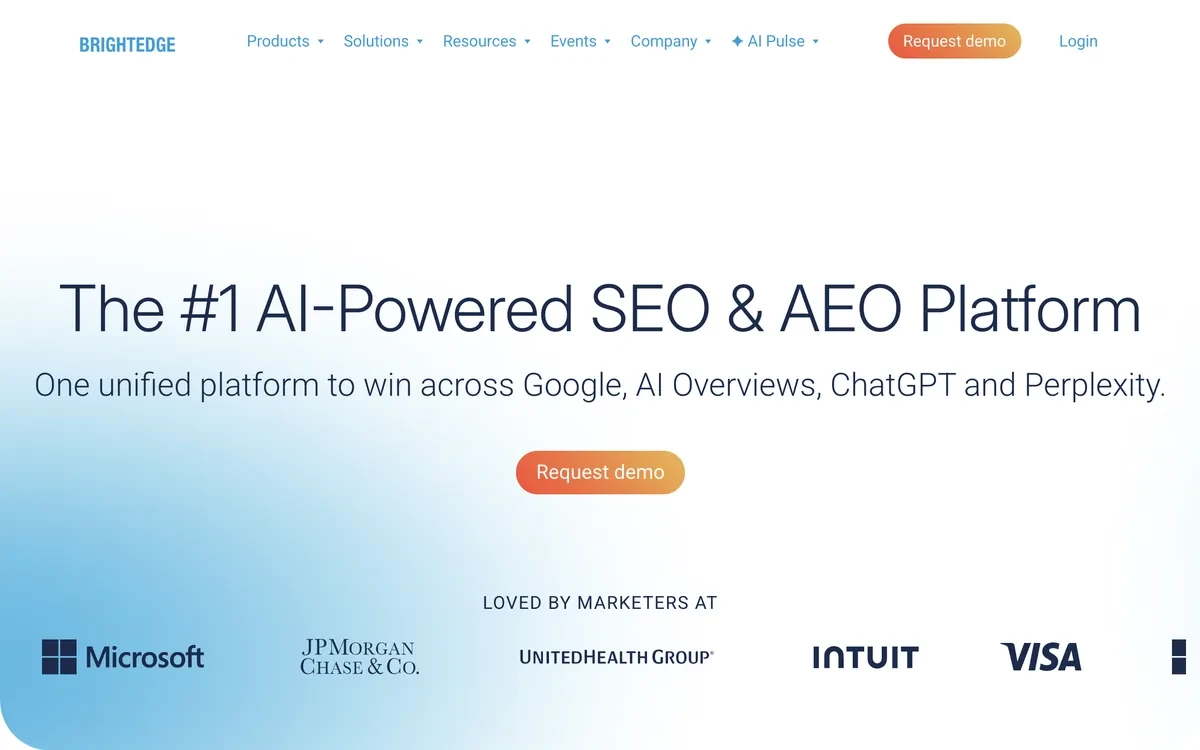
BrightEdge sells one unified platform across Google, AI Overviews, ChatGPT and Perplexity.
Key features
Site Agents Suite: internal links and JSON-LD changed automatically, titles and H1s pushed at Approve.
Agent Edge serves verified AI agents a lighter page at the CDN; people and Googlebot see the original.
AI Catalyst and AI Hyper Cube for AI mentions, citations, sentiment and trusted sources.
ISO 42001 and ISO 27001 certified, with GA4, Adobe Analytics and Search Console integrations.
Pricing
Nothing is published. The pricing URL returns a 404, every product page ends at “Request a Demo”, and no trial is offered. Agents are added to an existing contract through customer success, and the rename from Autopilot left pricing, contracts and SKUs unchanged.
Limitations
No price, no trial and no plan to choose, so it cannot be evaluated before a sales cycle.
Publishing Agent covers title tags, meta titles and H1s only; article bodies stay manual.
Agent Edge needs CDN access and IT sessions before its first change goes live.
Best for an enterprise SEO team already on BrightEdge that wants links and schema maintained across a very large site without developer tickets. Not for a team choosing its first AI visibility tool, or one that needs a price before a meeting.
03
Conductor — Best for global organisations that want AI visibility, content and round-the-clock site monitoring from one enterprise vendor.
Rung 4 of 7No published price500,000 pages monitored on GrowthGoogle SEO yes
Conductor is BrightEdge’s closest match as a company: an enterprise SEO platform with a decade of data that has added AI search on top. It tracks eight engines including Claude and Grok, writes content through its Writing Assistant, and monitors a site continuously for content, product-page and compliance problems. It names three tiers and prints the allowances for each, with every price removed.
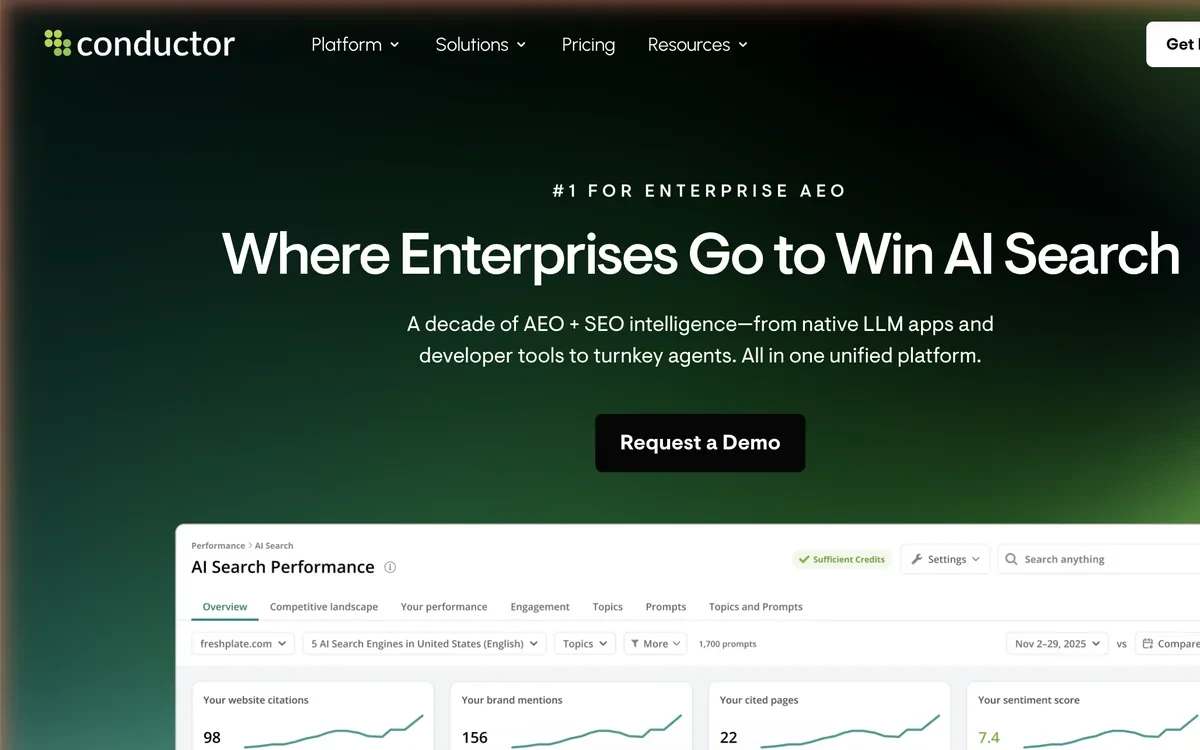
Conductor puts an AI Search Performance dashboard on the homepage and the price behind a demo.
Key features
Monitoring of up to 500,000 pages on Growth, with alerts on content and compliance changes.
Writing Assistant drafts allocated by the year: 60 on Essentials, 180 on Growth.
Internal link recommendations and content scores on every tier.
Priced on usage rather than seats; single sign-on from Growth.
Pricing
Essentials, Growth and Enterprise, with no figure on any of them. Essentials carries 500 tracked keywords, three websites and 2,500 AI search credits a year; Growth raises keywords to 5,000 and websites to five. Only Essentials can be tried; Growth goes to a demo and Enterprise to sales.
Limitations
No published price at any tier, so budgeting starts with a call.
Internal links are recommended rather than applied, and nothing is pushed into the CMS.
Drafts are counted per year, which suits a content calendar more than a sprint.
Best for a global organisation that wants AI visibility, content and site monitoring from one enterprise vendor with governance attached. Not for a team that wants the fixes applied rather than flagged.
04
Adobe Brand Visibility — Best for enterprises already on Adobe Experience Cloud that want AI-facing fixes deployed at the CDN without a release cycle.
Rung 6 of 7No published priceTrial for Adobe customersGoogle SEO yes
Adobe Brand Visibility, renamed this year from Adobe LLM Optimizer, is the closest thing here to BrightEdge’s Agent Edge. Optimize at Edge serves AI-friendly changes to LLM user agents at the CDN, works with any CMS, and rolls back in one click. It bundles Semrush entitlements, which puts classic SEO data under the same contract.
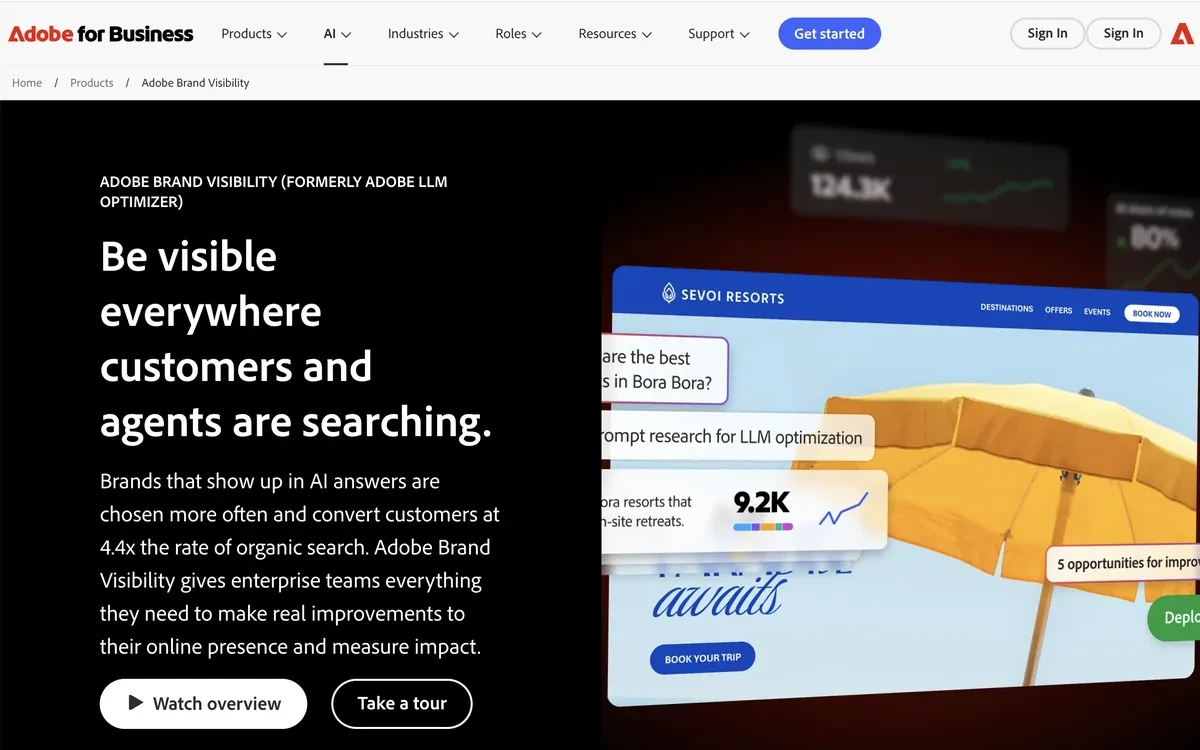
Adobe renamed LLM Optimizer to Brand Visibility and bundles Semrush entitlements.
Key features
Optimize at Edge applies summaries, FAQs and tables of contents for AI agents at the CDN.
CDN- and CMS-agnostic, with setup guides for Fastly, Akamai, Cloudflare and CloudFront.
One-click rollback that reverts a page in minutes.
Semrush entitlements bundled, covering the Google side of the report.
Pricing
No tiers or prices are published; it is licensed by prompts per year. AEM Cloud, Adobe Analytics and Customer Journey Analytics customers can start a free trial, which Adobe’s Quick Start caps at 100 prompts and one domain. Everyone else is onboarded once a business agreement is signed.
Limitations
No published price, and the trial is open only to existing Adobe customers.
Routing sits at the outer CDN, so outside AEM’s managed Fastly it needs the IT team.
Edge changes reach AI agents only; the page people and Google read is unchanged.
Best for an enterprise already inside Adobe Experience Cloud that wants AI-facing fixes live without a release cycle. Not for a team outside the Adobe estate, which cannot trial it.
05
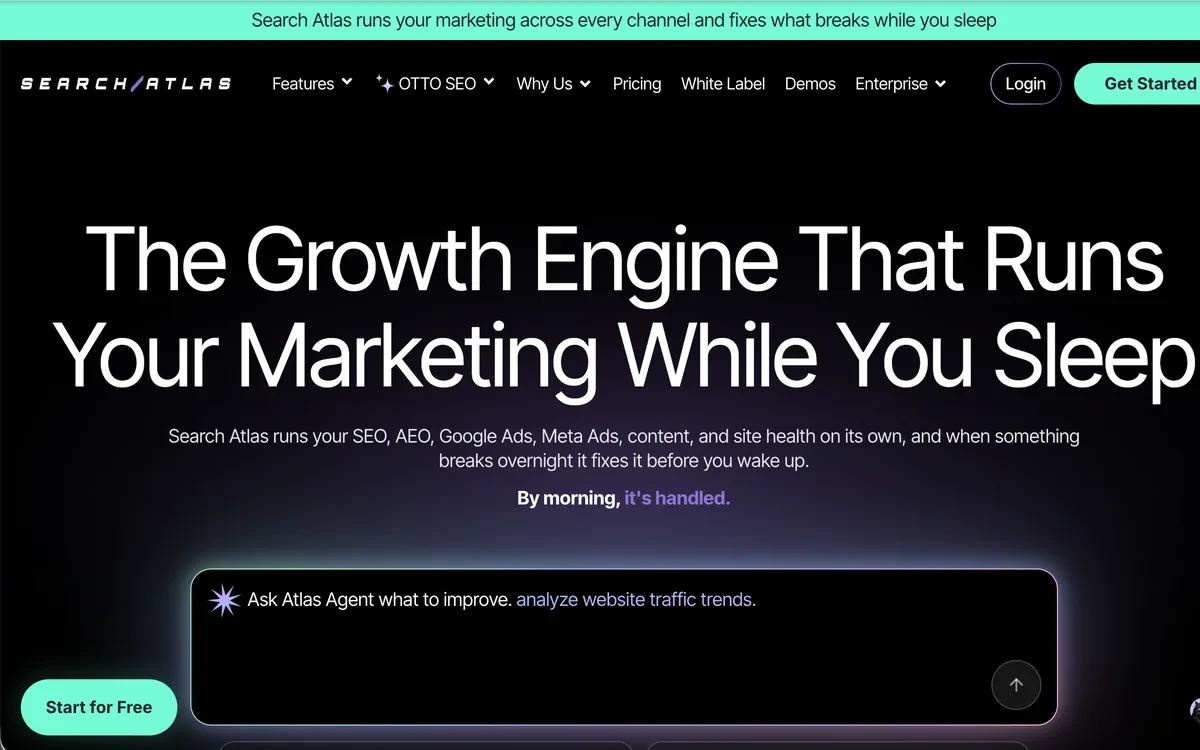
Search Atlas — Best for teams that want OTTO applying on-page and technical fixes to a live site at a published, self-serve price.
Rung 6 of 7From $99/moAI visibility from $199Google SEO yes
Search Atlas is the self-serve answer to the thing BrightEdge sells on contract. Its OTTO agent ships on-page and technical fixes to the live site through Cloudflare, a CMS or a code pipeline — titles, schema, canonical URLs, broken links, headings, alt text and internal links — with an optional approval mode. Every price is published and every tier below Agency can be trialled. We cover it in depth on the Search Atlas alternatives page.
Search Atlas sells the whole loop: run the marketing, then fix what breaks overnight.
Key features
OTTO applies technical and on-page fixes to the live site, with an approval mode.
A full SEO suite around it: rank tracking, site audit, Google Business Profile and local.
“Connect and publish to any CMS” on every tier, including the $99 Starter.
Pricing
Starter $99/mo, Growth $199, Pro $399, Agency from $999, billed monthly; annual billing, which is the tab the page opens on, takes 20% off. AI visibility starts on Growth with ChatGPT, Gemini and Google AI Mode; Pro adds Copilot and Perplexity. Seven-day trial below Agency.
Limitations
No AI visibility at all on the $99 Starter.
AI visibility is one module inside a large SEO platform, not the product.
One seat at entry, three on Growth.
Best for a team that wants BrightEdge-style automated fixes at a published price with a trial. Not for an enterprise that needs an ISO-certified vendor and a named account team.
06
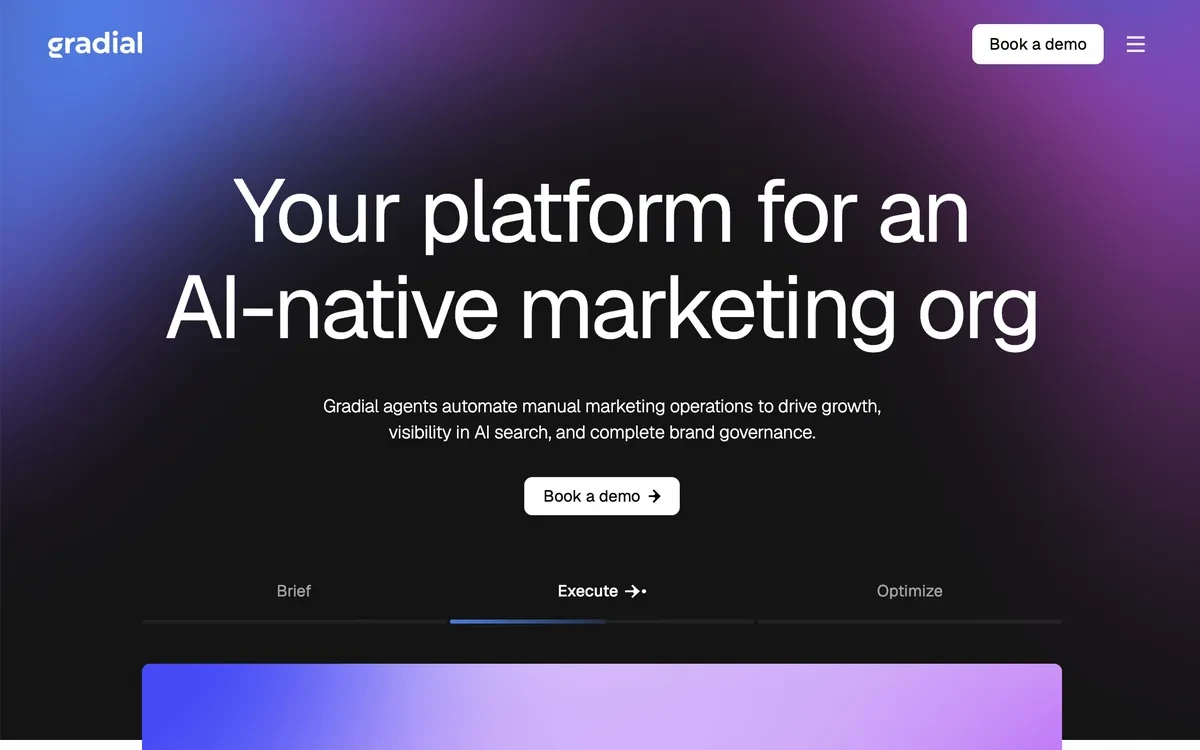
Gradial — Best for global brands on Adobe Experience Manager or Sitecore that want an agent editing live pages behind review gates.
Rung 6 of 7No published price30 integrationsGoogle SEO no
Gradial is a marketing-operations platform that added a GEO agent, and it edits pages where BrightEdge’s Publishing Agent stops at the title. The agent changes copy, FAQs, internal links and metadata, and ships approved updates into the CMS the content already lives in, behind review gates. T-Mobile, Cisco and Wells Fargo are customers, and $65M had been raised by June 2026.
Gradial sells agentic marketing operations rather than an AI visibility dashboard.
Key features
Edits page copy, FAQs, internal links and metadata, then ships them behind review gates.
30 integrations, including Adobe Experience Manager, Sitecore, Contentful, Sanity and Drupal.
Monitoring across eight engines, Grok and DeepSeek among them.
Tasks can carry human sign-off gates, which suits regulated brands.
Pricing
Nothing is published. The pricing URL returns a 404, every call to action books a demo, and no trial exists. GEO is enabled on request rather than standard, so confirm it is in scope before a contract is drafted.
Limitations
No Google organic view, so the rankings half comes from another vendor.
No price, tier list, seat count or trial published.
Built for enterprise CMS estates rather than a mid-market stack.
Best for a global brand on Adobe Experience Manager or Sitecore that wants page bodies edited under approval, not only titles. Not for a team that needs the AI number and the Google number together.
07
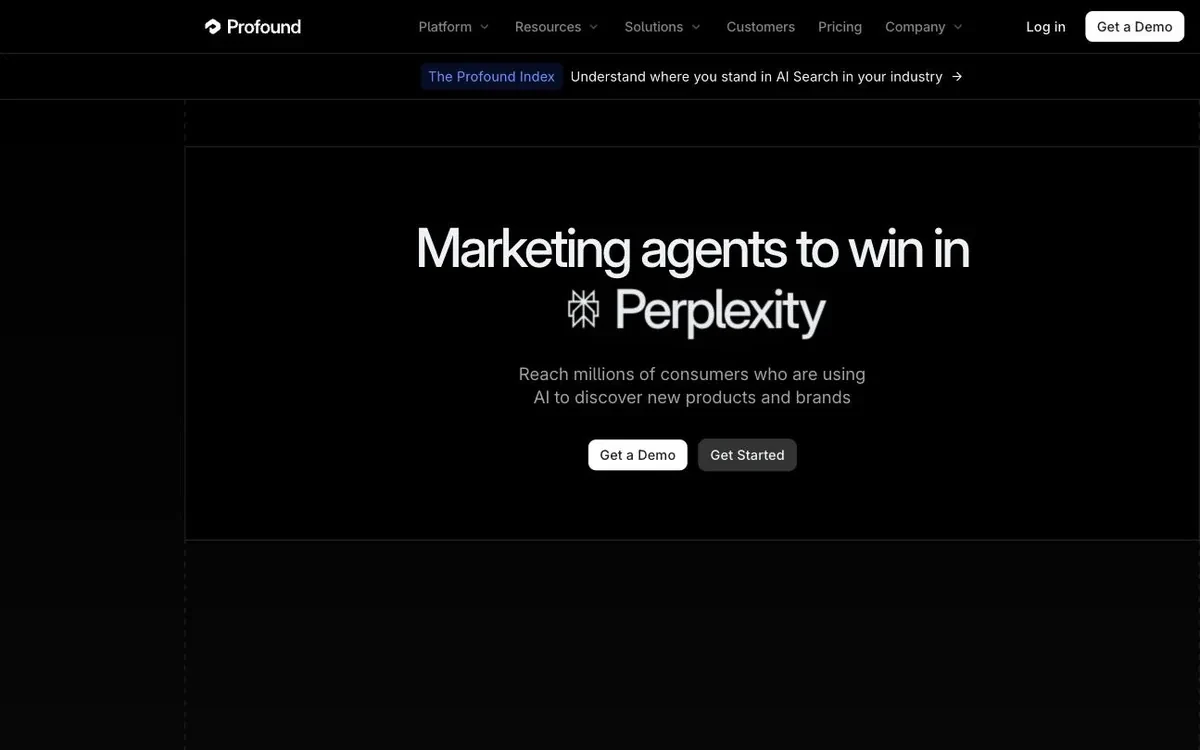
Profound — Best for one enterprise brand with an analyst to read deep citation data and a CMS team to act on it.
Rung 5 of 7From $99/mo1 seat at entryGoogle SEO no
Profound is the deepest answer-engine analytics platform on the market — $96 million raised at a billion-dollar valuation in February 2026 — and it now acts as well as reports. Its Agents draft and update entries in ten content systems and inject FAQs, stats and schema, queued for editorial review. Unlike BrightEdge, every self-serve price is on the page.
Profound now sells marketing agents rather than answer-engine analytics alone.
Key features
The deepest citation analysis here, down to the pages an engine actually pulled from.
Agents draft into ten CMSs, from WordPress to Adobe Experience Manager.
Agent Analytics reads AI crawler traffic through Cloudflare, Fastly and Vercel.
Nine engines on Enterprise, with SSO/SAML and SOC 2.
Pricing
Starter $99/mo: ChatGPT only, 50 prompts, one seat. Growth $399/mo: three engines, 100 prompts, three seats, with a free trial. Enterprise on quote for nine engines. Annual billing is an off-by-default toggle.
Limitations
No Google organic view anywhere, so rankings live in a second tool.
ChatGPT only at $99; three engines cost four times as much.
Agent output is queued as drafts rather than pushed live.
Best for a single large brand with an analyst who will use the depth, and a CMS on its list of ten. Not for a team replacing BrightEdge’s Google reporting, which Profound does not have — the Profound alternatives page covers that gap.
08
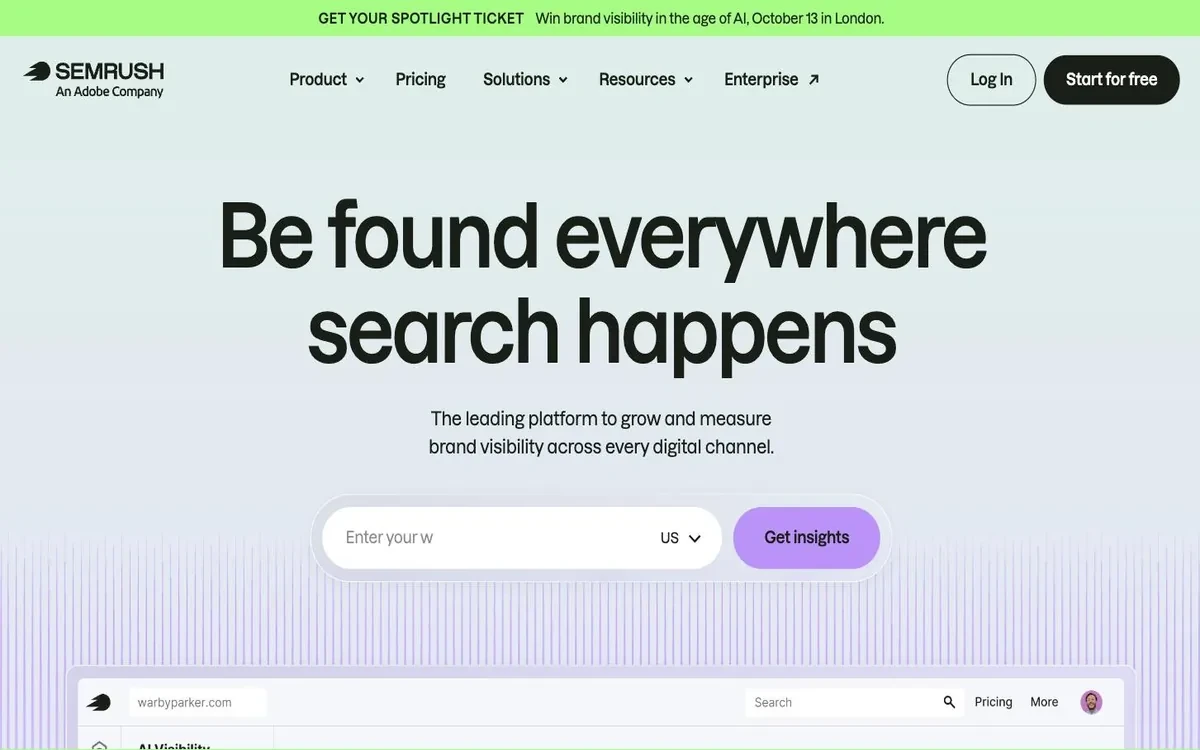
Semrush — Best for SEO teams that want the deepest keyword and backlink research with an AI visibility number beside it.
Rung 3 of 7From $199/mo1 domain for AIGoogle SEO yes
Semrush is the suite most BrightEdge buyers already know, and on research depth it has no equal here. AI visibility sits inside its plan structure from the $199 Starter tier, beside position tracking, site audit and keyword research. It reports and plans; the work it identifies is left to the team.
Semrush, now an Adobe company, sells visibility across every channel.
Key features
The deepest keyword and backlink research on this page.
AI visibility across ChatGPT, Perplexity, Gemini, Copilot and Google surfaces.
50 prompts tracked daily on Starter, 100 on Pro+ and 200 on Advanced.
An AI-ready site audit and MCP access from Starter.
Pricing
SEO $139/mo carries no AI tracking. Starter $199/mo, or $165.17 annually, is the first plan with it, and covers one domain for AI brand performance. Pro+ $299, Advanced $549. Extra users start at $45/mo.
Limitations
One domain for AI brand performance at entry.
Nothing is produced, published or applied to the site.
Seats are charged separately.
Best for a team that wants research depth first and treats the AI number as one more report. Not for anyone leaving BrightEdge for execution, which Semrush does not do.
09
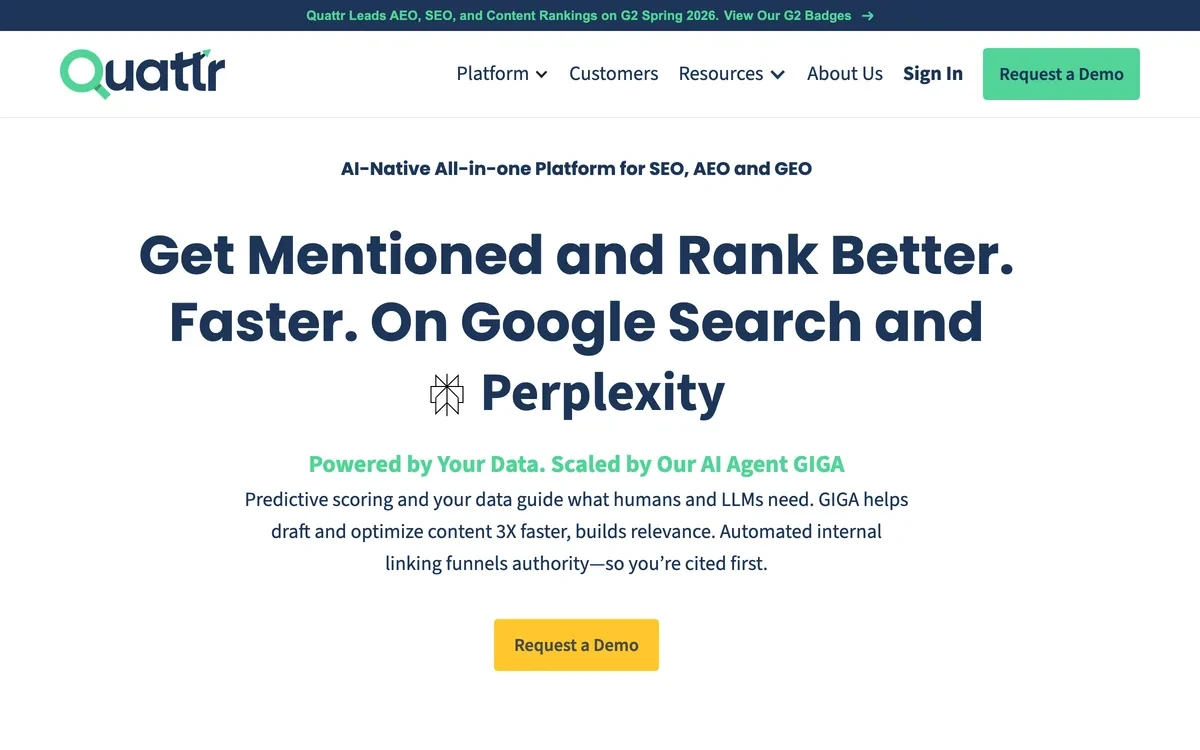
Quattr — Best for large sites that want drafts handed into the CMS and internal linking deployed with a vendor concierge.
Rung 5 of 7No published price4 engines prompted dailyGoogle SEO yes
Quattr puts Google and AI answers in one platform and carries a page from keyword to CMS. Its Content AI hands a draft into the CMS with an author assigned for the owner to publish, and its internal-linking browse modules go live with an assigned SEO concierge. ChatGPT, Perplexity, Gemini and Google AI Mode are prompted daily.
Quattr leads with Google and Perplexity, and an agent named GIGA.
Key features
Drafts land in the CMS with an author assigned; WordPress is the example shown.
Internal-linking modules built and deployed with a vendor concierge, at large-site scale.
Search Console, GA4, Adobe Analytics and Google Ads connected for revenue reporting.
A Search-to-Revenue agent ties rankings to configured goals.
Pricing
Nothing is published. The pricing page is a booking form offering a 30-minute call, with “Free trial included” beside it and no trial length stated. No tier names, seat counts or allowances appear anywhere on the site.
Limitations
No published price or tiers.
Much of the linking work runs through Quattr’s concierge rather than your team.
A far smaller company than BrightEdge, which matters for a long commitment.
Best for a large site that wants drafts and internal links handled with a vendor alongside. Not for a team that wants to run the platform alone.
Best by job
Buying the full loop without a contract
Amadora AI. Tracking, drafts, CMS publishing, link and schema repair and the Google report on published plans, with a three-day trial and no card. Growth at $799 covers 300 prompts, three projects and unlimited seats.
Changing what AI crawlers read without touching the CMS
Adobe Brand Visibility. Optimize at Edge serves AI-facing changes at the CDN on any CMS, with one-click rollback, and existing Adobe customers can trial it. BrightEdge’s Agent Edge does the same job inside a BrightEdge contract.
Automated SEO fixes at a published price
Search Atlas. OTTO applies titles, schema, broken links and internal links to the live site from $99 a month, with a seven-day trial. It is the nearest self-serve equivalent to the Site Agents Suite.
When BrightEdge is still the right choice
You need AI-facing pages served at the CDN with no CMS connection at all. Agent Edge does that, and we do not — our changes publish through WordPress, Webflow or an integration.
Your site runs to hundreds of thousands of pages and needs internal links maintained continuously without a person approving each one. Site Agent runs in Agent Mode; ours are approval-gated.
Procurement wants ISO 42001 and ISO 27001, a decade-old vendor and a named account team. BrightEdge clears that list, and we do not.
The execution ladder
The execution ladder is seven steps from measuring an AI visibility problem to proving it was fixed: measure, diagnose, plan, produce, publish, fix, prove. Engine counts and prompt limits miss the thing it captures, which is how much work lands back on your team. Every platform here climbs the same seven steps and each stops somewhere.
The seven execution rungs and which of the listed tools reach each one
Rung
What it means
Which tools reach it
1 · Measure
Tracks prompts, mentions, citations and share of voice
All nine
2 · Diagnose
Names why the citation went elsewhere and which source the engine trusted
All nine
3 · Plan
A prioritised, client-ready action list with reasoning attached
Amadora AI · BrightEdge, title tags, meta titles and H1s at Approve · Gradial, into AEM, Sitecore, Contentful and more · Search Atlas, to any CMS · Profound, as drafts across ten · Quattr, as CMS drafts an owner publishes · Adobe, at the CDN rather than the CMS
6 · Fix
On-page SEO, internal links, broken-link repair and schema — executed, not recommended
Amadora AI · BrightEdge, internal links and schema in Agent Mode · Search Atlas, through OTTO · Gradial, behind review gates · Adobe, for AI agents only
7 · Prove
Week-over-week movement in AI answers and Google rankings, in one report
Amadora AI · BrightEdge, AI Catalyst charts pinned beside rank reporting
Scroll the table sideways →
Rung placements reflect what each vendor documents publicly, read 25 September 2026. BrightEdge moves from 6 to 7: AI Catalyst says every chart and table can be pinned to a BrightEdge dashboard, the same dashboards that carry its keyword rank reporting. Quattr moves from 4 to 5: its Content AI page says the draft lands in your CMS with an author assigned and the owner publishes. Search Atlas is published at 6, as on every page in this cluster.
This is the most capable peer set in the cluster. Seven of the nine reach rung 5, five change the live site, and BrightEdge reaches rung 7 beside us, so the old line that AI visibility tools report and stop does not describe this market. What separates the five that fix is where the change lands and how you buy it. Adobe changes what AI agents read and leaves the human page alone; Gradial and BrightEdge work inside enterprise contracts; Search Atlas and Amadora AI publish their prices. Seven of the nine report a Google position, and two of them put it in the same report as the AI answer.
Migrating off BrightEdge
Keyword lists, competitor sets and prompts carry over by export and paste, and a fresh prompt set can be generated from the site and its competitors to compare against. Saved views rebuild in under an hour. Expect first data within twenty-four hours of adding a domain and a usable trend line at about two weeks. Historical visibility data does not transfer between vendors, because each samples and scores differently.
Two parts of BrightEdge need a plan before the contract ends. Agent Edge serves AI crawlers a lighter copy of each page from the CDN, so those copies disappear when the routing is removed; list the pages it covers and decide which need an equivalent. Schema Agent keeps structured data current as pages change, so audit the JSON-LD live on your key templates and confirm what your CMS will carry once the agent stops. BrightEdge sells annual contracts, so the clean sequence is to run the replacement in parallel during the final quarter and switch at renewal.
Common questions
−
How much does BrightEdge cost?
BrightEdge publishes no price. Its /pricing URL returns a 404 and every product page ends at "Request a Demo" (vendor site, September 2026). It sells annual enterprise contracts, and its own FAQ on the Autopilot rename says "pricing, contracts and SKUs on your invoice stay the same", which is as close as the site comes to describing the bill.
+
Does BrightEdge have a free trial?
No. Every BrightEdge product page routes to a demo request, and no trial is offered anywhere on the site. Among the alternatives here, Amadora AI runs three days free with no card, Search Atlas offers seven days, Conductor offers a trial on its Essentials tier, and Profound offers one on Growth.
+
What happened to BrightEdge Autopilot?
It was renamed. Autopilot is now the Site Agents Suite, and its old URL redirects there. The suite holds three agents: Site Agent for internal links and Schema Agent for JSON-LD, both running without a person in the loop, and Publishing Agent for title tags, meta titles and H1s, which a person approves. Existing contracts are unchanged.
+
Which BrightEdge alternatives track Google rankings too?
Amadora AI, Conductor, Adobe Brand Visibility, Search Atlas, Semrush and Quattr all report Google organic alongside AI answers, as BrightEdge does. Gradial and Profound track AI answers only. Amadora AI connects Search Console directly, so rankings and AI citations land in the same week-over-week report.
+
Does BrightEdge publish content to my CMS?
Partly. Publishing Agent pushes BrightEdge's recommended title tags, meta titles and H1s into WordPress, Drupal or another major CMS, and a person confirms each change before it goes live. Article bodies, briefs and drafts are not on the list, so those are published by your team.
+
Can I migrate off BrightEdge?
Yes. Keyword lists, competitor sets and prompts move by export and paste, and take under an hour to rebuild. Plan for two things: Agent Edge serves its AI-facing pages from the CDN, so they stop when the routing comes out, and historical visibility data does not transfer between vendors.
Last updated
This comparison is current as of , with every price, engine count, seat limit and prompt allowance verified against each vendor's own pricing page on that date.