
Guide · Tracking
Do AI Search Mentions Drive Organic Traffic? What the Data Shows
Yes, weakly, and not in the way the coverage claims. Every published figure on the correlation between AI search mentions and organic traffic is a cross-site average taken in a single period. None of them tests whether your mentions moved your traffic.
AI mention counts and organic traffic correlate positively but moderately. The three most-cited coefficients are 0.66 (Perplexity mention share against organic search traffic, June 2025), 0.664 (branded web mentions against AI Overview visibility, 75,000 brands) and 0.82 (organic against AI referral traffic inside one company’s blog). All three are same-period measurements. None is a per-brand, time-lagged test, so none of them predicts your next month. The coefficient you can act on is the one you compute on your own domain.
But those three numbers measure three different variable pairs. Stacking them into one claim is a category error. It’s the error running through most of what you’ll be shown on this question.
What the correlation actually is
An AI mention count is the number of times a brand or domain is named or cited across tracked AI answers in a period. Spearman’s rank correlation is the coefficient these studies report: it ranks both variables and measures whether the ranks move together. That handles skewed traffic distributions better than Pearson does.
| Study | What it correlates | Coefficient | Sample | Design |
|---|---|---|---|---|
| Ahrefs, mention share and organic traffic, June 2025 | AI mention share against organic search traffic | 0.47 AI Overviews, 0.33 ChatGPT, 0.66 Perplexity | Top 50 mentioned sites per platform, one month | Cross-site, same period |
| Ahrefs, AI Overview brand correlation, May 2025 | Branded web mentions against AI Overview visibility | 0.664 | 75,000 brands, filtered to DR above 40 | Cross-brand, same period |
| Seer Interactive, two years of blog data, March 2026 | Organic traffic rank against AI referral traffic rank | 0.47 at one month, rising to 0.82 lifetime | 247 blog posts, one company | Single site, same period |
| Search Engine Land, the SEO-GEO gap, May 2026 | Organic sessions against LLM sessions, page by page | reported as shares, not a coefficient | 10 sites, 150,000 pages, one month | Cross-site, same period |
The Ahrefs mention-share study is the only one of the four putting mentions and organic traffic on the same axes. The Seer Interactive analysis produces the largest coefficient. It is also the one you’ll see quoted back at you in a pitch deck.
Why those three numbers do not stack
The three headline coefficients answer different questions. The first correlates mention share with organic traffic. The second correlates mentions with AI Overview visibility, which is a presence metric rather than traffic. The third correlates two traffic channels with each other and never counts a mention at all.
Ahrefs’ ChatGPT figure is 0.33 at p=0.0515, which fails the conventional 0.05 threshold. Quote the Perplexity number, leave the ChatGPT one out, and you’ve selected the significant result without saying so.
The sample is also 50 sites per platform. That is small enough for a few domains to move it, and Ahrefs says so directly: without Wikipedia in the set, the correlation would have been stronger.
Seer’s figure has the opposite problem. It’s highly significant (p<0.0001).
But it covers one company’s blog, and it climbs with content age rather than with mentions. The coefficient passes 0.68 at six months. Older posts accumulate both kinds of traffic. A maturation curve, not a lag effect.
Where mentions and organic traffic come apart
The two channels decouple at the brand level. That’s why you can’t read one off the other.
AI Overviews are a Google SERP feature. LLM citations are references inside a chatbot answer from ChatGPT, Perplexity or Gemini. Separate surfaces, separate retrieval.
Your brand may be strong in one and absent from the other. Pool them into a single mention variable and you hide the effect you’re testing for.
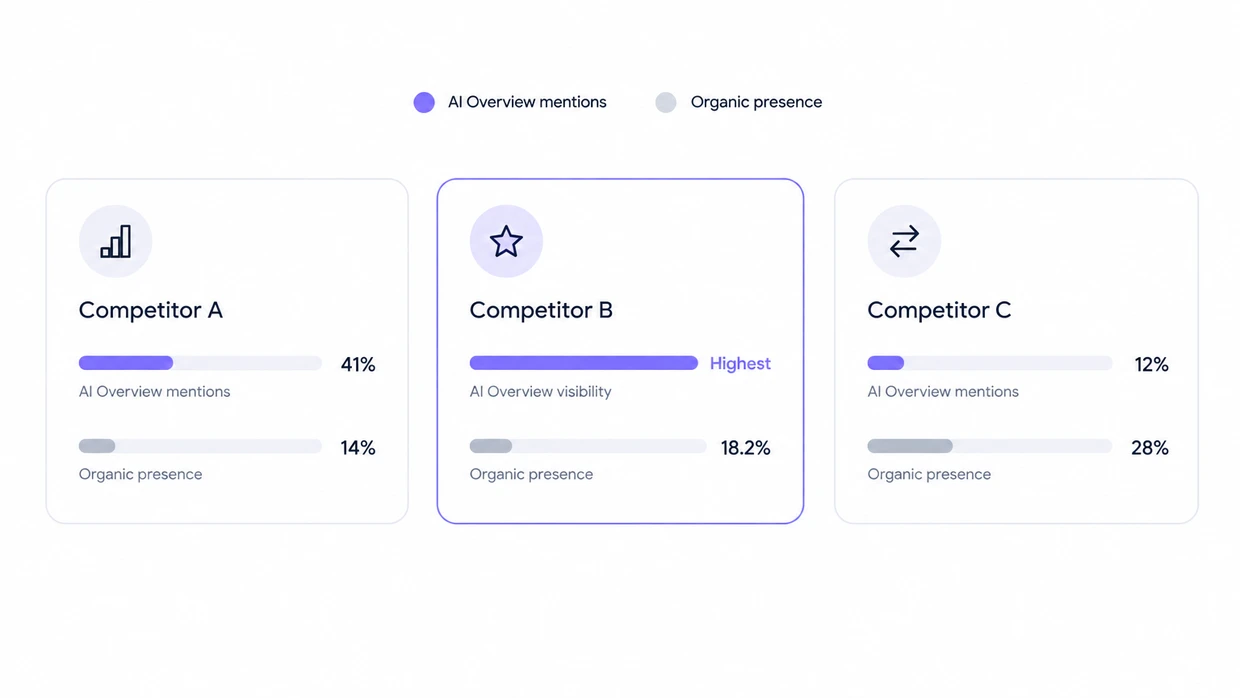
In Amadora AI’s tracking of the AI-visibility tool category (US, June to July 2026), one competitor held about 14% organic presence against a 41% AI Overview mention rate. Another held 18.2% organic presence and the highest average AI Overview visibility of any brand tracked. A third ran the other way, with more organic presence than AI Overview mentions.
The traffic side agrees. Search Engine Land’s GA4 analysis of 10 sites and 150,000 pages found the top 10 organic pages took 55% of organic sessions but only 29% of LLM sessions.
How to run the time-lagged test on your own data
A time-lagged correlation tests mentions in month N against organic sessions in months N+1 and N+2, rather than comparing both inside the same month. Same-period correlation can’t separate an effect from a common cause. A bigger brand generates more of both. Lagging your mention variable at least puts the proposed cause first in time.
Mentions in month N → sessions in month N+1 → repeat for twelve points.
- Count mentions monthly, split by surface. Keep AI Overview mentions, chatbot citations and unlinked web mentions in separate columns. Your rules for which source types produce AI citations set what the input variable counts before you compute anything. Daily collection keeps the count comparable, which is how we track AI mentions across ChatGPT, Perplexity, and Gemini.
- Pull organic sessions from GA4, impressions and clicks from Search Console. Same calendar months, same property. Segment out your branded queries, because branded demand contaminates both series in the same direction.
- Rank both series, then correlate at lags of 0, 1 and 2 months. A lag-1 coefficient meaningfully above your lag-0 coefficient is the only pattern supporting the mentions-move-traffic story.
- Log the confounders in the same table. Publishing volume, backlinks acquired, paid spend and SERP-feature changes all move organic sessions on their own.
- Run it for twelve monthly points before reading anything. A single AI answer is assembled from roughly 50 to 100 analyzed pages, and engines avoid pulling repeatedly from one source (Amadora AI citation data, May to July 2026), so your brand contributes at most one or two pages to any answer. Mention volume moves slowly. Short series produce noise.
Which metrics measure the link, and which do not
Rank correlation on monthly series. Spearman, because one spike will otherwise drive your coefficient on its own.
- Use monthly mention count per surface, organic sessions, organic impressions, and non-branded clicks.
- Skip the aggregate visibility score. It compresses per-prompt movement into one number. It moves when your prompt set changes rather than when performance does.
- Record the mention scale you are operating at. In Amadora AI’s tracking of the AI-visibility software category (May to June 2026), roughly 100 to 250 mentions put a brand in the category top 10. Roughly 250 to 600 put it in the top three to five. Thresholds like these are category-specific and move over time. But they tell you whether your 20-mention change is signal or rounding.
AI Overviews and chatbot citations are not one variable
Report them separately. Averaging them across your lag window blurs both.
Across April to August 2026, 72% to 92% of one tracked keyword set in the AI-visibility category triggered a Google AI Overview, with recent readings at 88% to 92%. Over the same set only about one keyword in twelve ranked in the organic top 10. The AI Overview surface is large where the organic surface is thin.
Why this matters: a mention gained in an AI Overview carries a different traffic mechanism than a citation inside a chatbot answer.
What to do with this if you run GEO
A mention count is not a traffic forecast. It is a leading indicator with an unproven lag. Report it that way, and say so to your client before they infer otherwise.
Two things are defensible today. First, your mention count moves with the work you control. It measures whether the program is executing. Second, per-surface mention share tells you which engines are worth chasing next quarter.
Running both against competitors is what benchmarking your mention-to-traffic lag is for, and it beats promising a visibility number you can’t predict.
What none of this data can tell you
Whether the mention caused the traffic. Every coefficient here is observational, and the bigger-brand confounder is never removed from any of them.
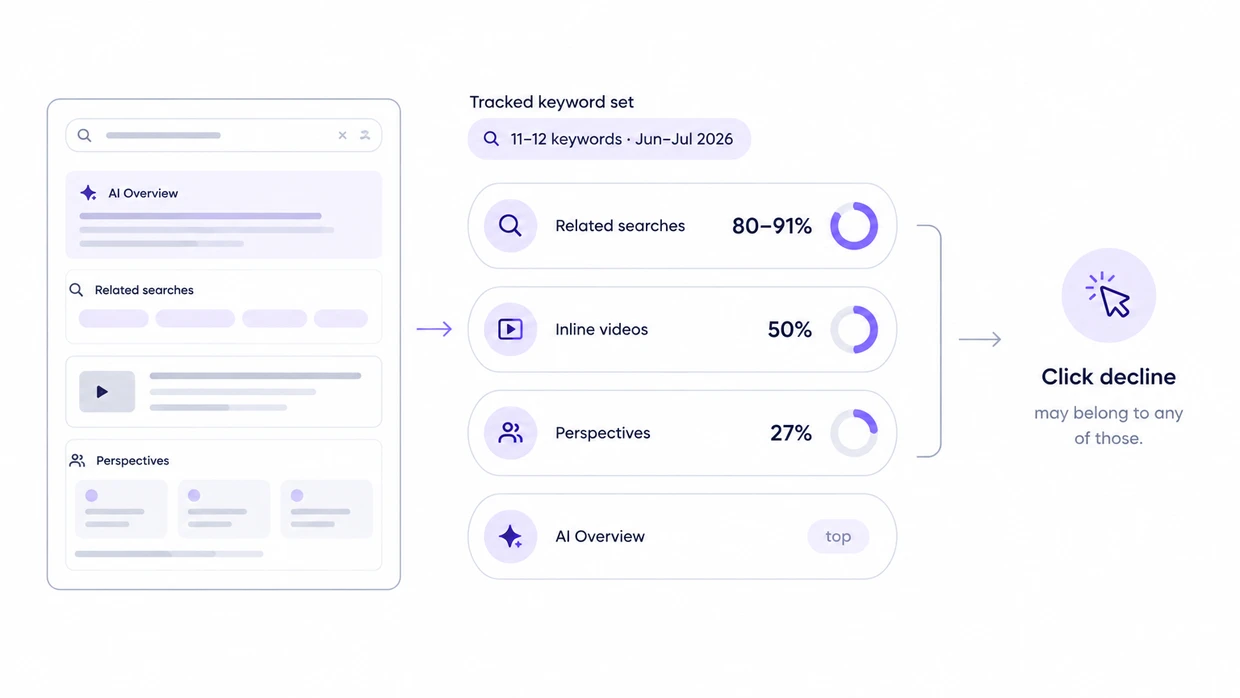
But the SERP is also moving underneath your measurement. On Amadora AI’s tracked keyword set (11 to 12 keywords, June to July 2026), related searches appeared on 80% to 91% of SERPs, inline videos on 50% and perspectives on 27%, on top of the AI Overview rate. A click decline inside your lag window may belong to any of those.
Sample sizes are the third limit. Fifty sites, one company’s blog, ten sites: these are the datasets the category is arguing from. A per-brand lagged cohort joining tracked mention counts to that same brand’s own sessions hasn’t been published by anyone yet, including us.
Common questions
Does an unlinked AI mention move traffic at all?
Possibly, but through branded search rather than referral. An unlinked mention reaches your site only if the reader types your name into a search engine afterward, so it surfaces as branded impressions in Search Console and never as a chatbot referral in GA4. Track the two paths separately or you will credit the wrong one.
Should you validate the correlation with GA4 or Search Console?
Both, because they answer different halves. GA4 measures sessions and identifies chatbot referrals through the referrer path. Search Console measures impressions and clicks, which separates a visibility change from a click-through change. Third-party traffic estimates carry error larger than the effect.
How often should you re-run the correlation?
Monthly, and never as a single reading. Each new month adds one point to the series, so an early coefficient moves a lot and settles slowly. Re-running weekly tells you about noise rather than about the lag. Recompute all three lags each time, because the gap between them is the signal rather than the level.