
Guide · Tools
What AI Visibility Tools Actually Cost: Pricing Models Compared (2026)

Paid AI visibility tools start at $95 to $99 a month. Published brand tiers run to roughly $500. Above that, pricing goes quote-only.
That range tells you little on its own. AI visibility tool pricing is charged on four different units, and the unit decides your bill far more than the tier name does.
Tools meter by tracked prompt, by domain, by user seat, or by credit. A credit is usually one prompt times one model times one day. Entry plans top out at $300 a month. Above that you ask and they quote.
Normalize the published entry tiers to one unit and the spread widens: $0.86, $1.90, $1.98 and $3.96 per tracked prompt per month. Same category, same month. A 4.6x gap.
Most pages in this category hide the number behind a demo request, or price agency retainers instead of tool licenses. If you want the capability view next to the price view, compare these tools feature by feature.
What actually drives AI visibility tool cost
Four meters exist. You’ll be charged on one or two of them.
- Per-prompt pricing charges by the number of prompts the tool monitors each month. It is the dominant model among AI visibility trackers, and the number you’ll be quoted first.
- Per-domain pricing charges per brand or domain tracked. One domain, one fee, repeated for every client you add.
- Per-seat pricing charges per logged-in user, on top of whatever usage meter you already pay for.
- Credit pricing charges against a pooled balance. Prompts, engines and refresh frequency all draw it down.
Two more shapes sit around the edges of those four.
Flat or tiered SaaS pricing publishes two or three fixed monthly packages, each carrying its own built-in allowances. You pick a package and take the limits that come with it.
Custom or enterprise pricing publishes no number at all. You request a quote, and the vendor prices your volume, engines, data retention and support as one figure. Every platform in the table below ends its published ladder with a custom tier.
Why this matters: two tools at the same price can differ by a factor of three in what they watch, because the meter runs per prompt, per model and per day. The headline number is the cheapest thing to compare and the least informative.
Per-prompt pricing, explained
Per-prompt pricing charges by the number of prompts a tool tracks for you each month, refreshed daily on most plans.
Peec AI starts at $95 a month. That buys 50 prompts across three models you choose, one project, one country.
Pro is $245 for 150 prompts. Advanced is $495 for 350. Every brand tier includes unlimited users.
Profound starts at $99 a month for 50 prompts. But it tracks ChatGPT only. Growth at $399 adds Perplexity and Google AI Overviews, lifts the cap to 100 prompts, and gives you 3 seats.
Divide and the two entry tiers land eight cents apart: $1.90 and $1.98 per prompt.
But they are not the same good. One watches three engines, the other watches one, so the plan that looks dearer is the one showing you three answer sets.
Profound publishes a second ceiling most buyers miss. Starter caps you at 1,500 responses a month, Growth at 9,000. Prompts are the number on the pricing page. Responses are the number you run out of.
Normalize by engine count before you compare anything. Otherwise the arithmetic flatters whichever vendor tracks fewest engines.
Per-domain pricing, explained
Per-domain pricing charges per brand or domain tracked. The unit sits inside the price itself.
Semrush prices its AI Visibility Toolkit at $99 a month per domain, billed annually. That buys 25 custom tracked prompts and one domain for brand performance analysis, with mentions pulled from ChatGPT, Google AI, Gemini and Perplexity. Additional users start at $45 a month (and no monthly billing option is shown for the base tier).
Per-domain is the most forecastable model on the market, and the most punishing at scale. One brand, one fee, and you can budget it a year out.
But add ten clients and you multiply that fee ten times. A per-prompt competitor lets you spread one pooled allowance across all ten.
At 25 prompts, this tier carries the highest unit cost in the table below. You’re paying for integration with a suite you may already own. Prompt depth costs extra.
Per-seat pricing, explained
Per-seat pricing charges per logged-in user. It layers on top of a usage tier.
The category splits cleanly here. Scrunch includes 3 seats on Starter and sells more at $25 a month each (or five for $75). Athena and Peec AI include unlimited users on every paid tier.
For a five-person team that gap costs you $50 a month on one tool and nothing on a tool priced $5 below it.
Seats are the cheapest axis to get wrong, because nobody prices them while you’re evaluating. You buy for the two people running the trial. Then the client asks for a login.
Instead, count the logins you’ll need in month six.
Agency and white-label pricing
Agency pricing is a separate rate card, not a discount on the brand plan. It meters clients instead of prompts.
Peec AI publishes the clearest example. Essential is $245 a month for 3 client projects and 10,000 credits. Growth is $495 for 10 projects and 25,000 credits. Scale is $795 for 25 projects and 65,000 credits.
Seats are unlimited throughout, and annual billing takes off roughly 15%.
Credits are where an agency budget breaks, because a credit is rarely one prompt. Peec defines one as one prompt times one model times one day. Track 50 prompts across 3 models daily for a single client and you spend 150 credits a day, roughly 4,500 a month, against an Essential plan advertising 10,000.
The number nobody in this category publishes is what the tool costs as a share of what you bill.
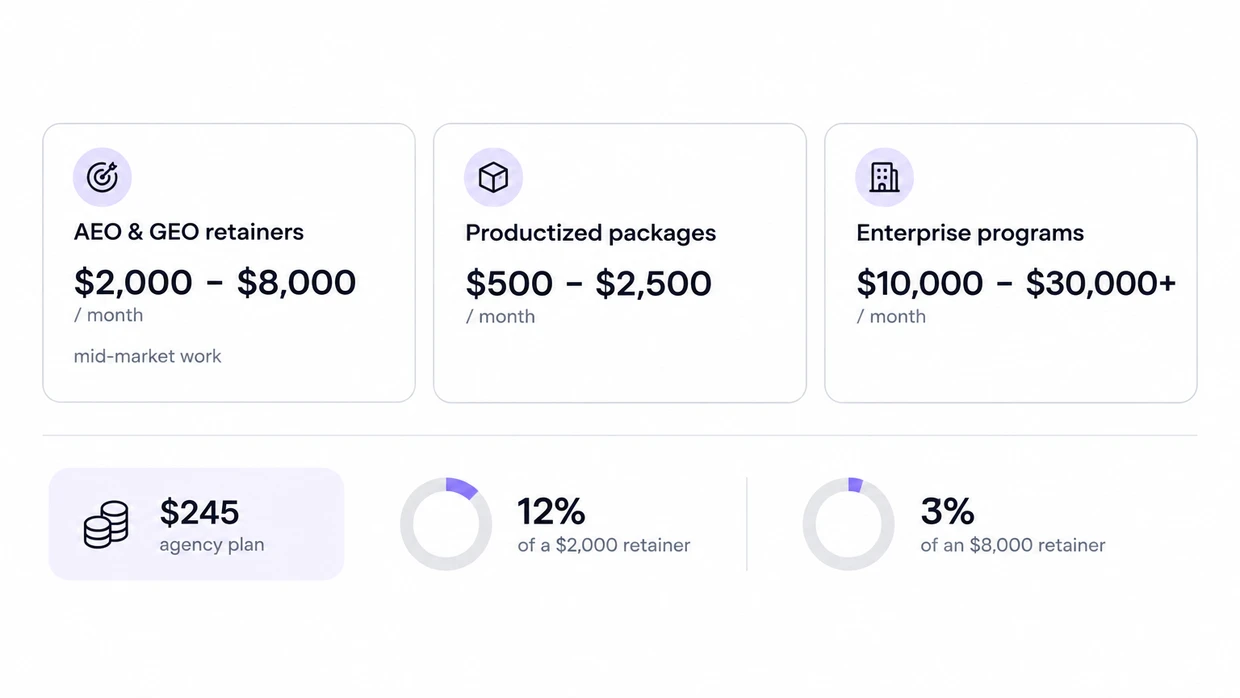
AEO and GEO retainers run $2,000 to $8,000 a month for mid-market work. Productized packages sit at $500 to $2,500, and enterprise programs run $10,000 to $30,000 and up, according to The Digital Elevator’s AEO and GEO pricing guide (updated July 2026). Against a $2,000 retainer, a $245 agency plan is about 12% of the fee. Against an $8,000 retainer it’s about 3%.
But shortlisting on tool price optimizes the smallest line in your deal. One agency that tested three trackers before moving to us switched for the depth of its client-facing reporting, not for a lower rate (one agency account, May 2026).
Our own position on the sell side is blunter, and it is a position, so weigh it as one. Don’t price a retainer against a promised visibility score. The result depends on niche, competition and whatever foundation your client already has.
Price the work instead, then report citation count and brand mention count. Both move with effort you control.
What AI visibility tools cost, vendor by vendor
Six tools publish an entry price on four different units, Amadora AI among them. Every competitor figure below was read from the vendor’s own published rate card on 14 September 2026, ours from our own current one, sorted by paid entry price.
| Tool | Pricing unit | Entry price | What the entry tier includes | What moves you up a tier |
|---|---|---|---|---|
| Amadora AI (ours) | Per prompt, plus credits for AI actions | $59/mo, or $49 billed annually | 15 prompts, ChatGPT, Perplexity and Gemini daily, 300 credits/mo, 1 brand, 1 seat, unlimited regions | 50 prompts ($99), unlimited brands and seats on Professional ($179), or add-on engines from $9/mo |
| Peec AI | Per prompt (brand), per credit (agency) | $95/mo | 50 prompts, 3 models of your choice, 1 project, 1 country, unlimited users | A 2nd project, a 4th model (+$35/mo), or passing 50 prompts |
| Profound | Per prompt, with a monthly response ceiling | $99/mo, billed yearly | 50 prompts, 1,500 responses/mo, ChatGPT only, 1 seat, 100 agent credits | A 2nd engine, a 2nd seat, or the response ceiling |
| Semrush AI Visibility Toolkit | Per domain | $99/mo per domain, billed annually | 25 prompts, 1 brand-performance domain, mentions from 4 AI surfaces | A 2nd domain, extra users (from $45/mo), or Pro Reports ($20/mo) |
| Athena | Per credit | $295/mo, plus a free Essential tier | 3,600 credits/mo, 11 models, unlimited seats | Credit burn rate, or API access (sold as an add-on) |
| Scrunch | Per prompt, plus per seat | $300/mo, or $250 billed annually | 350 custom prompts, 1,000 industry prompts, 3 seats, 7 platforms | A 4th seat ($25/mo), or 700 prompts on Growth |
Four things that table can’t hold.
Annual discounts cluster at 15% to 17% across the category. A year’s commitment buys you two free months, not a renegotiation.
Two of the six publish their base price on annual billing only, which makes that entry price a year’s commitment dressed as a monthly one.
The free tier is real but small. Athena’s Essential plan grants 300 credits as a one-time balance.
But Otterly.AI is absent on purpose. Its pricing page served no figures to four separate fetches on 14 September 2026, so its numbers stay out of this table.
Amadora AI sells in this category too, so it sits in that table on the same terms as everyone else. The section below opens up the rest of its rate card and holds it to the same arithmetic.
Where Amadora AI’s pricing sits
Amadora AI meters by prompt, the same unit as most of the table, so it normalizes the same way. This is the rate card as our own pricing page publishes it in September 2026.
| Plan | Prompts | Monthly | Billed annually | Credits a month | Brands and seats |
|---|---|---|---|---|---|
| Starter | 15 or 50 | $59 or $99 | $49 or $89 | 300 | 1 brand, 1 seat |
| Professional | 100 or 200 | $179 or $279 | $149 or $249 | 1,000 | Unlimited brands and seats |
| Agency | 300 to 1,000 | $499 to $1,099 | $399 to $999 | 3,000 | Unlimited, plus white-label, workspaces and API |
Every plan tracks ChatGPT, Perplexity and Gemini daily, in any region or language at no extra cost. So the fair comparison is the three-engine one. At 50 prompts the Starter tier works out to $1.98 per prompt, against $1.90 at Peec AI.
The rate then falls with volume: $1.79 per prompt at 100, $1.40 at 200, $1.10 at 1,000. At entry, Amadora AI is not the cheapest tracker per prompt. It gets cheaper per prompt the more you track.
Five more engines are add-ons, priced by the number of prompts tracked on each: Google AI Overviews, Google AI Mode, Grok, Microsoft Copilot and Claude, from $9 a month at 15 prompts. The engine-count rule above applies to us too. Adding all five at 50 prompts puts $185 a month on top of the plan.
Credits work differently from the credit meters above. Prompts pay for tracking; credits pay for the work the data points at. A content brief is 15 credits, a blog article or landing page draft 25, an AI skill run such as an internal-linking or on-page GEO audit 150, and a full AI visibility audit 300. Unused credits roll over up to twice the monthly allowance, and one-time packs start at $49 for 200.
Seats follow the split described earlier. Starter carries one. Professional and Agency carry unlimited seats and brands, so the logins you’ll need in month six cost nothing extra from $179.
The Agency plan starts at $499 for 300 prompts you allocate across clients, with white-label reporting, separate workspaces, API access and consolidated billing. Against the retainer range above, that is about 25% of a $2,000 retainer and about 6% of an $8,000 one.
What happens when you hit the cap
The cap matters less than the behavior at the cap. Almost no pricing page tells you which one you’re buying.
Three shapes exist. The tool stops collecting. The tool meters an overage onto your next invoice. Or somebody emails you.
Scrunch is the only one of the six that says which it does. Its pricing page states that overages go to team outreach rather than blocking access. Profound publishes hard monthly response ceilings but says nothing about what happens when you reach one, which is the more common pattern.
Peec’s credit definition at least lets you price the burn rate before you sign, so you can see the wall coming.
For an in-house team a mid-month stop is an inconvenience. For an agency it lands inside a client reporting cycle. Different category of problem.
Ask it directly on your demo call. What happens on the day I exceed this, and do I find out before or after? A vendor who can’t answer that in one sentence is quoting you a price without a service level.
If you are still shortlisting, a feature-by-feature comparison of these platforms is the other half of the decision.
The full rate card, with every add-on engine and credit pack, is on the Amadora AI pricing page.
Common questions
How much does an AI visibility tool cost per month?
Paid plans start at $95 to $99 a month, with published brand tiers to roughly $500 and quote-only pricing above that. The unit matters more than the tier: at the same $99 entry price, one tool tracked 50 prompts in September 2026 and another tracked 25.
Do AI search optimization tools charge per prompt or per seat?
Most charge per prompt. Seats are a layer on top, not an alternative. Some vendors include unlimited users on every paid tier, while others include three seats and sell extras at $25 a month each. Check the seat policy separately, because your team size and your prompt count are priced independently.
Is there a free AI visibility tracker?
Partly. One platform in this comparison offers a free tier, but it grants a one-time credit balance. It runs out and stays out. Short free trials are more common across the category than genuinely free plans.
What’s the difference between an AEO tool’s price and an agency’s AEO retainer?
The tool is software you operate yourself. The retainer buys people to operate it for you, and to do the work the data points at. Mid-market AEO and GEO retainers run $2,000 to $8,000 a month against agency tool plans of a few hundred. The tool is a line item inside the retainer, not an alternative to it.
How much does Amadora AI cost?
Amadora AI starts at $59 a month for 15 prompts tracked daily on ChatGPT, Perplexity and Gemini, or $99 for 50. Professional runs $179 to $279 with unlimited brands and seats, and Agency runs $499 to $1,099 with white-label reporting and API access. Annual billing lowers every tier except Agency 500, and five more engines are add-ons from $9 a month.