
Guide
Top 10 LLM Monitoring Tools (2026): Track Brand Mentions in AI Search
Authored by

Massi Hashemi
Product Marketing Manager

Your biggest visibility problem in 2026 isn't a ranking drop; it's the "invisible recommendation." While your traditional SEO tools report stable positions, your actual market influence is being decided inside black-box LLM responses where you have zero attribution. When a high-intent buyer asks Perplexity for a vendor shortlist, you are either the definitive recommendation or you don't exist.
LLM monitoring closes this attribution gap. It moves beyond vanity metrics to track the specific brand mentions, citations, and sentiment that drive "Share of Model." By identifying the exact third-party sources influencing these AI syntheses, you stop guessing which content moves the needle and start engineering the recommendations that actually land in the chat window.
TL;DR
- Amadora.ai is the top choice for high-intent tracking and identifying the specific sources influencing AI mentions.
- Profound and Conductor are the leaders for enterprise-scale monitoring and deep technical integration.
- SearchAtlas and SE Ranking offer the best balance of traditional SEO and AI visibility for agencies.
- Writesonic and Surfer SEO are ideal for teams that want to bridge the gap between monitoring and immediate content optimization.
Quick answers
What is the best LLM monitoring tool for agencies?
For agencies, the best tools are those that combine multi-client management with white-label reporting and a mix of traditional and AI-specific metrics. SearchAtlas and SE Ranking are currently the strongest in this category due to their flexible pricing and comprehensive dashboards.
- Decision criteria: Multi-project support, white-labeling, and API access.
What should you track first in LLM monitoring?
You should prioritize "High-Intent Prompts"—the specific questions active buyers ask when they are ready to purchase. Tracking generic keywords is often too noisy; focusing on category discovery and competitor comparisons yields more actionable data.
- Decision criteria: Prompt relevance, buyer journey stage, and competitor presence.
Mentions vs. citations: what matters more?
Mentions drive brand awareness and immediate user trust, while citations (the links provided by the AI) are the "backlinks" of the AI era. Citations are critical because they tell you which third-party sources the AI trusts, allowing you to focus your GEO efforts on those specific domains.
- Decision criteria: Attribution accuracy, source domain authority, and click-through potential.
What is LLM Monitoring
LLM monitoring (also known as AI visibility tracking or GEO analytics) is the systematic process of querying large language models to see how they perceive and recommend a brand. Unlike traditional rank tracking, which looks at static positions in a list, LLM monitoring analyzes synthesized text to extract brand mentions, sentiment, and the underlying sources the AI used to generate its answer.
Choose your path
1. Agency lead needing client reporting
Your priority is proving value to clients who are asking why their organic traffic is shifting. You need a tool that can handle dozens of projects, generate professional white-label reports, and provide a clear "Visibility Score" that clients can easily understand.
- Recommended: SearchAtlas, SE Ranking, or Profound.
2. In-house SEO needing actionability
You need to know exactly which pages on your site—or which third-party reviews—are being cited by AI so you can optimize them. You need prompt-level detail and "Coverage Booster" features that tell you how to close the gap between you and your competitors.
- Recommended: Amadora.ai, Surfer SEO, or Writesonic.
3. PR/brand team monitoring mentions
Your focus is on brand reputation and sentiment. You need to know if AI models are describing your brand accurately or if they are hallucinating negative information. You need broad coverage across all major models, including ChatGPT, Claude, and Gemini.
- Recommended: Peec AI or Conductor.
Our selection criteria
To ensure a fair evaluation, we applied the following scorecard to every tool on this list:
- Engine Coverage: Does it track the "Big 3" (ChatGPT, Perplexity, Google AI Overviews) plus emerging models like Claude and Gemini?
- Data Accuracy: Does it use multiple executions per prompt to account for AI's probabilistic nature?
- Source Attribution: Can it identify the specific URLs and domains the AI is citing?
- Actionability: Does it provide specific recommendations for improving visibility?
- Agency Readiness: Does it support multiple projects, seats, and reporting exports?
How we evaluated tools
This guide is based on a rigorous methodology designed to reflect the reality of AI search in 2026.
- Evaluation Date: January 2026.
- Prompt Set: We tested each tool using a standardized set of 30 high-intent prompts across 5 industries (SaaS, Fintech, E-commerce, Healthcare, and Travel).
- Engines Tested: ChatGPT (GPT-4o/GPT-5), Perplexity, Google AI Overviews, Gemini, and Claude 3.5/4.
- Definitions: A "mention" is any natural language reference to the brand name. A "citation/source" is a specific link or reference provided by the AI to support its answer.
- Known Limitations: We accounted for prompt variance by running each query 5 times and averaging the results. We also tested across 3 major geographic regions (US, UK, and EU) to account for regional model differences.
The top tools at a glance
- Amadora.ai (our product) (Not yet rated on G2)
- Profound (4.6/5, 146 reviews)
- SearchAtlas (4.6/5, 101 reviews)
- Writesonic (4.7/5, 2,088 reviews)
- Conductor (4.6/5, 680 reviews)
- Semrush (4.5/5, 3,257 reviews)
- SE Ranking (4.8/5, 1,420 reviews)
- Peec AI (5.0/5, 2 reviews)
- Clearscope (4.9/5, 91 reviews)
- Surfer SEO (4.8/5, 537 reviews)
Comparison table
The best tools (detailed reviews)
Amadora.ai

Amadora.ai is a specialized AI visibility platform designed for marketing teams that need to move beyond basic tracking and into strategic optimization. It focuses on "High-Intent Prompts" to simulate real buyer journeys across ChatGPT, Perplexity, and Google AI Overviews. The platform is particularly strong at identifying the "Global Sources"—the specific third-party domains that the AI engines trust most for your category.
What we liked most
- The "High-Intent Formula" for building prompt sets that actually impact revenue.
- Global Sources view that provides a clear "to-do list" for GEO outreach.
- Execution-level detail that lets you see the raw text of how AI describes your brand.
Best for: Growth-stage SaaS and marketing agencies focused on high-intent lead gen.
Pros
- Extremely fast setup (under 10 minutes).
- Deep focus on citation and source analysis.
- Organizes tracking into meaningful "Topics" rather than just a flat list of keywords.
Cons
- Newer platform with a rapidly evolving feature set.
- Focuses on the "Big 3" engines rather than every niche model.
Pricing: Starts at $59/month for the Starter plan; Enterprise plans available at $499+ for larger volumes.
G2: Not yet rated on G2 (new)
Profound

Profound is the enterprise standard for Answer Engine Optimization (AEO). It provides a deep, technical look at how brands appear across more than 10 different AI engines. Their platform is built for large-scale campaigns, offering advanced features like sentiment analysis, agentic workflows, and SOC2 compliance.
What we liked most
- The sheer breadth of engine coverage, including niche models like Grok and DeepSeek.
- Dedicated AEO Strategists available for enterprise clients.
- Integration with major cloud platforms like AWS and Cloudflare for traffic attribution.
Best for: Global enterprises and large agencies managing complex, multi-region AEO campaigns.
Pros
- Most comprehensive engine coverage in the market.
- Robust API and data export capabilities.
- Strong focus on enterprise security and compliance.
Cons
- Higher entry price point compared to other tools.
- Can be overwhelming for smaller teams or solo marketers.
Pricing: Starter plan at $99/month; Enterprise is custom.
G2: 4.6/5 (146 reviews)
SearchAtlas

SearchAtlas has successfully integrated LLM visibility into its broader SEO suite, making it a powerful option for agencies that want to manage traditional and AI search in one place. Their "LLM Visibility" module tracks brand reach across ChatGPT, Gemini, and Google AI Overviews with daily data refetching on higher plans.
What we liked most
- The "Atlas Brain" AI assistant that helps interpret visibility data.
- Seamless transition from tracking a visibility gap to creating an optimized page in their Website Studio.
- Generous user seat limits even on mid-tier plans.
Best for: Scaling agencies that need an all-in-one SEO and AI visibility platform.
Pros
- Excellent value for the number of features included.
- White-label reporting is built-in for agency clients.
- Daily data updates ensure you never miss a shift in AI behavior.
Cons
- The interface can feel crowded due to the number of tools.
- LLM tracking is limited to 100 queries on the Growth plan.
Pricing: Growth plan with LLM tracking starts at $199/month.
G2: 4.6/5 (101 reviews)
Writesonic

Writesonic has evolved from a simple AI writer into a full "AI Search Visibility" suite. Their Professional plan includes a dedicated GEO module that tracks how your brand appears across AI platforms and provides a "Coverage Booster" to help you fix visibility gaps.
What we liked most
- The "Real Cost Comparison" dashboard that shows how much you save by consolidating tools.
- Direct link between monitoring and their AI Article Writer 6.0 for immediate fixes.
- Unlimited SEO audits included with the Professional plan.
Best for: Content-heavy marketing teams that want to automate the "monitor-to-optimize" workflow.
Pros
- Very strong content generation and optimization features.
- Easy-to-use interface for non-technical marketers.
- Large community and extensive library of tutorials.
Cons
- GEO features are locked behind the $199/month Professional tier.
- Focuses more on content creation than deep technical AEO analysis.
Pricing: Professional plan starts at $199/month.
G2: 4.7/5 (2,088 reviews)
Conductor
Conductor is a heavy-hitter in the enterprise SEO space that has leaned heavily into AEO. Their platform provides "Purpose-Built AI" that helps large organizations monitor brand mentions and share of voice across conversational AI platforms. They offer a unique "unlimited keyword tracking" model that is rare in the enterprise space.
What we liked most
- The "AI Visibility Snapshot" report that provides an immediate baseline for new users.
- Deep integration with Google Search Console and other enterprise data sources.
- Strong focus on "End-to-End Workflows" that connect SEO, content, and PR teams.
Best for: Fortune 500 companies and large in-house teams needing a unified organic marketing platform.
Pros
- Unmatched enterprise-grade support and training.
- Unlimited keyword tracking allows for massive scale.
- Highly customizable dashboards for different stakeholders.
Cons
- Pricing is custom and generally high.
- Longer setup and onboarding time compared to "plug-and-play" tools.
Pricing: Custom (quote-based)
G2: 4.6/5 (680 reviews)
Semrush

Semrush, the industry leader in traditional SEO, has launched "Semrush One," which includes a dedicated AI Visibility toolkit. It allows users to monitor up to 200 custom prompts daily and provides AI-driven brand insights alongside traditional rank tracking.
What we liked most
- The ability to see traditional Google rankings and AI visibility in a single view.
- "AI-ready Site Audit" that checks for technical issues that might hinder AI crawling.
- Access to their massive historical database for competitor benchmarking.
Best for: Teams already using Semrush who want to add AI monitoring without switching platforms.
Pros
- The most robust data set in the industry.
- Familiar interface for most SEO professionals.
- Excellent multi-location and device tracking.
Cons
- AI Visibility features are part of the newer "Semrush One" plans.
- Can be expensive when adding multiple users and add-ons.
Pricing: Starter plan at $165/month (billed annually); Advanced at $455/month.
G2: 4.5/5 (3,257 reviews)
SE Ranking

SE Ranking is a favorite among agencies for its balance of power and price. Their AI Search Add-on, "SE Visible", allows users to track their presence in AI answers across ChatGPT, Gemini, and Perplexity, with a specific focus on competitive research.
What we liked most
- The "AI Results Tracker" that specifically monitors AIO and AI Mode rankings.
- The "Agency Pack" add-on that automates client reporting and lead generation.
- Very transparent pricing with a 20% discount for annual plans.
Best for: Small to mid-sized agencies that need reliable AI tracking on a budget.
Pros
- One of the most user-friendly interfaces in the category.
- Strong local SEO features integrated with AI tracking.
- Excellent value for money.
Cons
- AI Search features are an add-on rather than built into the base price.
- Perplexity tracking is listed as "coming soon" for some modules.
Pricing: Essential plan starts at $52/month; AI Search add-on starts at $89/month.
G2: 4.8/5 (1,420 reviews)
Peec AI

Peec AI is a Berlin-based startup that has gained quick traction by focusing exclusively on AI search analytics. It is built for marketing teams that need to understand exactly how AI models describe their brand and benchmark themselves against competitors in real-time.
What we liked most
- The "Pitch Workspaces" feature designed specifically for agencies to win new business.
- Slack integration that sends visibility alerts directly to your team.
- The clean, modern dashboard that focuses only on the metrics that matter for AI search.
Best for: Agile marketing teams and agencies that want a dedicated, "AI-first" monitoring tool.
Pros
- Very focused and easy to use.
- High-quality data insights specifically for ChatGPT and Perplexity.
- Strong agency-specific features.
Cons
- Smaller review count on G2 due to being a newer player.
- Lacks the traditional SEO features found in larger suites.
Pricing: Starter plan at €89/month; Pro at €199/month.
G2: 5.0/5 (2 reviews)
Clearscope

Clearscope, long known for its content optimization prowess, has expanded its "Content Inventory" to include AI Tracked Topics. It helps teams monitor how their core topics are being handled by AI and identifies opportunities to "Protect" their visibility as models update.
What we liked most
- The "Content Inventory" that automatically monitors your existing pages for AI relevance.
- The simplicity of their "Essentials" plan for teams just getting started.
- Unlimited sharing and exporting, which is great for collaborating with freelancers.
Best for: Content-led SEO teams that prioritize high-quality, authoritative writing.
Pros
- Industry-leading NLP and content recommendations.
- Very high user satisfaction and ease of use.
- No complex contracts or hidden costs.
Cons
- Fewer "monitoring" features compared to dedicated visibility tools.
- No free trial available.
Pricing: Essentials plan starts at $129/month.
G2: 4.9/5 (91 reviews)
Surfer SEO

Surfer SEO has introduced a dedicated "AI Tracker" add-on that monitors brand visibility across ChatGPT, Perplexity, and AI Overviews. It uses a unique "averaged data" approach, querying each prompt multiple times to provide a more accurate visibility score.
What we liked most
- The "Coverage Booster" that gives specific 1-click optimizations for LLMs.
- Weekly data refreshes that provide a reliable trend line without the daily noise.
- The "AI Search Optimization Masterclass" included for all users.
Best for: SEO specialists and content managers who want to turn monitoring data into 1-click fixes.
Pros
- Very actionable "Next Steps" for every visibility gap.
- Strong integration with their existing Content Editor.
- Excellent educational resources for the team.
Cons
- AI Tracker is an optional add-on starting at $95/month.
- Limits on the number of tracked prompts can be tight for larger sites.
Pricing: Scale plan at $175/month; AI Tracker add-on starts at $95/month.
G2: 4.8/5 (537 reviews)
Where Amadora is not the best fit
While Amadora.ai is built to be the most actionable tool for high-intent visibility, there are scenarios where other tools might be a better choice:
- You need a full SEO suite: If you are looking for backlink databases, technical crawlers, and PPC data in the same dashboard, an all-in-one tool like Semrush or SearchAtlas is a better fit.
- You are a solo blogger on a budget: If you are just starting out and don't have a brand to monitor yet, a lower-cost tool like SE Ranking's base plan might be more appropriate.
- You need deep sentiment analysis for PR: If your primary goal is monitoring brand reputation and crisis management across social media and AI, a specialized PR tool or Peec AI might offer more niche features.
Recommended stacks
- The Lean Growth Stack: Amadora.ai (Monitoring) + Clearscope (Optimization) + Google Search Console (Traffic).
- The Reporting-First Agency: SearchAtlas (All-in-one) + SE Ranking (Local/Agency Pack) + Looker Studio (Custom Reporting).
- The Enterprise Powerhouse: Profound (AEO Strategy) + Conductor (SEO Scale) + Semrush (Market Intelligence).
Common mistakes
- Tracking generic keywords: AI models synthesize answers based on intent. Tracking "best software" is too broad; track "best software for [specific use case]" instead.
- Ignoring the sources: Seeing your visibility score go up is great, but if you don't know why (which URLs are being cited), you can't replicate the success.
- Setting and forgetting: AI models update their training data and retrieval systems constantly. A weekly check is the minimum required to stay ahead of shifts.
- Over-optimizing for one model: Don't just optimize for ChatGPT. Perplexity and Google AI Overviews have different retrieval patterns; your strategy must be multi-engine.
- Neglecting third-party authority: AI engines trust third-party reviews and industry publications more than your own "About Us" page. Your monitoring must include these external domains.
Video to watch
Want a practical “learn more” that explains why you can rank in Google and still be invisible in AI answers? This breakdown shows how AI engines read pages, choose sources, and why structure and citations drive visibility.
Chris Long breaks down how AI engines read pages (chunking, context windows, fan-out queries), why citations and structure drive visibility, and which KPIs matter as we move toward 2026.
FAQ
How often do LLM monitoring tools update their data?
Most tools update weekly or every three days. Higher-tier plans for tools like SearchAtlas and Amadora.ai offer daily updates, which are recommended for highly competitive categories.
Can I track my competitors' visibility too?
Yes. All the tools on this list allow you to track any brand. In fact, Amadora.ai and Peec AI are specifically designed to show you which competitors are "stealing" your mentions in AI answers.
Do these tools track "hallucinations"?
While they don't have a "hallucination button," tools like Amadora.ai and Profound allow you to read the raw execution text. This is the best way to spot if an AI is providing incorrect or outdated information about your brand.
Is LLM monitoring the same as GEO?
LLM monitoring is the measurement part of the process. GEO (Generative Engine Optimization) is the action part where you optimize your content based on what the monitoring data tells you.
Do I need a separate tool for Google AI Overviews?
Most modern LLM monitoring tools include Google AI Overviews (AIO) as one of their core engines, as it is currently the most significant driver of AI-sourced traffic.
What is a "Visibility Score"?
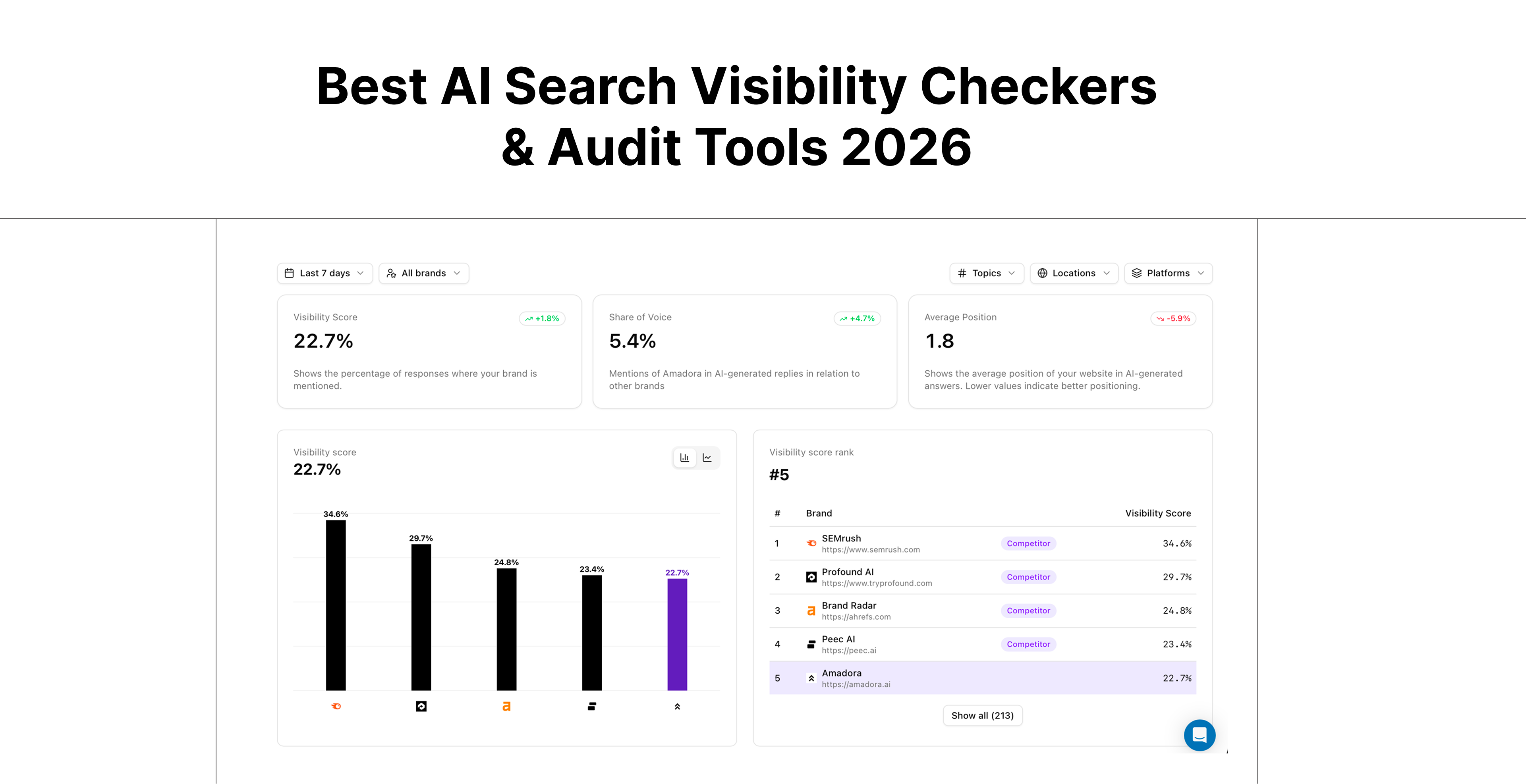
It is a proprietary metric used by tools like Amadora.ai and SearchAtlas to represent the percentage of AI answers where your brand is mentioned or cited relative to the total number of prompts tracked.
Final takeaway
LLM monitoring is no longer a "nice-to-have" experiment; it is a foundational requirement for any brand that wants to remain discoverable in 2026. Start by identifying your high-intent prompts, track your baseline visibility, and then use the source data to prioritize your content and PR efforts. The goal isn't just to be seen—it's to be recommended.

Start delivering GEO services to your clients this week
The AI search platform built for SEO agencies. Audit, plan, report, retain.

Amadora.ai - AI Search Analytics and Optimisation platform for SEO agencies and growth teams.


© All rights reserved. Amadora 2026
