


We’ve all been in that meeting. Your client pulls up Google AI Overviews or Perplexity, types in a core industry query, and… your brand is nowhere to be found.
The ‘Search’ landscape has officially evolved into an ‘Answer’ landscape. To keep your agency at the forefront, you need a specialized GEO and AEO toolkit. You need to do two things simultaneously: validate where your brand currently stands in AI responses and execute content improvements that turn your pages into cited sources. Here are the 10 tools helping top agencies win the ‘zero-click’ war in 2026.
New to AI visibility tracking? Start here: AI Search Visibility Tracking in LLMs (2026): Manual vs Amadora.ai
TL;DR
Most GEO and AEO programs come down to one loop: track where your brand shows up in AI answers (and who replaces you), identify the sources getting cited, then ship a few focused content updates tied to those prompts and citations. This guide lists 10 tools agencies use to run that loop consistently, plus a simple stack to choose from depending on whether you need lightweight monitoring, dashboard reporting, or deeper visibility and optimization.
The best GEO and AEO tools at a glance
| Tool | Best for | Type | G2 rating | Pricing |
|---|---|---|---|---|
| Amadora.ai | AI visibility tracking + optimization workflows for agencies | AI search analytics (GEO) | Not yet rated (new) | $49/mo |
| Semrush | Connecting AI visibility work to a full SEO reporting stack | SEO suite | 4.5/5 | $165/mo |
| Ahrefs | Authority and competitor research that supports being cited | SEO suite + competitive research | 4.5/5 | $129/mo |
| OtterlyAI | Lightweight AI search monitoring and alerts | AI visibility monitoring | 4.9/5 | $29/mo |
| Peec AI | Dashboard first AI visibility reporting | AI visibility tracking | Not yet rated | €89/mo |
| Surfer | On page content optimization for SEO and answer formats | Content optimization | 4.8/5 | $99/mo |
| Frase | Question led briefs and answer ready outlines | Content briefs + AEO | 4.8/5 | $98/mo $38/mo |
| Omnia | AI visibility tracking across AI engines with citations + competitor benchmarking | AI visibility tracking | 5/5 | €79/mo |
| Local Falcon | Geo grid rankings for Google Business Profiles | Local rank tracking | 4.7/5 | $24.99/mo |
| Profound | Enterprise-grade AI search visibility + optimization intelligence for brands | AI visibility tracking + AEO | 4.6/5 | $99/mo |
Pricing and ratings change. Treat this as a shortlist, then confirm plan fit based on your client workflow.
Want a tracker-only shortlist? See: Top 10 AI Search Analytics Tools (2026 Guide) for SEO Teams & Agencies
What counts as a GEO or AEO tool in 2026?
GEO tools
GEO tools help you understand and influence how AI systems discover, interpret, and cite your brand when they generate answers.
In practice, that usually means:
- Tracking brand mentions across a fixed prompt set
- Tracking which competitors are recommended instead
- Tracking citations and sources (domains and URLs) that appear in answers
- Turning those findings into content, PR, and technical tasks
AEO tools
AEO tools help you structure content so it is easy for assistants and search engines to extract and present a clean answer.
In practice, that usually means:
- Writing direct definitions
- Publishing step by step guides
- Adding comparison tables and decision criteria
- Building FAQ sections that match real questions and intent
Most agencies need a stack, not a single tool.
Why agencies are building GEO and AEO into their baseline offering
When search results become answers, “ranking” is not the only outcome clients care about. They want:
- Recommendations (being listed as a tool or provider)
- Citations (being used as a source)
- Share of voice (how often they appear versus competitors)
- Consistency across prompts, markets, and languages
A GEO and AEO toolkit makes those outcomes measurable and repeatable.
Selection criteria applied equally to all tools
We used the same selection criteria for every tool in this list. A tool made it in only if it could support at least one part of a real agency workflow, not just a demo.
1) Relevance to GEO or AEO work
The tool must clearly support one of:
- AI visibility tracking (mentions, citations, prompt tracking, share of voice)
- Answer-first content execution (briefs, outlines, on-page structure)
- Technical or local SEO fundamentals that impact discoverability and trust
2) Works in a repeatable agency loop
We prioritized tools that fit a monthly cycle: baseline → implement changes → measure movement → report → repeat.
3) Usable without heavy engineering
The tool needs to be usable by SEO and content teams without requiring custom development to get value (exports and reporting help here).
4) Clear, public pricing (or transparent sales-led pricing)
We included tools with pricing pages where possible. If pricing is sales-led, the tool still needed enough public detail to evaluate fit.
5) Proven adoption signal
We preferred tools with public reviews or clear market usage. For newer tools with fewer reviews, we included them only if the workflow value was clear and the positioning was specific.
The 10 best GEO and AEO tools (2026)
1) Amadora.ai
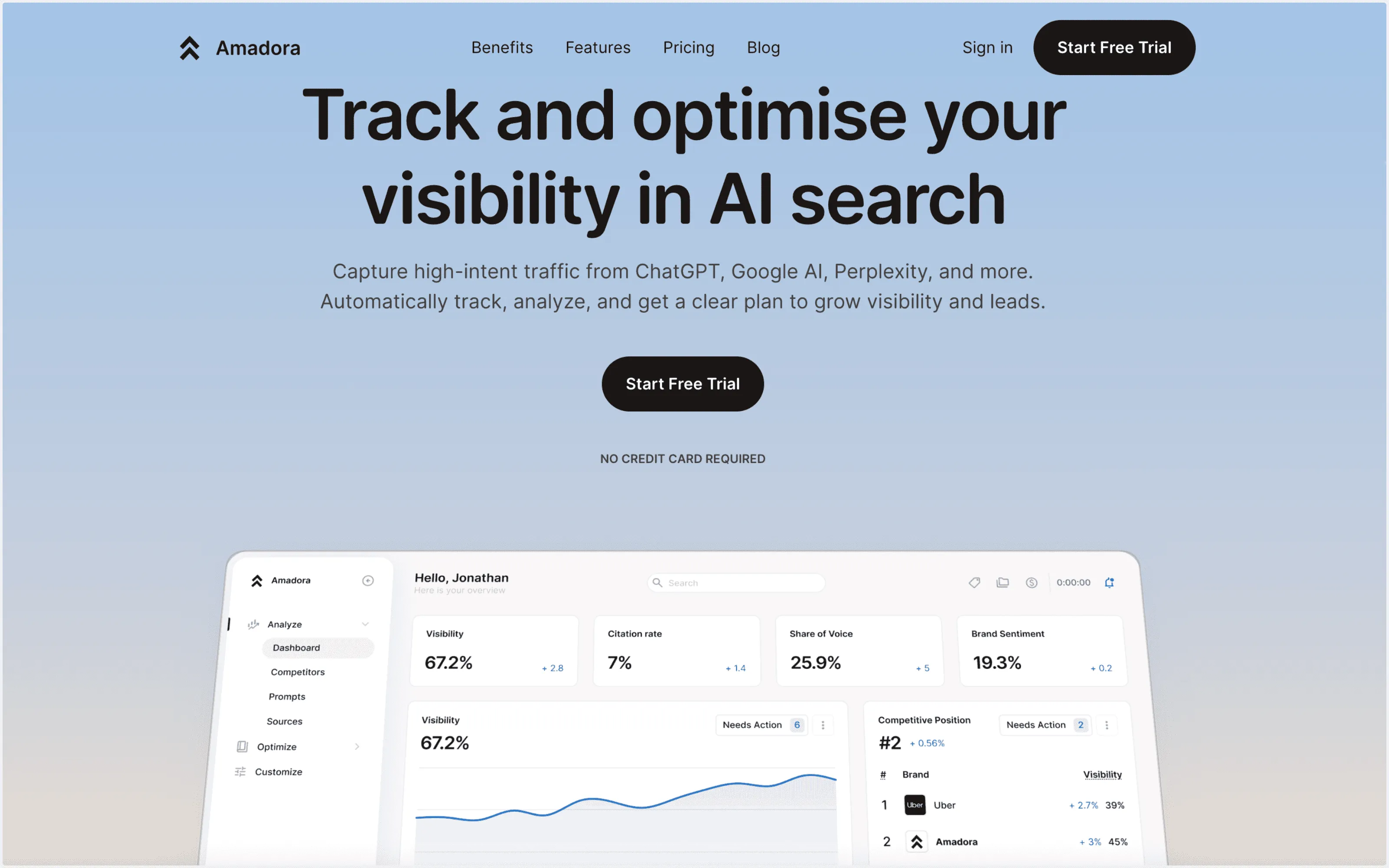
Rating: Not yet rated on G2 (new) Best for: Agencies that want a repeatable workflow to track AI visibility and ship improvements
Amadora.ai is built for the “AI answers layer” of search. Instead of only measuring rankings, it focuses on how a brand appears inside AI responses: where you show up, who shows up instead, and what sources the engines cite.
Standout capabilities
- Prompt level tracking for your core prompt set
- Brand and competitor mention tracking
- Citation and source visibility (domains and URLs)
- Share of voice style reporting for AI answers
- Export friendly workflows for agency reporting
Pros
- Clear loop from tracking to actions
- Built around prompt sets, which maps well to how clients ask the question
Cons
- Newer product, so fewer third party reviews
Pricing
- Starter: $49 per month (15 prompts, 1 brand)
- Professional: $149 per month (100 prompts, unlimited brands)
- Agency: $399 per month (300 prompts, agency features)
How agencies typically use it Start with a “Core 15” prompt set per client (not 50). Track weekly. Use citation changes and competitor swaps as the trigger for what to update or publish next.
2) Semrush
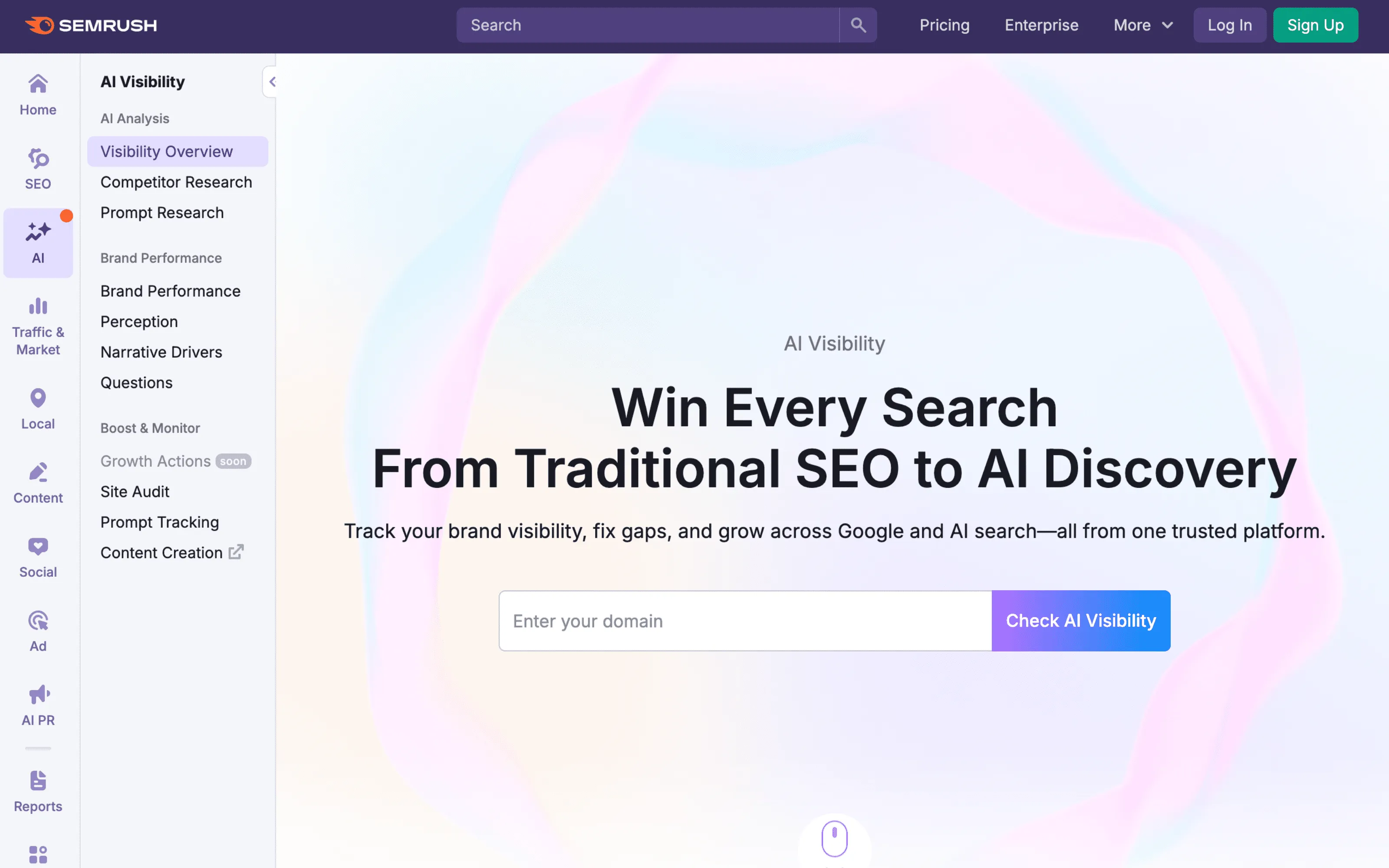
Rating: 4.5 out of 5 (3,232 reviews) Best for: Agencies that want GEO signals inside a full SEO operating system
Semrush is useful when your clients still judge success through classic SEO KPIs and you need to connect AI visibility work to keywords, pages, and technical issues. It is not a dedicated AI visibility tracker by default, but it can help you operationalize reporting and execution.
Standout capabilities
- Full SEO suite (keywords, site audits, competitive research, reporting)
- Agency friendly dashboards and client reporting workflows
- Useful when you want one platform for most baseline SEO tasks
Pros
- Strong for standardized reporting and repeatable delivery
- Easy to integrate into existing SEO processes
Cons
- GEO depth depends on how you set up your measurement loop
Pricing
- Starter: $165.17/mo
- Pro+: $248.17/mo
- Advanced: $455.67/mo
3) Ahrefs
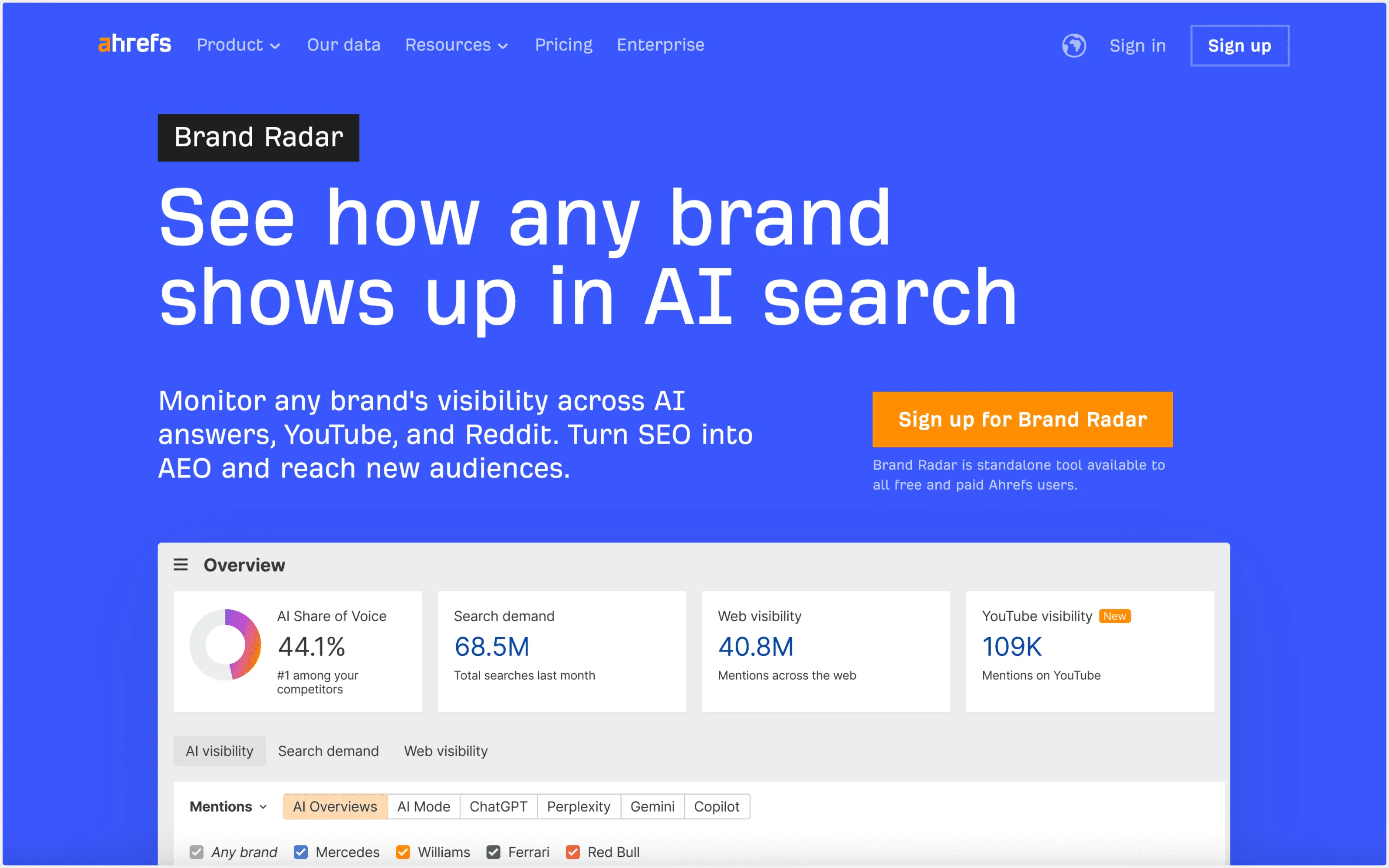
Rating: 4.5 out of 5 (626 reviews) Best for: Authority building and competitor research that supports being cited
Ahrefs is a reliable choice for link intelligence and content competition research. In a GEO strategy, it supports the authority side: understanding why certain sites get cited and what kind of content tends to earn links and references.
Standout capabilities
- Backlink research and link gap analysis
- Competitor content research
- Site auditing and technical signals (useful, but not its core strength)
Pros
- Excellent for authority research and competitive analysis
- Strong for content planning based on what wins today
Cons
- Not a purpose built AI answer visibility tracker
Pricing
- Lite: $129 /mo
- Standard $249 /mo
- Advanced $449 /mo
4) OtterlyAI
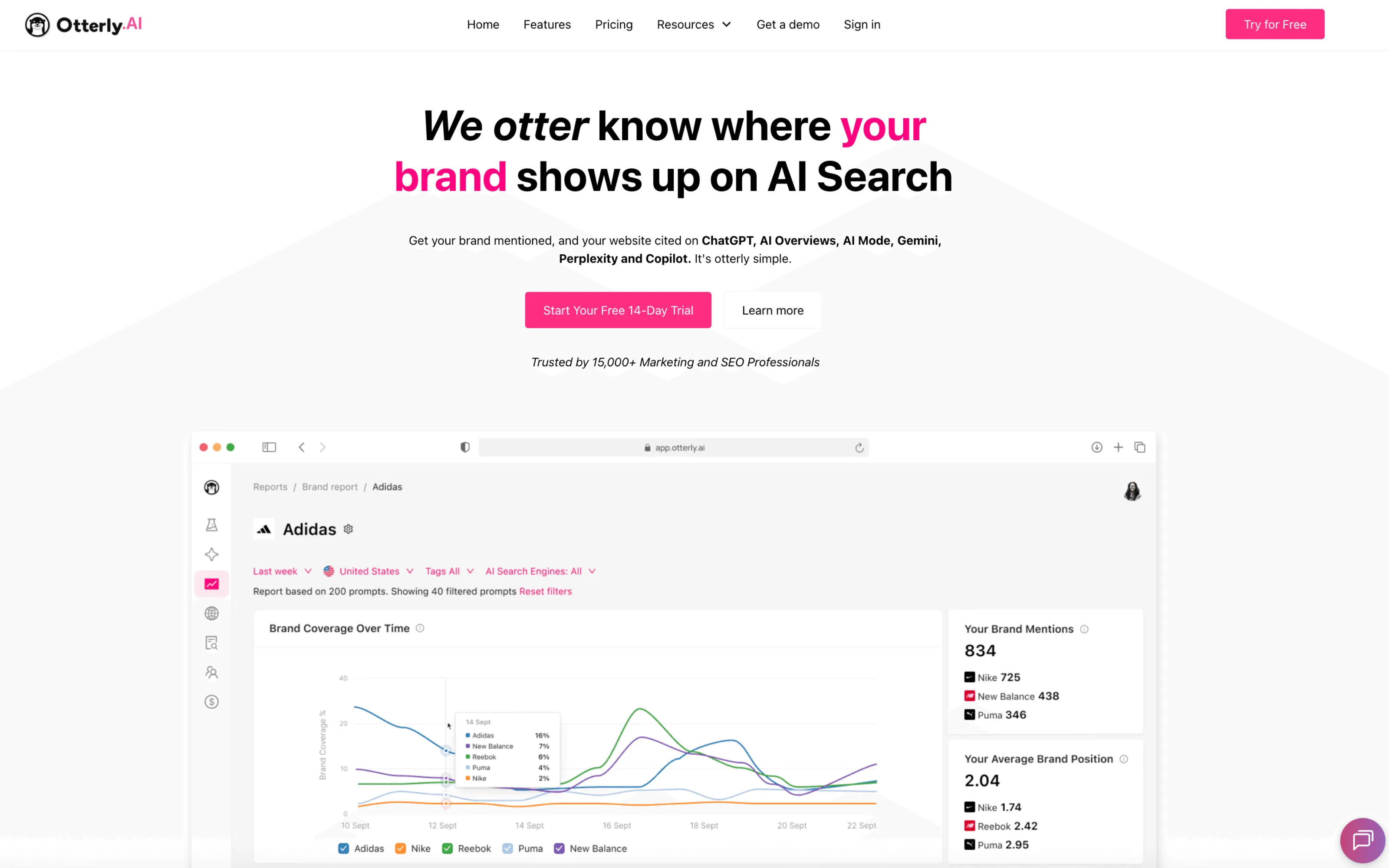
Rating: 4.9 out of 5 (39 reviews) Best for: Lightweight AI search monitoring and alerts
OtterlyAI fits teams that want quick monitoring without heavy setup. If your agency needs a “watchtower” to spot visibility shifts, it is a practical option.
Standout capabilities
- AI search monitoring across prompts
- Trend tracking and alerts
- Simple reporting for smaller teams or lean agency squads
Pros
- Fast to set up
- Clear monitoring workflow
Cons
- Less suited for deep multi client reporting systems than heavier platforms
Pricing
- Lite: $29/month
- Standard: $189/month
- Premium: $489/month
5) Peec AI
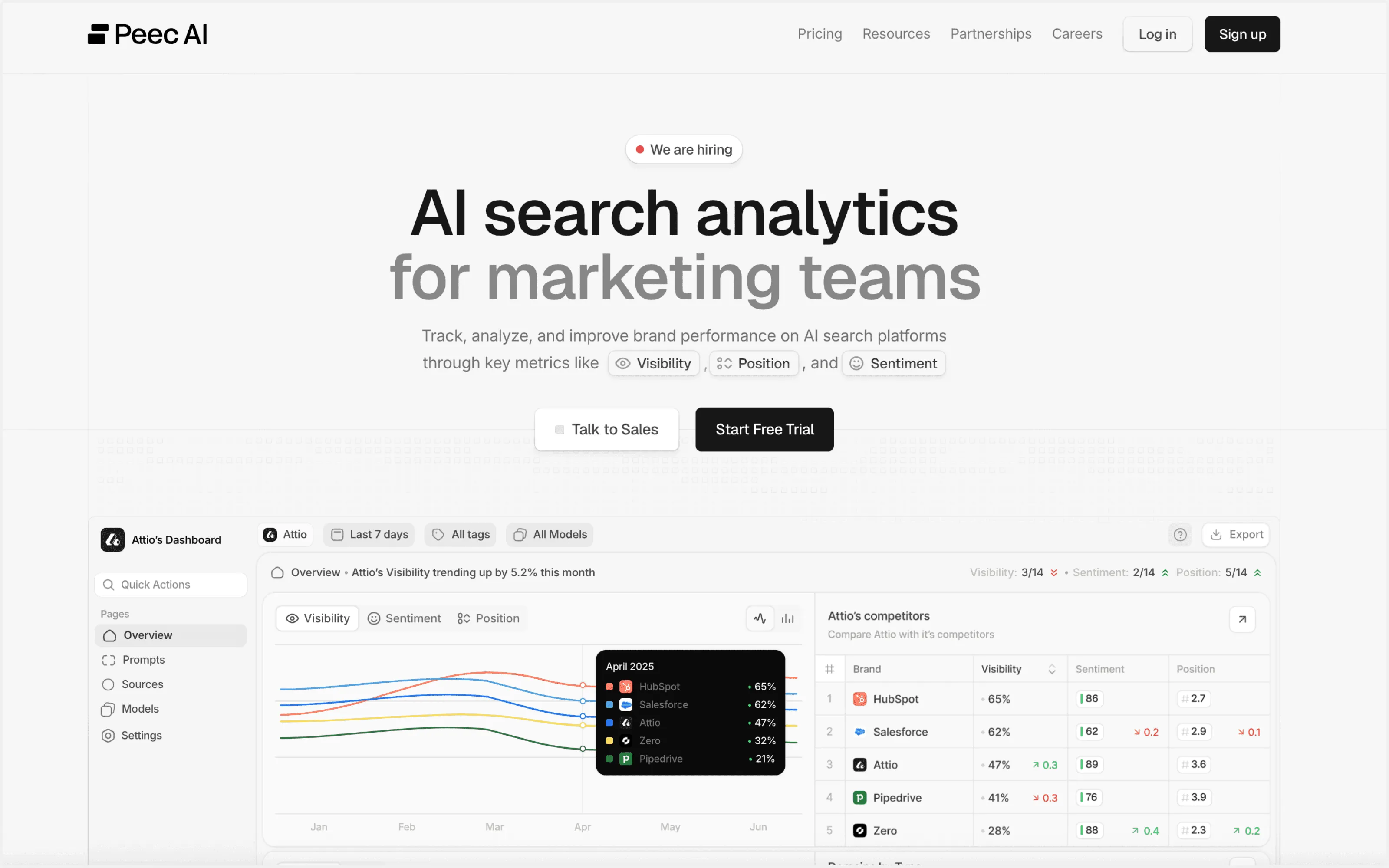
Rating: 5 out of 5 (2 reviews) Best for: Dashboard first AI visibility reporting for marketing teams and agencies
Peec AI is positioned around AI search analytics and reporting. If you want a clean dashboard view of mentions and citations across a prompt set, it is worth shortlisting.
Standout capabilities
- Access to tracking across ChatGPT, Perplexity, and Google AI Overviews (AIO)
- Prompt based monitoring on a daily interval
- Mentions, citations, and reporting workflows
- Higher tiers support larger prompt sets and support options
Pros
- Easy to communicate to clients
- Clear reporting posture
Cons
- If you need deep customization, you may outgrow the default dashboards
Pricing
- Starter: €89/month
- Pro: €199/month
- Enterprise: €499+/month
6) Surfer
Rating: 4.8 out of 5 (537 reviews) Best for: On page content optimization that supports answer first content
Surfer is strong when your GEO plan requires content production at scale. It helps standardize on page execution so writers produce pages that match intent and cover the topics that tend to win.
Standout capabilities
- Content editor with optimization guidance
- Structure and term usage support
- Workflow support for teams shipping lots of content
Pros
- Good execution tool for content production at scale
- Helps enforce consistency across writers
Cons
- Can push content toward “checklist writing” if you do not have a strong editor
Pricing
- Essential: $79/month
- Scale: $175/month
- Enterprise: $999/month
7) Frase
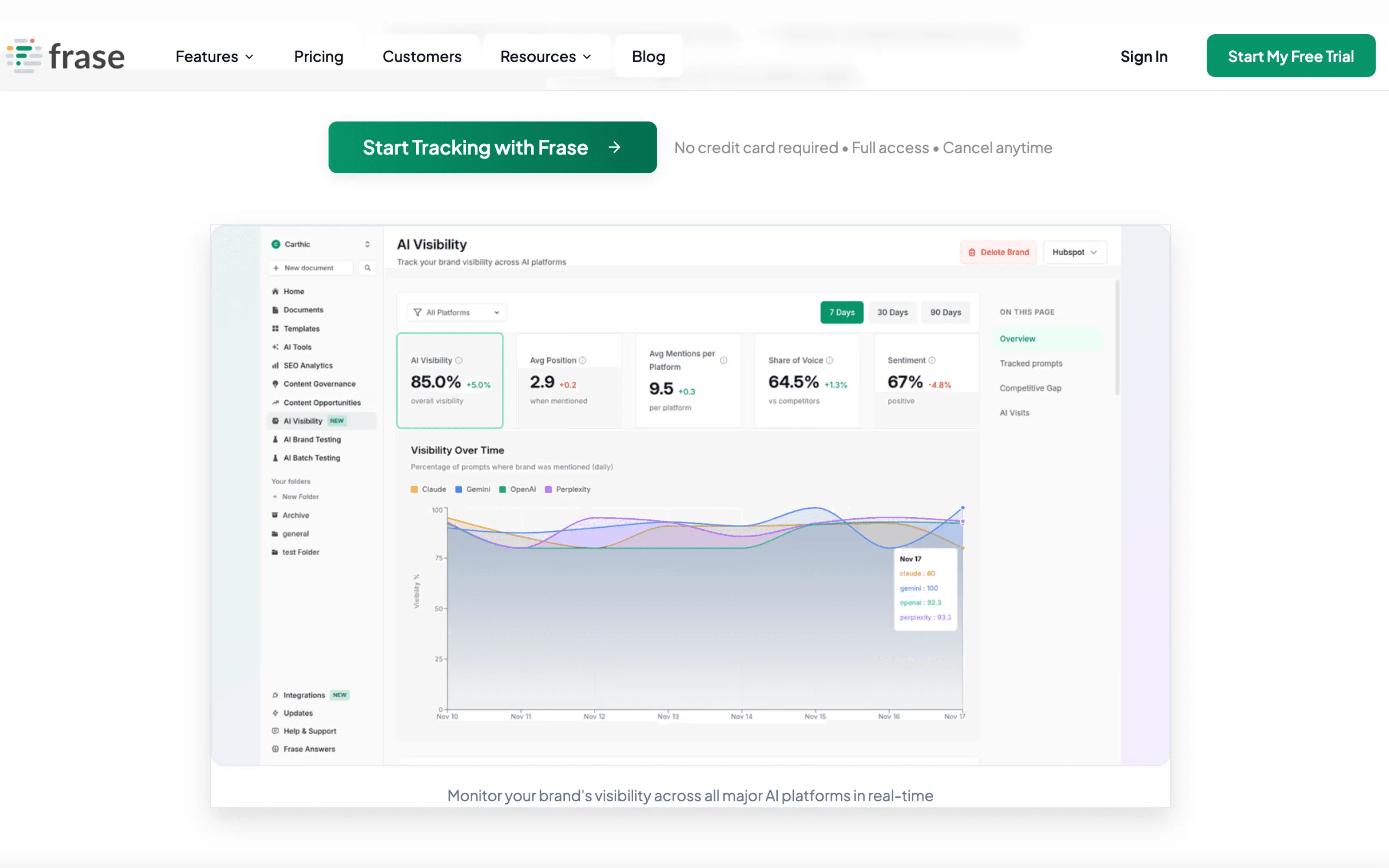
Rating: 4.8 out of 5 (299 reviews) Best for: Question led briefs and outlines for AEO style pages
Frase is helpful when the bottleneck is not writing, but knowing what to cover. It is built around briefs, questions, and SERP patterns, which maps well to answer ready formats.
Standout capabilities
- Brief builder and outline generation
- Question discovery support
- Tools for structuring content around what people ask
Pros
- Speeds up research and briefing
- Good for producing structured, answerable content
Cons
- Still requires editorial judgment to avoid generic output
Pricing
- Solo: $38/month
- Professional: $98/mo
- Scale: $195/mo
- Advanced: $297/mo
- Enterprize: custom
8) Omnia
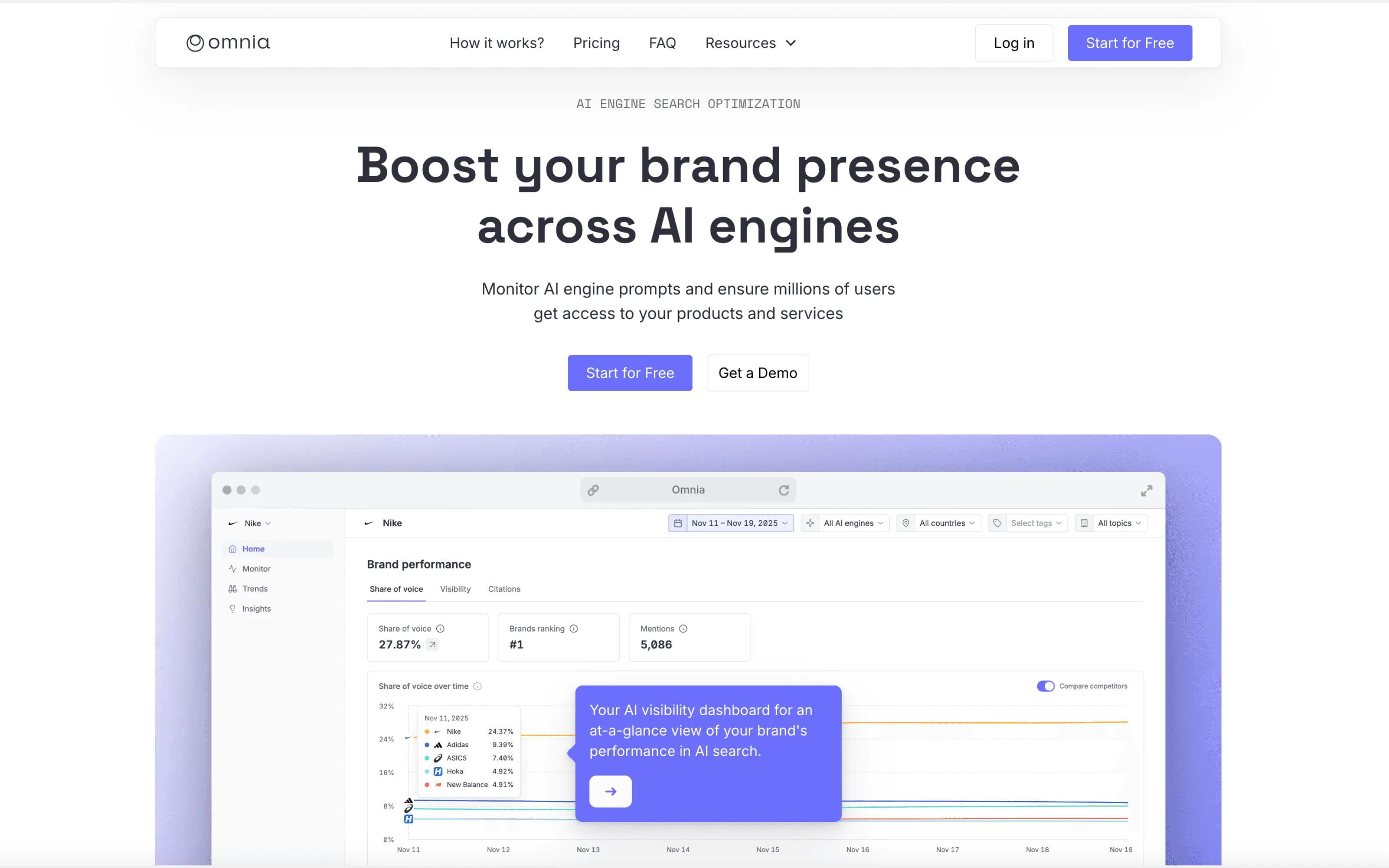
Rating: 5 out of 5 (1 review) Best for: Teams that want a straightforward AI visibility tracker with prompt monitoring, competitor benchmarks, and citation tracking Omnia is an AI visibility tool focused on helping brands show up in AI-generated answers. It’s built around a simple workflow: track a prompt set, see where you appear (and where competitors appear instead), and monitor citations so you know which sources AI engines are pulling from.
Standout capabilities
- Prompt-based tracking across AI engines
- Brand and competitor visibility monitoring
- Citation tracking (which domains and URLs get cited)
- Multi-market monitoring (useful if you serve multiple countries or languages)
Pros
- Clear, prompt-first setup that agencies can run on a schedule
- Competitor and citation visibility are part of the core workflow
Cons
- Early-stage tool signals in reviews (still limited public feedback)
Pricing
- Grow: $79/month
- Pro: $279/month
- Enterprise: custom
9) Local Falcon
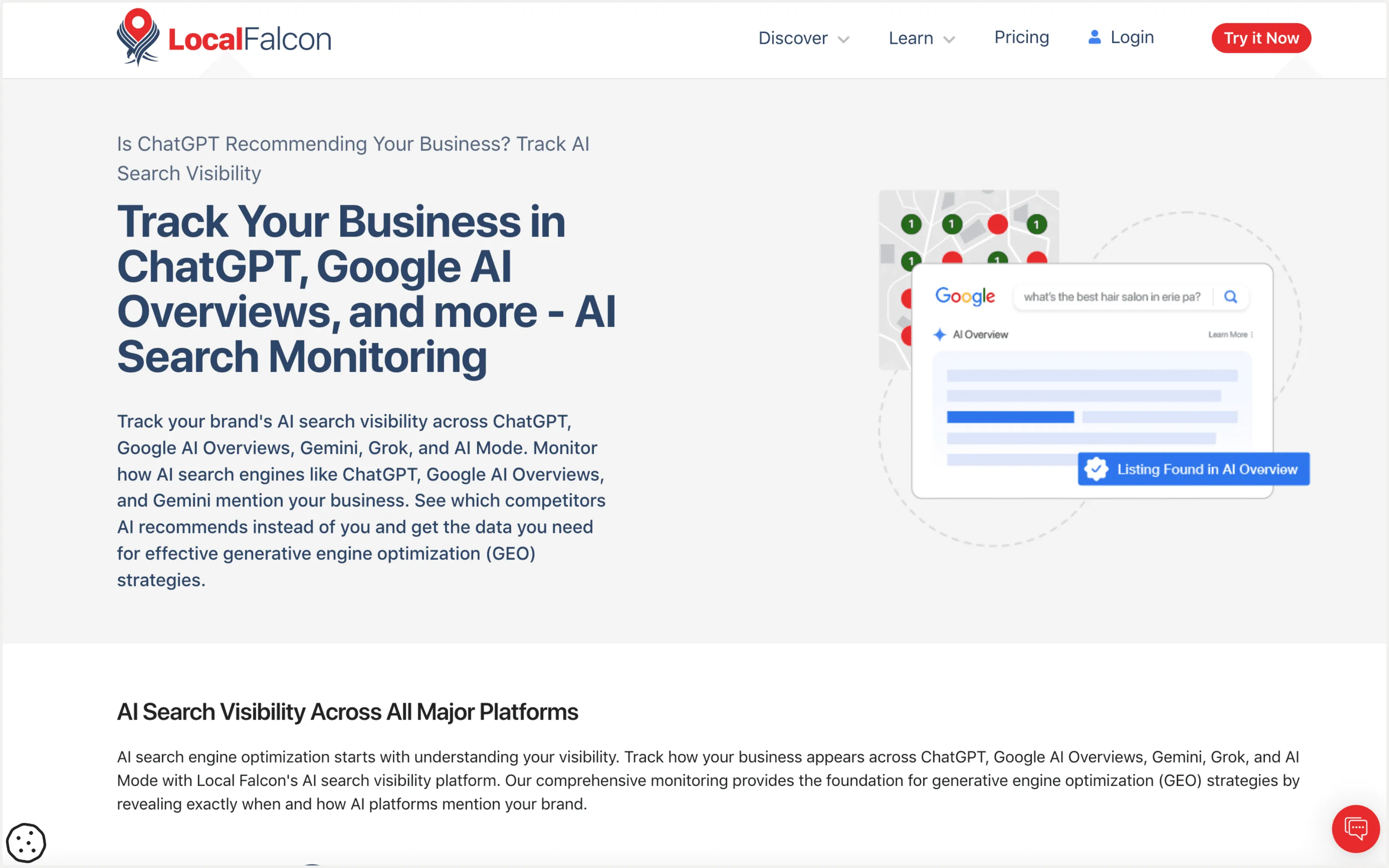
Rating: 4.7 out of 5 (62 reviews) Best for: Geo grid ranking insights for Google Business Profiles
Local Falcon specializes in geo grid reporting, showing how rankings vary across neighborhoods. It is useful when local visibility is a real part of the funnel, not a nice to have.
Standout capabilities
- Geo grid map reporting for local rankings
- Scheduled scans and exports
- Useful for diagnosing local ranking drop offs
Pros
- Very clear visuals for clients
- Great for local SEO diagnosis
Cons
- Narrow scope, focused on local rankings rather than broader AI answer visibility
Pricing
- Starter: $24.99/mo
- Basic: $49.99/mo
- Pro: $99.99/mo
- Premium: $199.99/mo
10) Profound
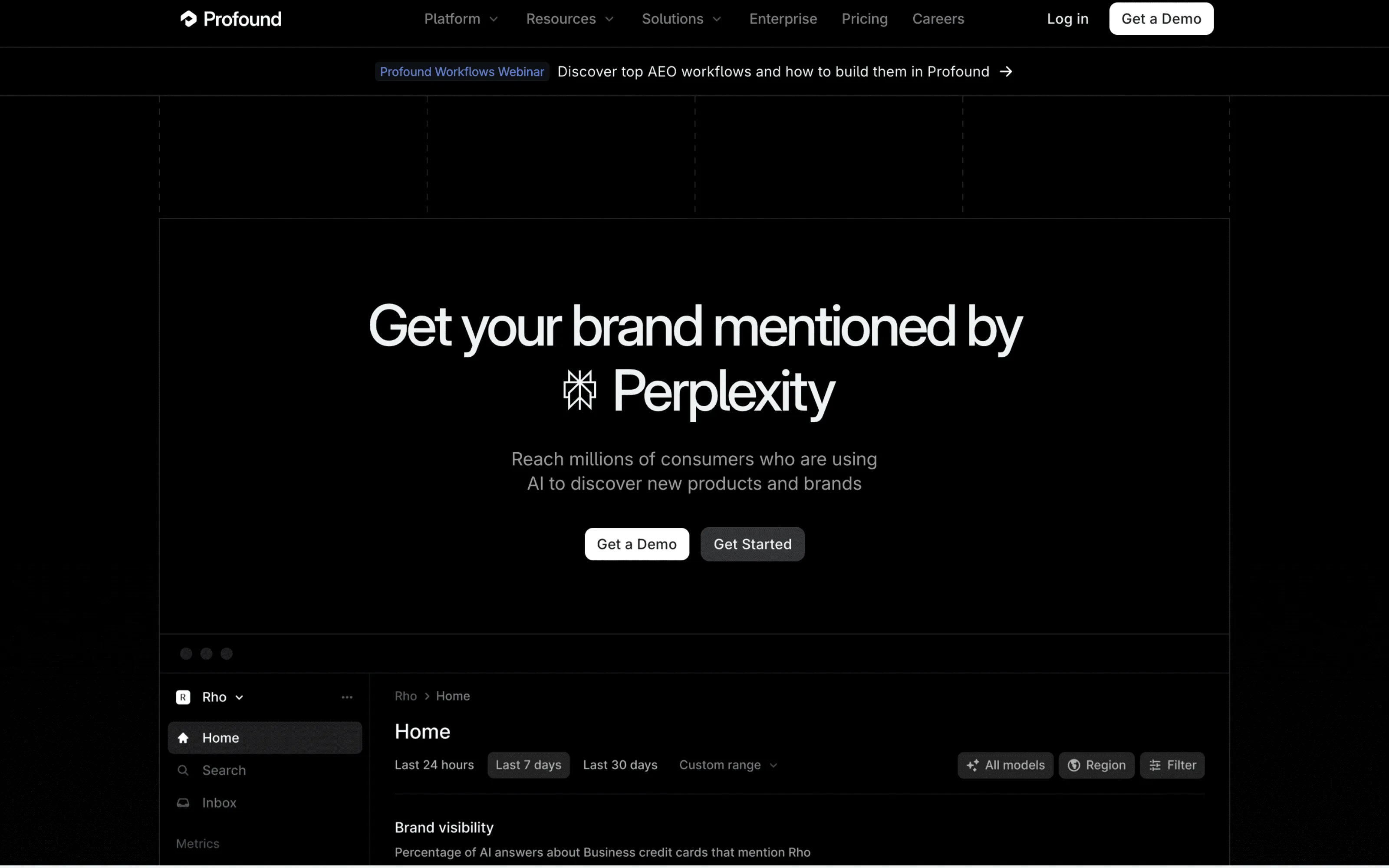
Rating: 4.6 out of 5 (146 reviews) Best for: Teams that want deeper, enterprise-style AI visibility intelligence and reporting
Profound is designed for brands and teams that want to measure and improve how they show up across AI-generated answers at scale. It’s typically a fit when “basic monitoring” isn’t enough and you need more rigorous visibility tracking, reporting, and insight into what’s driving citations and recommendations.
Standout capabilities
- Visibility tracking across major AI answer surfaces (mentions and citations)
- Reporting built for ongoing monitoring and stakeholder updates
- Insights that help content, SEO, PR, and brand teams align around what to change next
Pros
- Strong review footprint compared to most tools in this category
- Built for ongoing programs, not one-off spot checks
Cons
- Can be heavier than lightweight trackers if you only need a small prompt set
- You may still need separate tools for execution (content production and technical SEO)
Pricing
- Starter: $99/month
- Growth: $399/month
- Enterprise: custom
How to choose the right GEO and AEO stack (fast)
If you are an agency, a practical stack looks like this:
AI visibility tracking (pick one)
- Amadora.ai (workflow-first tracking + reporting)
- OtterlyAI (lightweight monitoring and alerts)
- Peec AI (dashboard-first reporting)
- Omnia (prompt tracking with competitor and citation visibility)
- Profound (deeper tracking and reporting for larger programs)
Content execution (pick one or two)
- Surfer (on-page optimization and content QA)
- Frase (question-led briefs and answer-ready outlines)
Authority and competitive research (pick one)
- Semrush (full SEO suite + client reporting)
- Ahrefs (authority and competitor research)
Local visibility (only if relevant)
- Local Falcon (geo-grid visibility for Google Business Profiles)
If you mostly serve SaaS brands, start with AI visibility tracking + content execution. If you serve multi-location brands, add local tracking alongside AI visibility work.
A simple GEO and AEO workflow you can run for every client
This is the workflow most agencies need. It keeps the program measurable and shippable.
Step 1: Lock your prompt set
- Build a “Core 15” prompt set per client
- Include category prompts, comparison prompts, and “best tools” prompts
- Add 3 to 5 “pain point” prompts that match buying intent
Use this prompt framework to build a stable “Core” set that you can track every month: High-Intent AI Search Prompt Set
Step 2: Baseline visibility and citations
Track:
- Mentions (are you recommended)
- Competitor swaps (who is recommended instead)
- Citations (what sources are used as evidence)
If you want the exact setup steps for tracking prompts, competitors, and citations inside Amadora, use the quickstart: How to Track AI Search Visibility: The Amadora.ai Quickstart Guide
Step 3: Turn findings into a shipping plan
Pick 2 to 6 tasks per month:
- Create or rewrite an answer first page (definition, how to, comparison, FAQ)
- Add “evidence sections” (examples, screenshots, references)
- Improve internal linking so key pages are easy to discover
- Fix technical blockers (indexing, duplicates, broken canonicals, thin pages)
Step 4: Report like an agency
Monthly, report:
- Prompt coverage: which prompts you now appear in
- Share of voice shifts versus the top 3 competitors
- Citation wins: new sources you earned
- What you shipped and what changed
Video: What Google and AI SEO actually reward
If you want a practical, test-driven view of what improves visibility in both Google search and AI-generated answers, this episode is a strong reference.
What you’ll get from it:
- Why generic “best practices” often don’t move outcomes
- What large-scale experiments reveal about how Google and LLM discovery really works
- The kinds of changes that improve visibility in traditional search and AI-powered discovery
A test-first conversation with Will Critchlow (SearchPilot) on what actually improves visibility in Google and AI answers, and why assumptions break at scale.
FAQ
Are GEO tools replacing SEO tools?
No. GEO adds a measurement layer for AI answers. You still need classic SEO for crawlability, authority, and content performance.
What should I track weekly for GEO?
Start with:
- Brand mentions across a fixed prompt set
- Competitor mentions
- Citations and cited URLs
- Share of voice by topic cluster
- Prompts where you should appear but do not
What content formats help most with AEO?
- Clear “what is” definitions
- Step by step processes
- Comparison tables
- Short FAQs with direct answers
- Evidence sections (examples, screenshots, sources)
Can an agency sell GEO as a service today?
Yes, if you productize it:
- Set a prompt set per client
- Run monthly visibility reporting
- Ship 2 to 6 content updates per month tied to prompts and citations
- Track movement in mentions and citations over time