9 Best Brandlight Alternatives in 2026 for Enterprise Brands
The nine Brandlight alternatives worth looking at are Amadora AI, BrightEdge, Adobe Brand Visibility, Profound, AthenaHQ, Evertune, Scrunch AI, Goodie and Brandlight itself. Brandlight is an enterprise AI visibility platform sold as a managed programme: it tracks six or more engines with no tiers, scores the publishers that shape each answer, and assigns a strategist to act on the findings. The friction is where the work lands. Brandlight hands over drafts, outreach briefs and recommendations, and the change to your own pages is made by your team, its strategists or your agency — there is no price to read, only a paid three-month pilot.
By Dmitry Chistov, CEO & co-founder, Amadora AIPrices verified 29 Sept 20269 tools tested · ~12 min read
All nine, side by side
Nine tools on the five things that decide a Brandlight evaluation: whether a price is published, the engines included at entry, brands and seats, how far each carries the work, and whether it sees Google. Four of the nine publish no brand price at all, and one of those four, Profound, has withdrawn the brand plans it published in August.
9 tools compared on price, engines at entry, brands and seats, execution and Google coverage
Tool
Best for
Starting price
Engines at entry
Brands & seats
Execution
Google SEO
Amadora AIOur product
Teams wanting the change made on their own site
$99/mo20 prompts · 15 articles
ChatGPT, Perplexity, GeminiGoogle and AI Overviews from $299
1 project, 1 seatunlimited seats on Growth
7Creates, publishes and fixesRung 7 of 7
Yes
Brandlight
Global brands wanting a strategist-led programme
Quote onlystarts with a paid 3-month pilot
ChatGPT, Gemini, Perplexity, Copilot, Claude, AI Overviewsnot tiered
Not publishedmulti-brand, multi-region
4Drafts and briefs; people actRung 4 of 7
No
BrightEdge
Enterprises wanting links and schema changed for them
Quote only/pricing returns a 404
ChatGPT, Perplexity, Gemini, AI Overviews, AI Modeno tiers published
Not publishedsold by contract
7Fixes links and schema itselfRung 7 of 7
Yes
Adobe Brand Visibility
Adobe-stack enterprises fixing pages at the CDN
Quote onlytrial for Adobe customers
ChatGPT, Perplexity, Gemini, Copilot, AI Overviews, AI Modein the trial view
Not publishedbundles Semrush entitlements
6Fixes pages at the CDN edgeRung 6 of 7
Yes
Profound
Brands wanting agents that draft into the CMS
Quote onlyfree 7-day trial
ChatGPT, Gemini, AI Overviewson the trial; 9 on Enterprise
Unlimitedon both plans
5Creates and drafts into your CMSRung 5 of 7
No
AthenaHQ
Single-brand teams publishing drafts to their CMS
$295/moper website; free tier
11 models, Claude and Grok includedmore on request
1 websiteunlimited members
5Creates and publishes to six CMSsRung 5 of 7
Partial
Evertune
Advertisers pairing AI visibility with AI ads
$800/modemo required
11 AI models100,000 prompts
Not published
4Writes 25 articles a monthRung 4 of 7
No
Scrunch AI
Enterprises watching what AI crawlers fetch
$250/moCore; Enterprise custom
ChatGPT, Perplexity, AI Overviews, Copilot9 on Enterprise
1 brand, 5 licences
4Audits and generates contentRung 4 of 7
No
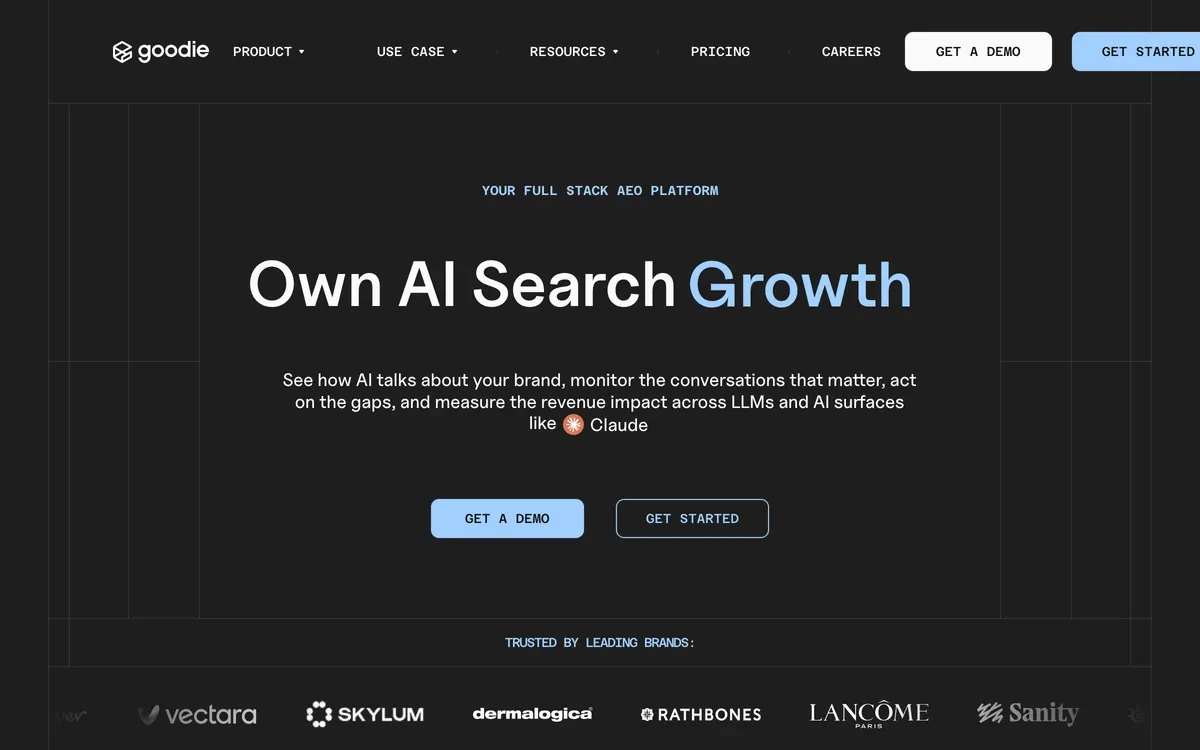
Goodie
Single-brand teams wanting agents plus a strategist
$478.80/mo$399 billed annually
ChatGPT, AI Overviews, Perplexity, AI Mode, Copilotup to 13 on Enterprise
1 brand, 5 seatsunlimited on Pro
4Writes and recommendsRung 4 of 7
Partial
Scroll the table sideways →
Prices are monthly list, read off each vendor's own pages on 25 and 29 September 2026. Brandlight, BrightEdge, Adobe and Profound publish no brand price, so their cells say so. Amadora AI is our product.
Why teams leave Brandlight
Teams leave Brandlight over where its work stops, rarely over the quality of its data. Brandlight watches the engines well: it tracks at least six without tiering them, scores which publishers and third-party sources shape each answer, and hands a dedicated strategist the job of turning that into priorities. What it produces is drafts, publisher outreach briefs and recommendations. Its own comparison pages call the model “done-with-you execution”, and its agency programme states the split in five words: “You execute, you bill.” A recommendation to fix a product page or add a comparison table becomes a ticket for your web team, and an outreach brief becomes a job for PR.
The second reason is how it is bought. There is no pricing page, the /pricing URL returns a 404, and no trial exists; its own buyer’s guide says engagements typically begin with a paid three-month pilot. Google rankings are out of scope by design — Brandlight describes AI visibility as a different discipline from SEO — so the report showing whether a change also moved Google lives in a second tool. Attribution is still listed as coming soon.
How we compared
Every fact here comes from the vendor’s own pages. Brandlight, Profound, AthenaHQ, Evertune, Scrunch AI and Goodie were read in a browser on 29 September 2026; BrightEdge and Adobe on 25 September. Brandlight publishes no price, so we compared on what it does document — its llms.txt, its product pages, its buyer’s guide and its own vendor comparisons — and on what each alternative changes on the buyer’s site.
Amadora AI is our product and it ranks first here. Its entry follows the same shape as every other one, limitations included, and each competitor links to its own site so the figures can be checked. A wider set of tools sits in our roundup of the top LLM monitoring tools.
The nine alternatives, ranked
Ranked for the buyer currently evaluating Brandlight: an enterprise marketing team that wants AI visibility moved, not only mapped. Execution on the buyer’s own site weighs heavily, and so does whether the product can be priced and started without a paid pilot.
01
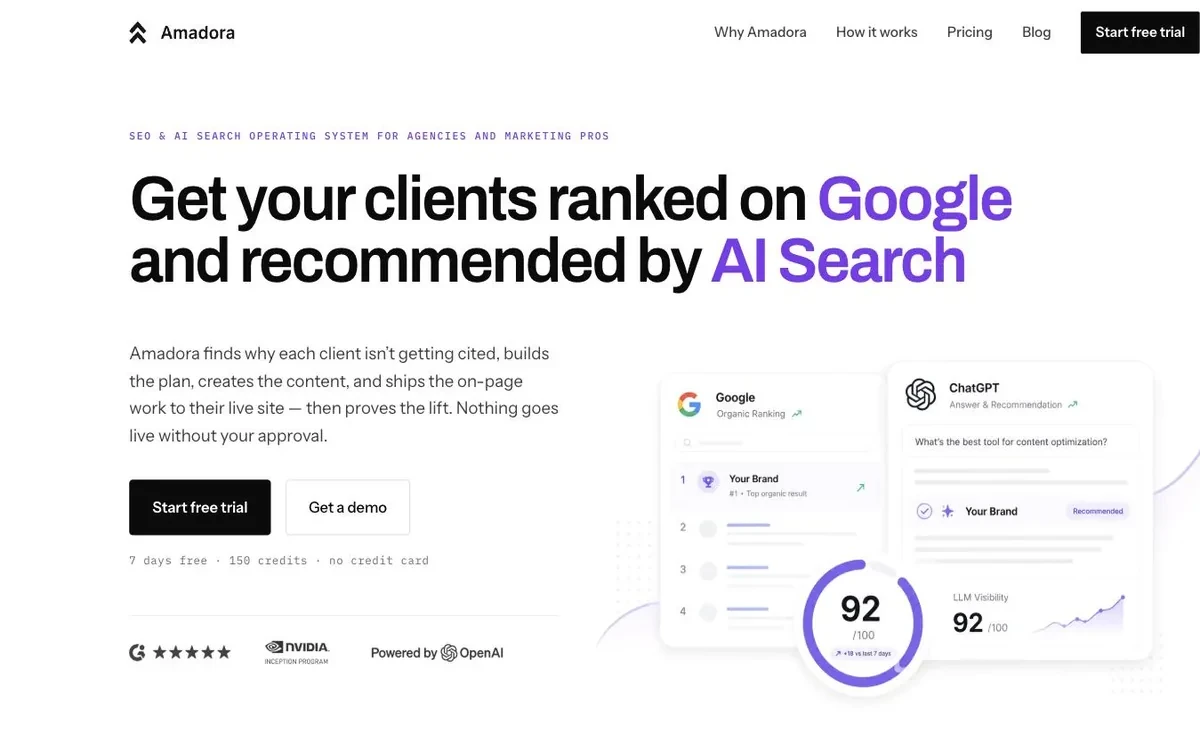
Amadora AI — Best for enterprise and mid-market brands that want the fix published on their own site and measured against Google in the same report.
Our productRung 7 of 7From $99/moPublishes to WordPress and WebflowGoogle SEO included
Amadora AI runs a brand’s prompts daily against the live ChatGPT, Perplexity and Gemini interfaces and names the sources each answer trusted. It then produces the work that closes the gap — briefs, drafts, landing pages, outreach lists — ships approved changes into the CMS, and repairs internal links and schema. Search Console connects, so the ranking and the AI answer arrive in one report.
Amadora AI leads on finding why a client is not cited, then shipping the fix.
Key features
Publishes to WordPress and Webflow directly, other platforms via plugin, API and MCP.
Agents place internal links and apply on-page changes and schema, approval-gated and reversible.
Google and AI Overviews included from Pro, beside ChatGPT, Perplexity and Gemini.
A Strategist add-on runs onboarding, plan approval and mention outreach, $999/mo on Pro and Growth.
Pricing
Three plans on Amadora AI’s pricing page, billed monthly. Starter $99/mo: 20 prompts, 15 articles, one seat. Pro $299/mo: 100 prompts, 30 articles, five seats. Growth $799/mo: 300 prompts, 120 articles, three projects, unlimited seats. Two months free on annual billing; three days free, no card.
Limitations
Claude, Copilot, AI Mode and Grok are paid add-ons on every plan.
Publisher influence is read from citations, not scored per publisher as Brandlight does.
Single sign-on is on the custom agency Enterprise plan only.
Best for a brand that wants the fix published on its own site and the AI number beside the Google number, on a plan it can buy this week. Not the right call if the work is mainly publisher placement across dozens of markets.
02
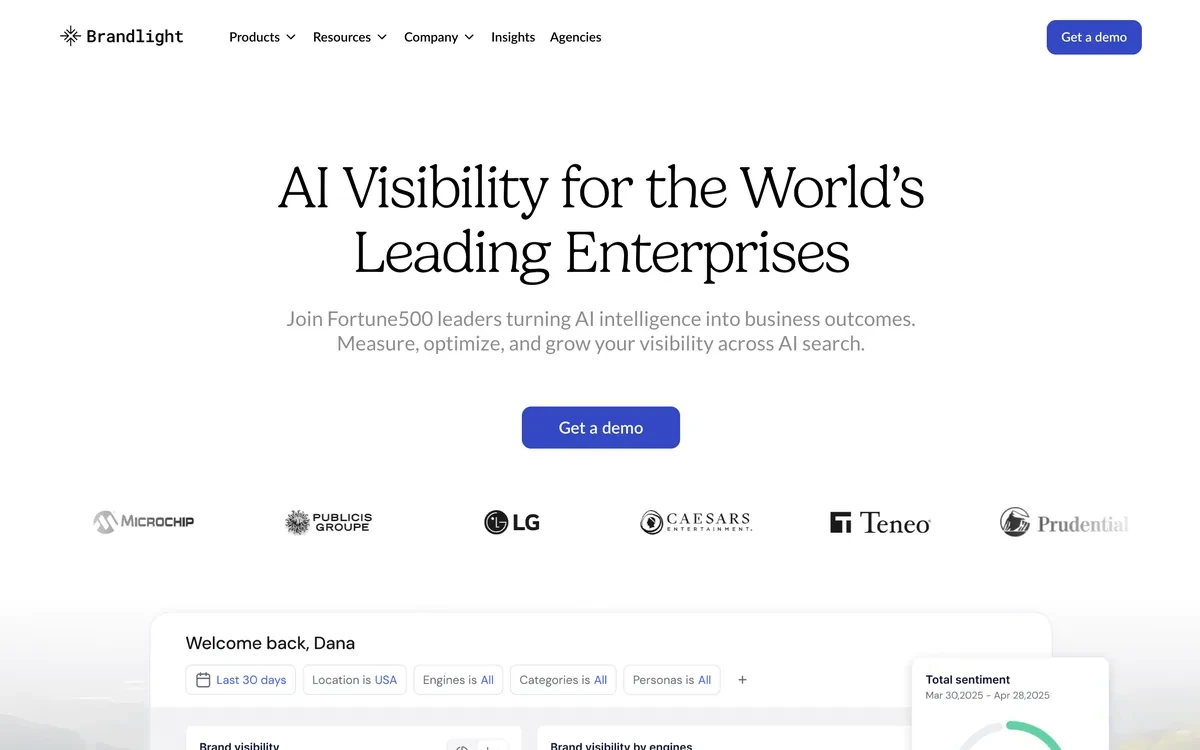
Brandlight — Best for Fortune 500 brands that want a managed programme with a named strategist, and publisher influence mapped across every market.
Rung 4 of 7No published pricePaid 3-month pilotGoogle SEO no
Brandlight is the enterprise programme in this category: a platform plus a dedicated AI strategist, a CX lead, biweekly working sessions and quarterly planning. It maps which publishers shape each AI answer and scores them, tracks paid placements inside answers, and follows products through AI shopping. Its own comparisons cite twelve of twelve Kimberly-Clark brands in the top three, and it raised a $30 million Series A in February 2026.
Brandlight sells AI visibility to enterprises and names its customers on the homepage.
Key features
Partnerships module: publisher influence scores and exportable outreach briefs.
Multi-agent content generation from the brand book, with legal guardrails.
Impact Tracker ties each implemented change to shifts in AI citations.
SOC 2 Type II, multi-brand and multi-region, with no PII required.
Pricing
Nothing is published. The /pricing URL returns a 404, and its llms.txt says pricing is quote-based with no self-serve tiers. Its buyer’s guide says engagements typically begin with a paid three-month pilot, priced to the markets, lines of business and service level in scope.
Limitations
No price, no trial, and a paid pilot before anything can be judged.
Nothing is published to your site; changes run through people.
No Google rankings, and Attribution is still marked coming soon.
Best for a Fortune 500 marketing organisation that wants a strategist running AI visibility across brands, regions and publishers. Not for a team that wants the software itself to change its pages.
03
BrightEdge — Best for enterprise SEO teams that want internal links and schema changed on a very large site without a developer ticket.
Rung 7 of 7No published price5 AI engines namedGoogle SEO yes
BrightEdge is the incumbent enterprise SEO suite, and it has gone further into execution than Brandlight on the owned site. Site Agent builds internal links and Schema Agent deploys JSON-LD in what BrightEdge calls Agent Mode, with no person in the loop. AI Catalyst tracks mentions, citations and sentiment by engine, and pins to the dashboards that carry its rank reporting.
BrightEdge sells one unified platform across Google, AI Overviews, ChatGPT and Perplexity.
Key features
Site Agents Suite: links and schema changed automatically, titles and H1s pushed at Approve.
Agent Edge serves verified AI agents a lighter page at the CDN.
AI Catalyst for AI mentions, citations, sentiment and trusted sources.
ISO 42001 and ISO 27001 certified.
Pricing
Nothing is published. The pricing URL returns a 404, every product page ends at “Request a Demo”, and no trial is offered. Agents are added to an existing contract through customer success.
Limitations
No price, no trial and no plan to choose before a sales cycle.
AI visibility is one module inside a large SEO suite.
Best for an enterprise SEO team that wants links and schema maintained across a very large site without developer tickets. Not for a team that needs publisher influence mapped off-site — the BrightEdge alternatives page covers its peers.
04
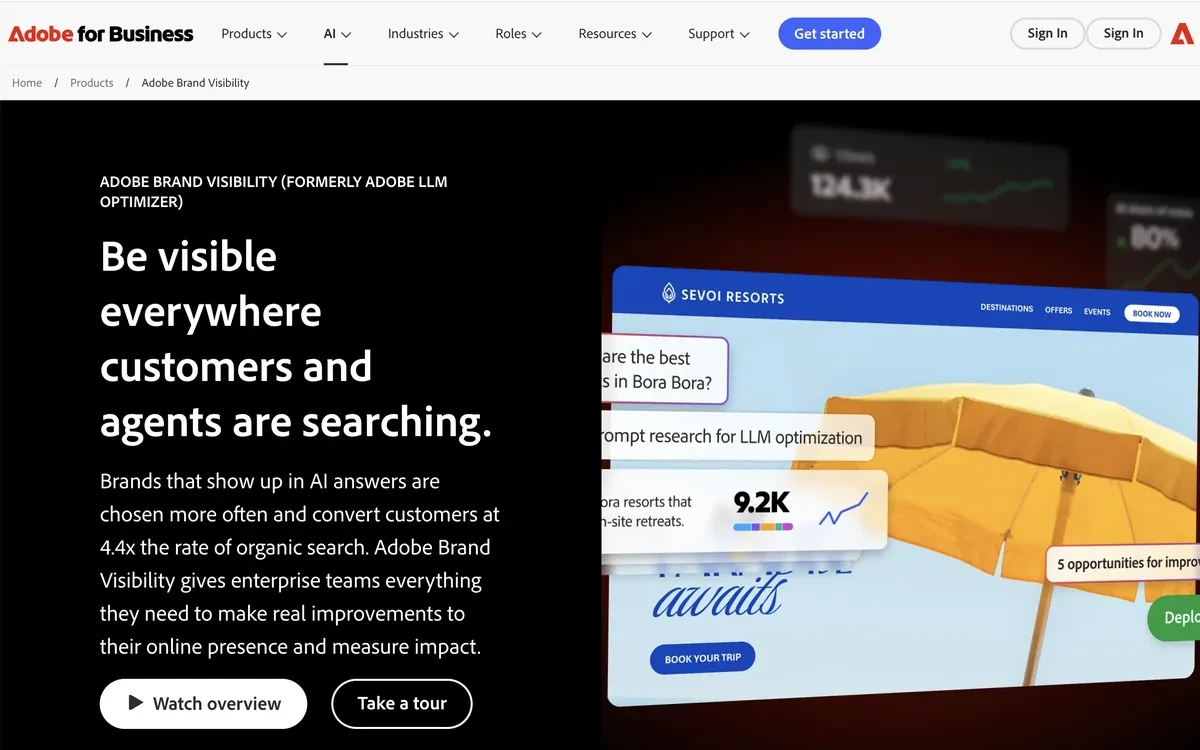
Adobe Brand Visibility — Best for enterprises already on Adobe Experience Cloud that want AI-facing fixes deployed at the CDN without a release cycle.
Rung 6 of 7No published priceTrial for Adobe customersGoogle SEO yes
Adobe Brand Visibility, renamed this year from Adobe LLM Optimizer, changes pages where Brandlight recommends. Optimize at Edge serves AI-friendly summaries, FAQs and fixes to LLM user agents at the CDN, works with any CMS, and rolls back in one click. It bundles Semrush entitlements, which puts classic SEO data under the same contract.
Adobe renamed LLM Optimizer to Brand Visibility and bundles Semrush entitlements.
Key features
Optimize at Edge applies summaries, FAQs and tables of contents for AI agents.
CDN- and CMS-agnostic, with guides for Fastly, Akamai, Cloudflare and CloudFront.
One-click rollback that reverts a page in minutes.
Semrush entitlements bundled for the Google side.
Pricing
No tiers or prices are published; it is licensed by prompts per year. AEM Cloud, Adobe Analytics and Customer Journey Analytics customers can start a free trial capped at 100 prompts and one domain. Everyone else is onboarded once a business agreement is signed.
Limitations
No published price, and the trial is open only to Adobe customers.
Outside AEM’s managed Fastly, routing needs the IT team.
Edge changes reach AI agents only; the page people read is unchanged.
Best for an enterprise inside Adobe Experience Cloud that wants AI-facing fixes live without a release cycle. Not for a team outside the Adobe estate, which cannot trial it.
05
Profound — Best for one enterprise brand with an analyst for deep citation data and a CMS team to approve what the agents draft.
Rung 5 of 7No published brand price7-day free trialGoogle SEO no
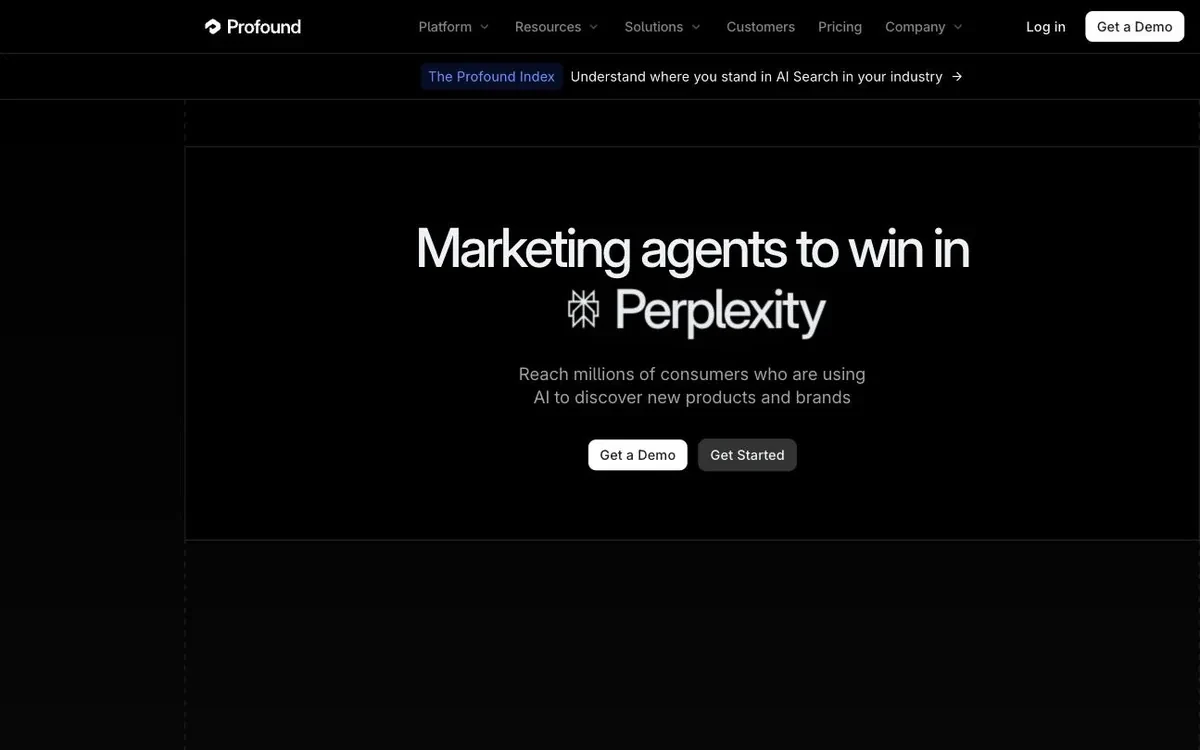
Profound is the deepest answer-engine analytics platform here — $96 million raised at a billion-dollar valuation in February 2026 — and it now sells itself as an AI Marketer. Its Agents draft and update entries in ten content systems, queued for editorial review. The $99 and $399 brand plans it published in August are gone: brands now see a free trial and a custom Enterprise tier.
Profound now sells marketing agents rather than answer-engine analytics alone.
Key features
The deepest citation analysis here, down to the pages an engine pulled from.
Agents draft into ten CMSs, from WordPress to Adobe Experience Manager.
Agent Analytics reads AI crawler traffic through Cloudflare, Fastly and Vercel.
Up to nine engines on Enterprise, with SSO/SAML and SOC 2.
Pricing
No brand price is published. The free Trial runs 50 prompts daily for seven days across ChatGPT, Gemini and AI Overviews, with unlimited seats; Enterprise is custom. Agencies see a $399/month rate per client workspace.
Limitations
No Google organic view, so rankings live in a second tool.
No published brand price since the August plans were withdrawn.
Agent output is queued as drafts rather than pushed live.
Best for one large brand with an analyst who will use the depth, and a CMS on its list of ten. Not for a team that wants Google rankings in the same report — the Profound alternatives page covers that gap.
06
AthenaHQ — Best for a single-brand team that wants eleven engines tracked and drafts published straight into its CMS at a published price.
Rung 5 of 7From $295/mo11 models at entryGoogle SEO partial
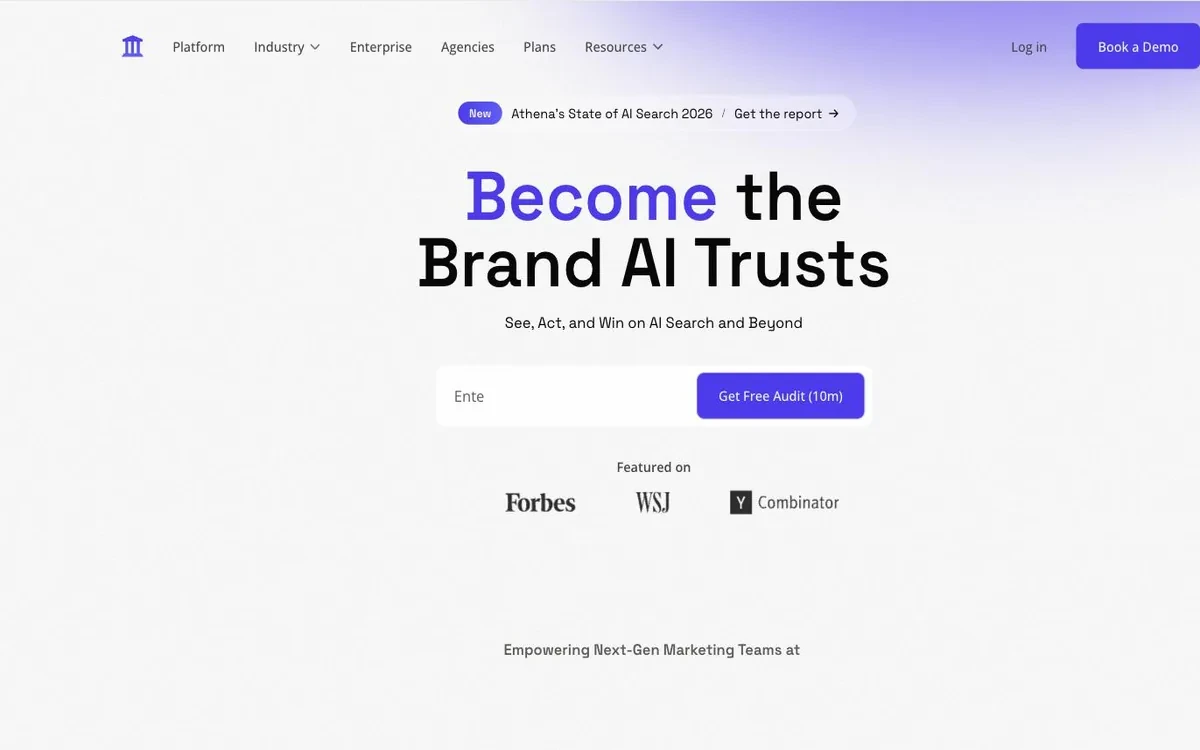
AthenaHQ is the published-price answer to Brandlight’s breadth of engines. Its $295 Starter tracks eleven models, Claude, Grok, DeepSeek and Mistral among them, and its Content Hub publishes drafts straight to Shopify, Webflow, Wix, Framer, WordPress and Payload CMS. Search Console feeds clicks and impressions into each content row.
AthenaHQ leads on agents that see, act and win on AI search.
Key features
Eleven models on the $295 Starter, more on request.
Content Hub publishes to six CMSs, with draft or live chosen at publish.
Unlimited members with role-based access control.
A free Essential tier with 300 credits and five engines.
Pricing
Starter $295/month with 3,600 credits, one credit per AI response; API access and extra credits are paid add-ons. Enterprise is custom and adds the Athena Citation Engine, SSO and multi-region support. The subscription attaches to a website, so a second brand is a second subscription.
Limitations
One website per subscription.
Search Console clicks and impressions, but no ranking positions.
No on-page, link or schema repair on existing pages.
Best for a single-brand team that wants wide engine coverage and drafts published to its CMS without a sales cycle. Not for a portfolio of brands, which pays per website.
07
Evertune — Best for brands with a paid-media team that want AI visibility, generated articles and AI advertising under one published price.
Rung 4 of 7From $800/mo25 articles a monthGoogle SEO no
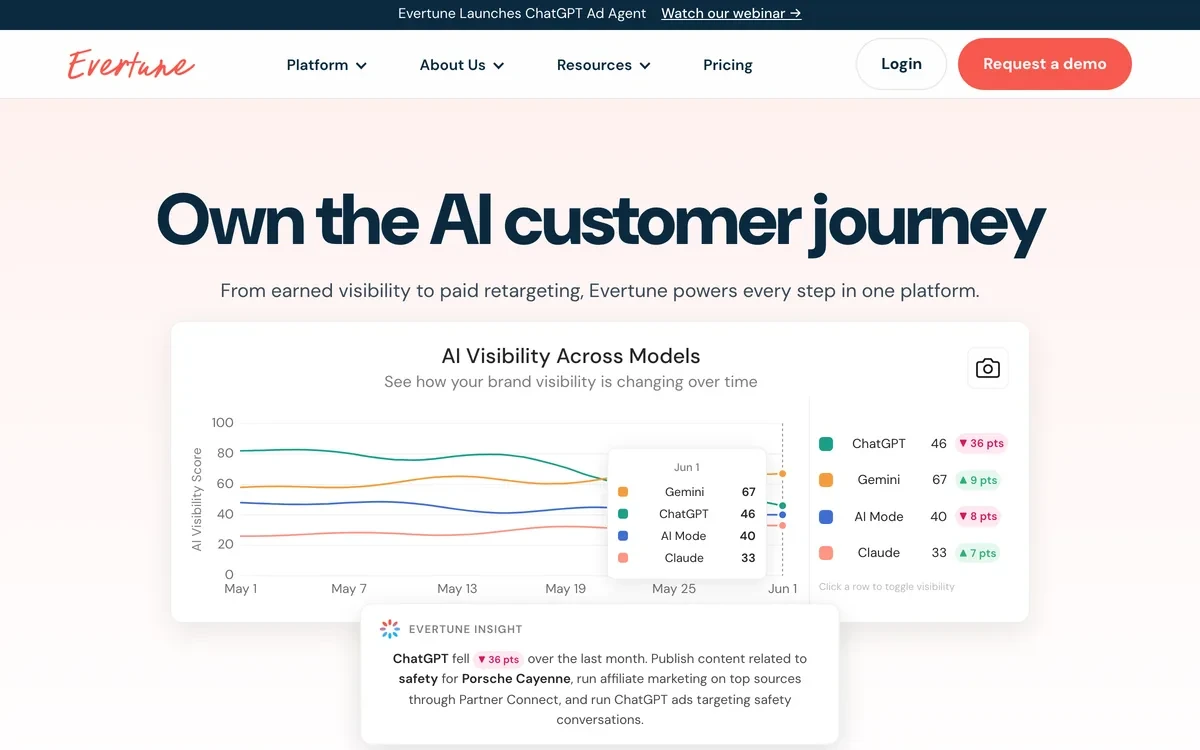
Evertune shares Brandlight’s interest in the paid side of AI answers and prices it. Its $800 Pro plan tracks 100,000 prompts across eleven models, writes 25 AI-optimised articles a month, and carries affiliate advertising partnerships and AI retargeting. Its Act module creates content and sets up ChatGPT ad campaigns. Roku and WPP are named customers.
Evertune runs from earned visibility through to paid retargeting in a single platform.
Key features
100,000 prompts across eleven models, tracked daily, weekly or monthly.
25 AI-optimised articles a month on Pro; unlimited on Enterprise.
Affiliate advertising partnerships and AI retargeting.
Global language and country tracking.
Pricing
Pro is $800 a month and is sold through a demo. Enterprise is custom and adds a dedicated success manager, AI website optimisation, AI bot analytics and SSO. No trial is offered and no seat count is published on either tier.
Limitations
No trial; the published price still sits behind a demo.
Articles are delivered, not published to the CMS.
No Google organic view.
Best for a brand with a paid-media team that wants AI visibility and AI advertising measured together at a price it can read. Not for a team that needs the site itself changed.
08
Scrunch AI — Best for enterprises that treat AI answers as a customer-experience surface and have an engineer to act on what the crawler data shows.
Rung 4 of 7From $250/mo7-day free trialGoogle SEO no
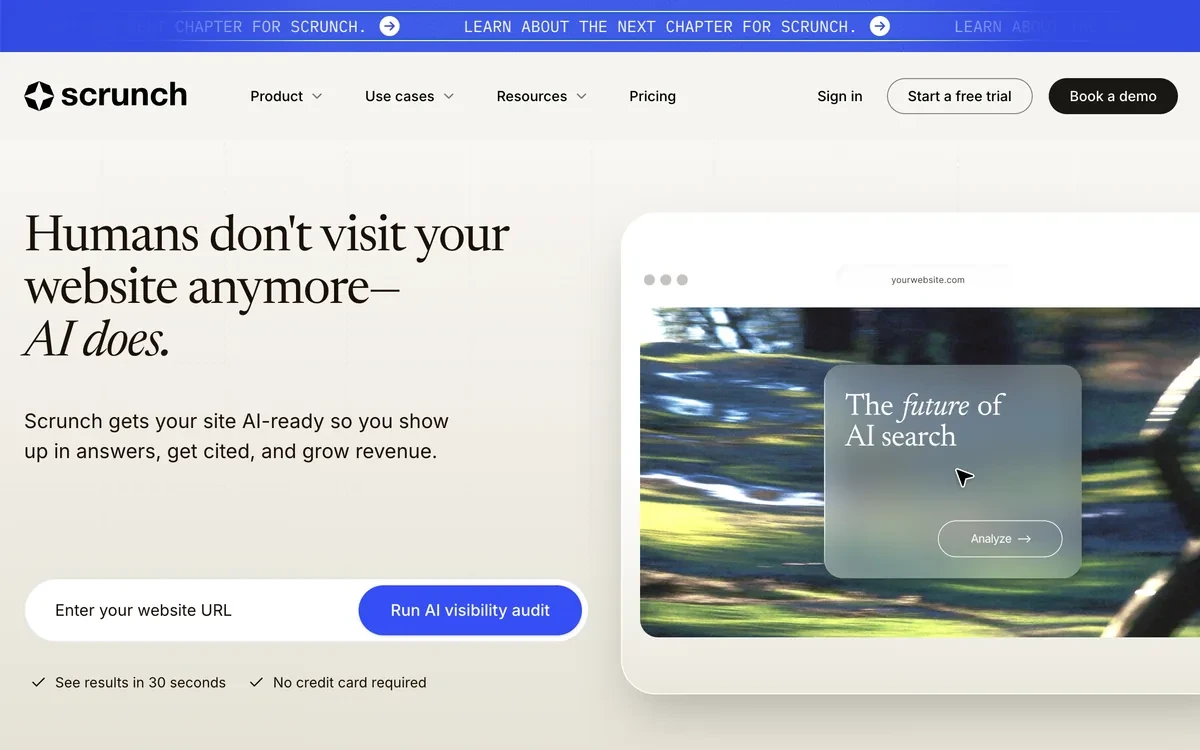
Scrunch AI sells itself as an AI customer-experience platform and has the best crawler-level observability here: it watches what AI bots fetch from a site and why an answer went elsewhere. Core generates basic content and optimises one page a month; its Agent Experience Platform, on Enterprise, serves agents a machine-readable copy of each page.
Scrunch opens on the crawler problem: humans do not visit your site, AI does.
Key features
AI agent and bot traffic analysis on every tier.
Five site audits a month on Core, full audits on Enterprise.
Funnel stages, citations and sentiment across 125 prompts.
AXP serves agents a parallel page version on Enterprise.
Pricing
Core $250/mo: 125 prompts, 5,000 responses a month, one brand workspace, five user licences, four engines, seven days free. Enterprise is custom and adds nine engines, API access, SAML single sign-on and a dedicated account team. Compared in depth on the Scrunch AI alternatives page.
Limitations
Four engines on Core; Claude and Gemini need Enterprise.
One page optimisation a month at entry.
Nothing reaches the CMS, and no Google view.
Best for an enterprise with an engineer on hand that wants to see what AI crawlers read. Not for a team that wants content published for it.
09
Goodie — Best for a single-brand team that wants AI agents working a monthly action budget, with strategist support on a published plan.
Rung 4 of 7From $478.80/mo50 actions a monthGoogle SEO partial
Goodie pairs AI agents with strategist support at a published price, which makes it the nearest self-serve shape to Brandlight’s programme. Its Core plan runs a content writer, an outreach agent and a technical agent against 50 action credits a month. Revenue attribution is on every plan. The price shown first is the annual rate; billed monthly, Core is $478.80.
Goodie claims the full AEO stack rather than one step of it.
Key features
AEO content writer, blog generation and an outreach agent.
Technical agent with llms.txt and sitemap repair.
Search Console, Analytics and Bing Webmaster Tools on every tier.
Five engines on Core, eight on Pro, up to 13 on Enterprise.
Pricing
Core $478.80/mo billed monthly, $399 billed annually: 120 prompts, 50 actions, five seats, seven days free. Pro $1,198.80 monthly or $999 annually, with 250 prompts, 100 actions and unlimited seats. Enterprise by demo, with SOC 2 and API access.
Limitations
The price shown first is the annual one.
WordPress, Vercel and Cloudflare connect on Enterprise only.
Search Console clicks, not ranking positions.
Best for a single-brand team that wants agents and a strategist without an enterprise contract. Not for a team that needs changes pushed live below Enterprise.
Best by job
Getting the change onto your own site
Amadora AI. Drafts, CMS publishing, link and schema repair and the Google report on published plans, with a three-day trial and no card. Pro at $299 adds Google and AI Overviews and five seats.
Mapping which publishers shape AI answers
Brandlight. Its Partnerships module scores publisher influence and exports outreach briefs, and a strategist works the list with PR and partnerships teams across every region.
AI visibility and AI advertising together
Evertune. 100,000 prompts across eleven models, 25 articles a month, affiliate partnerships and AI retargeting, at $800 a month.
When Brandlight is still the right choice
Your AI visibility work is mostly off-site — publishers, reviews, retail listings — and you want each source scored for influence. We read the sources behind each answer; we do not score publishers the way Brandlight’s Partnerships module does.
You want a strategist, a CX lead and biweekly working sessions included in the contract. Our Strategist is a $999 add-on, not a standing team.
You need paid placements inside AI answers tracked beside organic visibility. Brandlight’s AI Ads module does that, and we do not.
The execution ladder
The execution ladder is seven steps from measuring an AI visibility problem to proving it was fixed: measure, diagnose, plan, produce, publish, fix, prove. Engine counts and prompt limits miss the thing it captures, which is how much work lands back on your team. Every platform here climbs the same seven steps and each stops somewhere.
The seven execution rungs and which of the listed tools reach each one
Rung
What it means
Which tools reach it
1 · Measure
Tracks prompts, mentions, citations and share of voice
All nine
2 · Diagnose
Names why the citation went elsewhere and which source the engine trusted
All nine
3 · Plan
A prioritised, client-ready action list with reasoning attached
All nine: Brandlight through content agents and outreach briefs, Evertune through 25 articles a month
5 · Publish
Agents ship approved work into the live CMS
Amadora AI · BrightEdge, title tags and H1s at Approve · Adobe, at the CDN rather than the CMS · Profound, as drafts across ten CMSs · AthenaHQ, live to six
6 · Fix
On-page SEO, internal links, broken-link repair and schema — executed, not recommended
Amadora AI · BrightEdge, internal links and schema in Agent Mode · Adobe, for AI agents only
7 · Prove
Week-over-week movement in AI answers and Google rankings, in one report
Amadora AI · BrightEdge, AI Catalyst charts pinned beside rank reporting
Scroll the table sideways →
Rung placements reflect what each vendor documents publicly, read 25 and 29 September 2026. Brandlight moves from 3 to 4: its comparison pages describe multi-agent content generation and exportable publisher outreach briefs. Its buyer's guide also says drafts are routed to your CMS for review, but no CMS is named anywhere, so it is not placed at 5.
All nine tools here produce something, so rung 4 no longer separates them. Rung 5 does: five of the nine carry work into a CMS or onto a site, and four — Brandlight, Evertune, Scrunch AI and Goodie — stop at the draft, the brief or the recommendation. Of those five, Adobe changes only what AI agents read, and Profound and AthenaHQ publish content without repairing existing pages. Three of the nine report Google positions, and two — BrightEdge and Amadora AI — put them in the same report as the AI answer, which is rung 7.
Migrating off Brandlight
Prompt sets, competitor lists and publisher targets carry over by export and paste, and a fresh prompt set can be generated from the site and its competitors to compare against. Expect first data within twenty-four hours of adding a domain and a usable trend line at about two weeks. Historical visibility data does not transfer between vendors, because each samples and scores answers differently.
Two parts of Brandlight need a plan before the contract ends. The strategist holds your priorities, your publisher list and the reasoning behind both, so ask for the current roadmap and the outreach briefs in writing during the final quarter. And Impact Tracker holds the record of which changes moved which citations; export it, because that history is the evidence for next year’s budget. Running the replacement in parallel for the last month lets the two trend lines meet before you switch.
Common questions
−
How much does Brandlight cost?
Brandlight publishes no price. Its /pricing URL returns a 404, every call to action is a demo, and its own llms.txt says pricing is enterprise and quote-based with no self-serve tiers (vendor site, September 2026). Its buyer's guide says engagements typically begin with a paid three-month pilot, priced to the dashboards, markets, lines of business and service level in scope.
+
Does Brandlight have a free trial?
No. Brandlight says access begins with a scoped visibility assessment rather than a free trial, and its buyer's guide describes a paid three-month pilot. Among the alternatives here, Amadora AI runs three days free with no card, Profound, Scrunch AI and Goodie offer seven-day trials, and AthenaHQ has a free Essential tier.
+
Does Brandlight publish content to my CMS?
Not directly. Brandlight generates drafts through a multi-agent workflow and, by its own buyer's guide, routes them to your CMS for human and legal review without publishing, though no CMS integration is named anywhere on its site. The page change is made by your team, your agency or Brandlight's strategists.
+
Which AI engines does Brandlight track?
Brandlight tracks ChatGPT, Google AI Overviews, Gemini, Perplexity, Microsoft Copilot and Claude on every list it publishes. Its llms.txt adds Grok; its buyer's guide adds Google AI Mode instead and says coverage is adapted per market. Engines are not tiered, so the contract does not decide which models you see.
+
Which Brandlight alternatives track Google rankings too?
Amadora AI, BrightEdge and Adobe Brand Visibility report Google organic alongside AI answers. AthenaHQ and Goodie read Search Console for clicks and impressions without reporting a position. Brandlight itself calls AI visibility a different discipline from SEO and does not track rankings, and neither do Profound, Evertune or Scrunch AI.
+
Can I migrate off Brandlight?
Yes. Prompt sets, competitor lists and publisher targets move by export and paste, and take under an hour to rebuild. Plan for two things: the strategist's working knowledge of your priorities leaves with the contract, and historical visibility data does not transfer between vendors, because each samples and scores answers differently.
Last updated
This comparison is current as of , with every price, engine count, seat limit and prompt allowance verified against each vendor's own pricing page on that date.