Guide · GEO
What Is AI Search Optimization? GEO, AEO and How It Differs From SEO
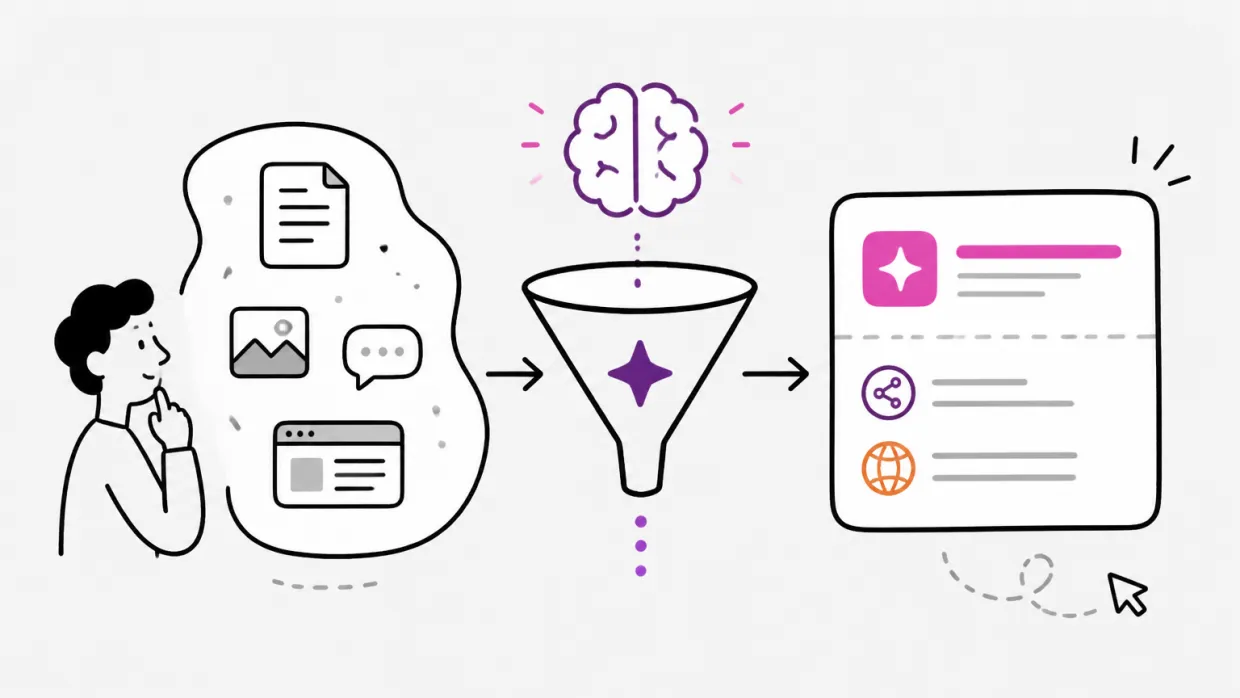
AI search optimization is the practice of structuring your content and brand presence so AI search engines cite, mention or recommend you inside the answers they generate, rather than only ranking you in a list of links.
It goes by several names. Generative engine optimization (GEO) is the most common, answer engine optimization (AEO) the next. AI optimization (AIO) turns up as an umbrella for both. They describe the same job.
AI search optimization means earning a place inside AI-generated answers on ChatGPT, Perplexity, Gemini and Google AI Overviews. It runs on the same crawlable, indexable foundation as SEO. But the unit that wins is the passage an engine can lift and attribute, not the page that ranks tenth. You measure it by how often you’re cited and mentioned, rather than by position in a results list.
The effect is measured, not assumed. The KDD 2024 research paper that named GEO found specific content changes raised a source’s visibility inside generated answers by up to 40%.
AI Search Optimization vs. Traditional SEO
AI search optimization is not a replacement discipline. It’s the same technical foundation measured against a different output.
| Traditional SEO | AI search optimization | |
|---|---|---|
| What you compete for | A position in a ranked list of links | Inclusion in the composed answer |
| The unit that wins | The page | The passage |
| How the reader arrives | Clicks a result | Reads the answer, or clicks a citation |
| What you optimize | Crawlability, relevance, authority, page experience | The same, plus extractable phrasing and entity clarity |
| What you measure | Rank, impressions, clicks | Citations, mentions, share of the answer |
| Where the ceiling sits | Position one | Being one of the few sources an answer names |
The overlap is larger than the category’s marketing suggests. Google’s own documentation for AI features states there are no additional requirements to appear in AI Overviews or AI Mode. No special schema.org structured data either.
So what’s actually new? The measurement, and the phrasing. Your page still has to be indexed and eligible to be shown with a snippet.
But a sentence that reads well inside a paragraph isn’t always the sentence that survives being lifted out of one. Only the second kind gets quoted.
GEO, AEO and AIO: How the Terms Differ
Three labels, one job, different emphasis. In practice that usually means you can read any of them as “getting cited by AI.” Does the label you pick change the work? No.
- GEO (generative engine optimization) optimizes content to be surfaced and summarized inside AI-generated answers. Searchers most often look it up as the bare phrase “generative engine optimization geo,” so that is the string worth tracking.
- AEO (answer engine optimization) structures content so a passage can be lifted as a direct answer. It is narrower than GEO, and older: it grew out of featured snippets and voice search.
- AIO (AI optimization) is the umbrella term some sources use for both. But no separate practice sits behind the letters.
- Semantic search matches meaning and context, not exact keyword strings. That is why one well-explained concept can answer queries you never targeted.
- Structured data (schema markup) is machine-readable metadata describing what a page contains. It should match the visible text on the page.
Where This Shows Up: ChatGPT, Perplexity, Gemini and Google AI Overviews
Google AI Overviews is one surface among several, not the whole topic. AI search optimization spans at least four:
- ChatGPT, which composes answers and cites sources when it browses
- Perplexity, which is citation-first by design
- Gemini, in its own app and inside Google Search
- Google AI Overviews and AI Mode, which sit above the organic results
Treating the Google surface as the whole category cuts both ways. Optimize only for chatbots and you miss the surface with the most traffic attached. Optimize only for Google and you miss the standalone assistants entirely.
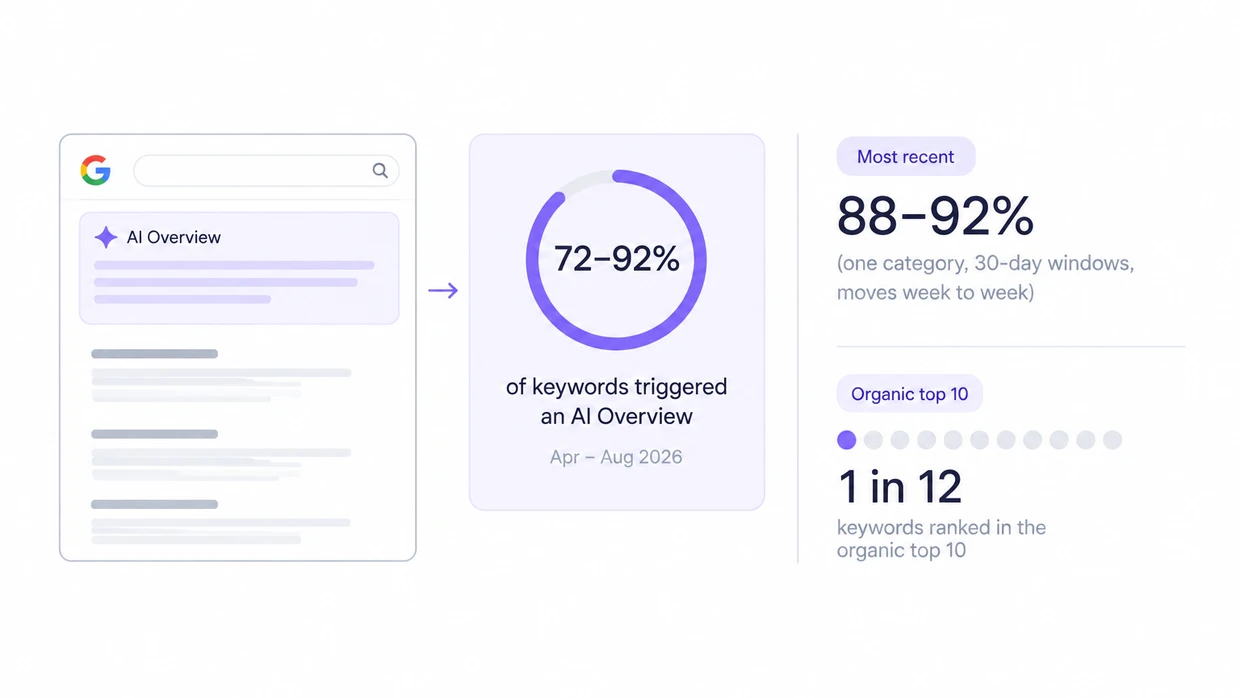
But on Google, the AI answer is closer to the default than the exception. Across Amadora AI’s own tracked keyword set, 72–92% of keywords triggered an AI Overview between April and August 2026. Most recent readings: 88–92% (one category, 30-day windows, and the rate moves week to week). Over that same set, roughly one keyword in twelve ranked in the organic top 10.
That changes what a ranking is worth. In Pew Research Center’s July 2025 browsing study, users who met an AI summary clicked a traditional result in 8% of visits. Without a summary, 15%. They clicked a link inside the summary itself in just 1% (900 US adults, browsing tracked through March 2025).
How AI Search Ranking Actually Works
Retrieval first, then synthesis. Most of what gets called “AI ranking” happens in the first stage. That stage is ordinary search.
The sequence runs: your question → fan-out into several sub-queries → retrieval of candidate passages → selection → synthesis into one answer with citations.
That fan-out is why semantic search matters. Classic learning-to-rank systems score whole documents against the query as typed. Semantic retrieval converts meaning into vectors. It returns passages matching the intent, including phrasings nobody entered.
Relevance becomes distance in that vector space. An article explaining a concept properly may be pulled for a question it never asks.
But no single page carries an answer on its own. Our citation data shows a single AI reply is assembled from roughly 50 to 100 analyzed pages (tracked projects, May–July 2026). Engines also avoid pulling repeatedly from one source. So a brand contributes one or two pages to any given answer, at most.
What makes a passage get lifted?
The KDD 2024 paper that introduced generative engine optimization tested content changes against a 10,000-query benchmark. Its strongest methods were adding quotations, adding statistics and citing sources.
The best of them improved visibility by up to 40% on the paper’s Position-Adjusted Word Count metric. That was measured on the authors’ own benchmark rather than on live commercial engines, and the effect varies by domain.
But the practical read is narrow. A passage that states a fact, attributes it and dates it is easier to lift than a passage that gestures at one.
How to Measure Impact
Three metrics, and one trap that invalidates all three.
- Visibility Score is the share of tracked prompts where your brand appears at all.
- Share of Voice is your slice of the brand mentions against competitors on the same prompts.
- Average Position is where you land when an answer names several brands in order.
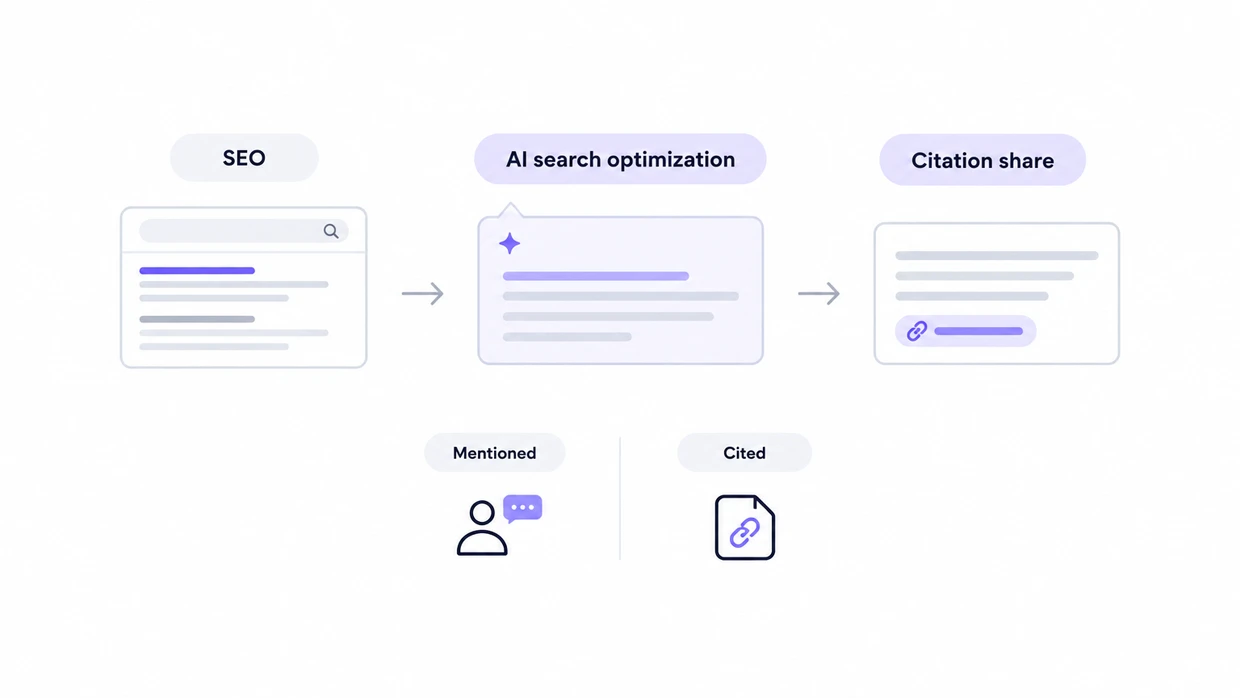
Citation share sits alongside them: the share of answers that link your page rather than only naming you. Being mentioned and being cited are separate states, and each gap is a different fix.
Now the trap. A prompt containing your brand name returns close to 100% visibility by construction. The engine was handed the answer in the question. Pad a prompt set with branded prompts and the average climbs while nothing improves.
Strip them out and most scores collapse. For roughly nine businesses in ten the unbranded score is zero (practitioner estimate, 2026, not a measured population).
Instead, track unbranded commercial prompts and read per-prompt movement week over week rather than the headline average. We exclude branded prompts from our own reporting for the same reason. If you want to see how the tooling differs on this, compare GEO/AEO tools.
Getting Started on a Small Site
Four actions, in order, none of them expensive.
- Check that you’re crawlable and snippet-eligible. On Google’s account this is the whole technical gate. A page has to be indexed and eligible to be shown with a snippet. A
nosnippettag, or a robots.txt rule blocking AI crawlers, removes you from the answer entirely. - Put the answer in the first paragraph, in text. Not in an image, not in a video, not behind a tab, and not three scrolls down. If the definition a reader wants is the first sentence on the page, it’s also the sentence an engine can lift.
- Pick the format that actually gets cited. Across citation data covering 10,563 AI citations, blog articles and listicles together carried 60–72% of them. Every other page type combined stayed under 40% (B2B SaaS projects, 2026). A comparison article or a well-built list beats another homepage rewrite.
- Track 10 to 20 unbranded prompts and watch movement rather than the average. A week of data tells you nothing. A month tells you which prompts you’re close on.
But none of this guarantees a citation. It makes you eligible for one, which is the only thing any of it can do.
If you want to measure your own site, this is how Amadora AI tracks AI search visibility daily across ChatGPT, Perplexity and Gemini. It is the same tracking our own numbers above come from.
Common questions
Does structured data help you get cited by AI engines?
Indirectly, and never on its own. No special schema.org markup is required to appear in Google’s AI features. But schema still helps systems parse your page and resolve it to the right entity. Keep it accurate and matched to the visible text.
How long does AI search optimization take to show results?
Longer than a rank change, and nobody can promise you a date. Answers are regenerated constantly and drawn from many sources at once. Progress shows up as a rising share of prompts, not a jump on any one of them. Give it a month of daily tracking before reading a trend.
Can you do AI search optimization without ranking in Google first?
Yes, partly. Standalone assistants retrieve from their own indexes and from the open web. Your pages and third-party mentions may surface you there without a Google top-10 position. Google’s own AI surfaces are the exception: those still run on ordinary Search eligibility.