
Guide · GEO
How to Improve Your Brand’s Visibility in AI Search: A Practical Optimization Workflow
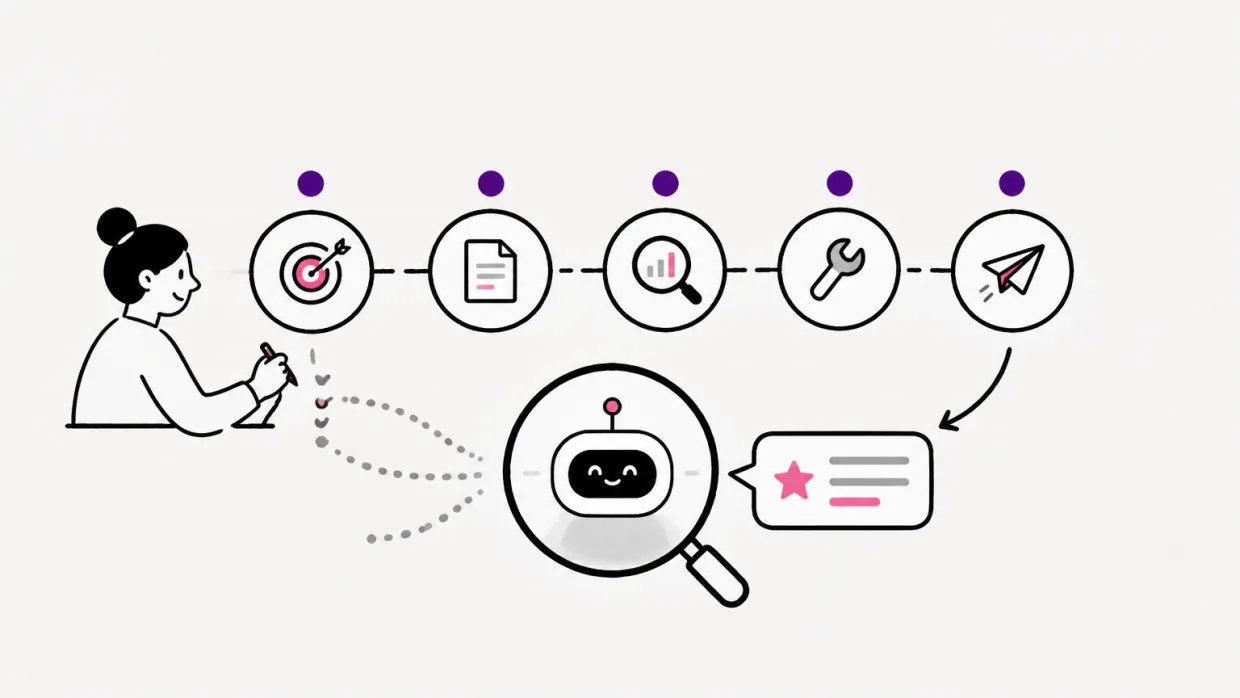
Most brands missing from AI answers are not losing on content quality. They are failing an eligibility check, or publishing pages an engine cannot lift a clean passage from. So here is how to optimize content for AI search, in the order the fixes actually pay off.
Fix eligibility first, structure second, substance third. An engine can only cite a page it can crawl, index and lift a self-contained passage from, so access and structure gate everything else. Once those hold, the content changes that measurably move visibility are citing sources, adding quotations and adding statistics. Expect movement in weeks, and read it per prompt rather than per page.
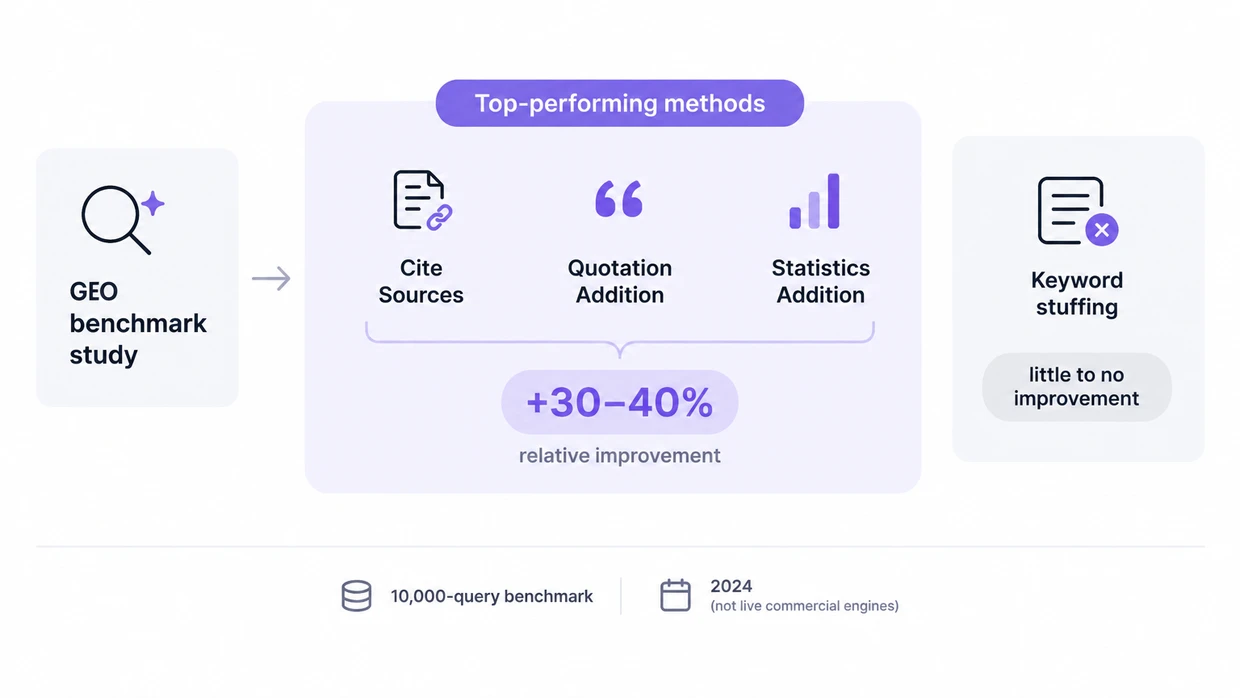
The GEO benchmark study (Aggarwal et al., KDD 2024) tested nine content changes across 10,000 queries. The three above came out on top. Keyword stuffing did close to nothing.
What to track once the fixes ship is a separate piece on AI search visibility tracking.
What actually moves AI search visibility, and what doesn’t
Four things move it: crawler access, passage structure, citable substance, and third-party pages that describe you consistently. Most of the rest is noise.
| Change | Does it move AI visibility? | Why |
|---|---|---|
| Allowing AI crawlers in robots.txt | Yes, and it gates everything else | An engine that can’t fetch the page can’t verify or cite it |
| Answer-first passage structure | Yes | Engines lift passages, not whole pages |
| Citing sources, quotations, statistics | Yes, 30–40% in GEO benchmark testing | The largest measured content-side gain |
| Schema markup | Weakly, as hygiene | Google states no special markup is required for its AI features |
| Publishing more pages | Weakly | One answer draws on many pages and only one or two can be yours |
| Keyword stuffing | No | No measurable gain under benchmark conditions |
The volume row is the one most plans get wrong. In our own citation data, a single AI reply is assembled from roughly 50 to 100 analyzed pages (Amadora AI cross-project tracking, May to July 2026). Engines also avoid pulling repeatedly from the same source. So your ceiling inside any one answer is one or two of your own URLs.
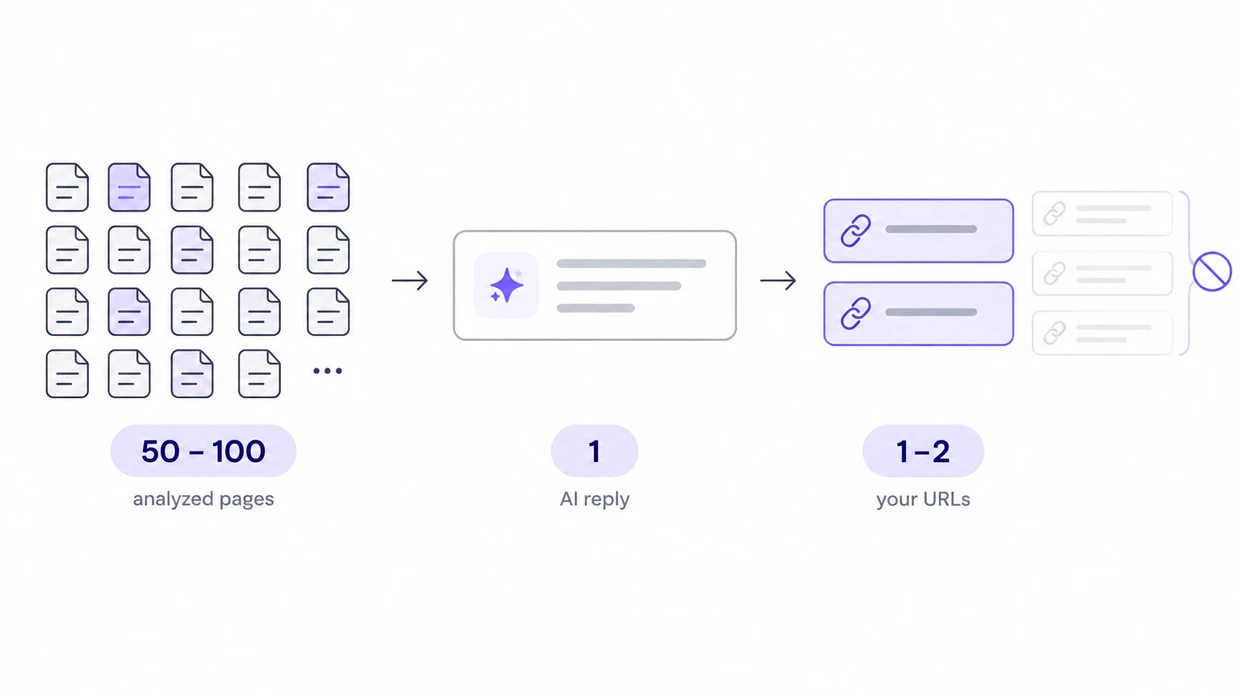
Doubling your publishing rate does not double that ceiling. It buys more chances across different prompts. That is a slower and much weaker effect than repairing the pages you already have.
But the ceiling cuts the other way too. Because your own domain can only occupy a sliver of any answer, the pages describing you elsewhere carry more of the result than most content plans assume.
Step 1: Audit your current AI visibility baseline
Start by finding out where you stand, because every later step is priced against that baseline.
AI Citation Share is the share of tracked answers that cite or mention your domain for a given prompt set. It is the number this workflow exists to move.
Four checks, in this order:
- Crawler directives. Read your robots.txt for the AI user agents specifically. Blocking them is often accidental, inherited from a template or a migration.
- Eligibility. Confirm the page is indexed and eligible for search snippets. AI optimization for websites begins at indexation rather than word count.
- Prompt coverage. Run 10 to 20 unbranded, buying-intent prompts and record where you appear. Branded prompts return you by construction and tell you nothing.
- Cited URLs. Record which of your pages get cited, if any, and which domains take the slots you want.
That first check is not a formality. On one client site, a dental clinic, robots.txt disallowed the ChatGPT, Perplexity and Claude crawlers (Amadora AI client account, August 2026). The assistants couldn’t reach the site to verify its services or reviews. So it stayed at zero visibility on queries it should have won.
A prioritized AI optimization action plan assembles this baseline from your tracked prompts (all three engines, scored per prompt).
Step 2: Structure pages so engines can lift them
Answer-first formatting means the direct answer sits in the first sentence of a section, before any setup, so the passage stands alone when it is pulled out of context. It is the highest-yield structural change you can make, because engines quote passages rather than pages.
Before:
Improving your position in AI answers depends on a range of factors, and the right approach will vary from one business to another.
After:
Two things decide whether an engine cites you: it can fetch the page, and it can lift a passage that answers the question on its own.
The second version survives extraction. The first one says nothing an engine can repeat.
Four rules that produce that shape:
- One idea per paragraph. A paragraph carrying two claims gets lifted with the wrong one attached.
- Headings that match real questions. Write the H2 as the question a buyer types, then answer it in the next sentence.
- No back-references. Cut “as mentioned above” and “as we saw earlier.” The passage may be the only part an engine reads.
- Server-side rendering. If your core content only appears after JavaScript runs, treat it as invisible until proven otherwise.
Apply this to your highest-intent pages first. Rewriting an archive top to bottom is how this step stalls.
Step 3: Add schema without over-claiming it
Schema markup (structured data) is code that tells a crawler what a page’s parts are, instead of making it infer them from prose. Add it. Then stop treating it as the lever.
Does schema make an engine cite you? No. Google’s guidance on optimizing for generative AI features is blunt about it: “Structured data isn’t required for generative AI search, and there’s no special schema.org markup you need to add.” Google still recommends keeping structured data, because it earns rich-result eligibility in classic search.
This is the minimum that earns its place on an article:
{
  "@context": "https://schema.org",
  "@type": "BlogPosting",
  "headline": "How to Improve Your Brand’s Visibility in AI Search",
  "dateModified": "2026-09-14",
  "publisher": {
    "@type": "Organization",
    "name": "Amadora AI",
    "url": "https://amadora.ai"
  }
}
If the page carries numbered steps or a FAQ block, HowTo and FAQPage markup are reasonable additions. Neither is required, and neither substitutes for the passage structure in Step 2.
Hygiene, not strategy.
Step 4: Earn citations with data, quotes, and sources
The content change with the largest measured effect is adding verifiable substance.
In the GEO benchmark study, the top-performing methods (Cite Sources, Quotation Addition and Statistics Addition) “achieved a relative improvement of 30-40% on the Position-Adjusted Word Count metric.” Keyword stuffing, tested alongside them, offered “little to no improvement.” That was measured on a 10,000-query benchmark in 2024 rather than on live commercial engines, so treat the ranking of methods as the finding and the exact percentage as indicative.
E-E-A-T (Experience, Expertise, Authoritativeness, Trustworthiness) is the trust signal set these systems weight when choosing what to repeat. Named sources, dated figures and first-hand detail are how a page carries it. Unattributed assertions are how a page loses it.
But substance lands differently depending on the format carrying it. Across 10,563 AI citations we classified, blog articles and listicles together carried 60 to 72% of all citations (Amadora AI cross-project analysis, B2B SaaS projects). Every other page type combined stayed under 40%.
The page types that actually carry AI citations are how-to articles, comparisons and “best tool” listicles. Building those citations off your own domain is a separate discipline, and that piece covers the mechanics.
Step 5: Write once, then adapt per engine
Should you optimize for each AI engine separately? No. Build one platform-agnostic page first, then vary the prompts you track against it.
The criteria an LLM applies before recommending a brand come back almost the same across every engine we track (Amadora AI action-plan analysis, April to July 2026). What changes them is the prompt and the niche, not the model. A local contractor and a B2B SaaS product return materially different criteria sets.
The benchmark study points the same way. Its best-performing method varied by query domain, not by engine.
So vary by prompt intent instead. A buying-intent prompt and a definition prompt need different pages, even on the same engine. Per-engine variants cost you maintenance and typically buy nothing.
In practice, that usually means: one canonical page per buying question, written answer-first, plus a prompt list covering the wordings each engine tends to produce. You vary the prompt coverage. You do not vary the page.
How long results take, and how to sequence fixes
How long? Weeks, not days. The floor is set by mechanics you don’t control.
The page has to be crawled, then re-indexed, then picked up the next time an engine composes an answer for that prompt. Nothing moves on the day you ship.
One agency reported moving a client from behind its main competitor to level or ahead on visibility score in roughly two months (one client account, reported to Amadora AI, April 2026). Treat that as a plausible good case rather than a forecast. Nobody can predict your number, because it depends on your category and what you already have in place.
But the order is predictable even when the timing is not:
Eligibility → structure → schema → substance → third-party pages.
Sequence them that way, by how fast each one can move and how easily you can undo it.
- Eligibility. Crawler directives, indexation, snippet eligibility, rendering. Days of work, and nothing else counts until it’s done.
- Structure. Answer-first passages on your highest-intent pages. A week or two, fully reversible, and the change engines respond to fastest.
- Schema. Cheap, low risk, small effect. Do it while the structure work is in review.
- Substance. Statistics, quotations and named sources on the pages that already come close. Slower, because it needs real research.
- Third-party pages. Listicle inclusion, review platforms, community threads. Slowest, and the most compounding.
Why this matters: the first three are cheap and reversible, so they front-load what you learn. The last two compound, so starting them late costs you the delay twice.
Engines favor current sources, so a page nobody touches decays out of answers (recency bias) even when nothing in it became wrong.
If you’d rather not assemble the sequence by hand, Amadora AI will build a prioritized action plan from your tracked prompts.
Common questions
Is generative engine optimization different from SEO?
Mostly no. Generative engine optimization, or GEO, is largely the same work under a newer name, and the eligibility gates are identical: crawlable, indexed, eligible for snippets. What changes is the unit of competition. You’re competing to have a passage lifted rather than a link ranked.
Should I block or allow AI crawlers?
Allow them, unless you have a specific licensing reason not to. A disallowed crawler can’t verify your services, prices or reviews, so the engine leaves you out of answers you would otherwise win. Blocking is a legitimate business decision with a known visibility cost. Make it deliberately.
Why do my pages rank but never get cited?
Rank and citation are separate states, so work them separately. Pages that rank in AI search results can still be unusable to an engine, because their answers are spread across paragraphs instead of sitting in liftable passages. Rewrite the opening sections answer-first, then recheck in a month.