Guide · GEO
AI SEO for SaaS: Getting Your Product Into the AI Recommendation Set

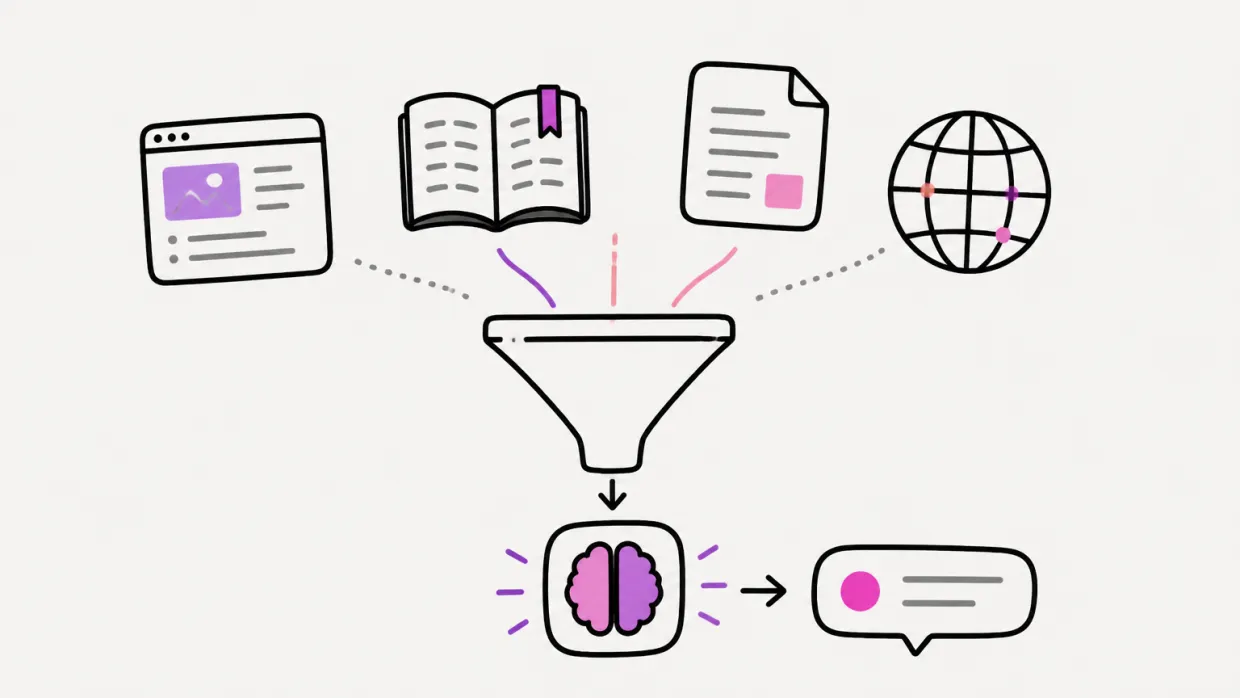
AI SEO for SaaS is a placement problem before it’s a content problem. Ask ChatGPT or Gemini for the best tool in your category. The engine assembles a shortlist from what other pages say about that category. Then it reads your own site to verify the details.
Your blog post isn’t the page being read. The roundup that names you is.
An AI recommendation set is the shortlist of products an engine names when it answers a comparison or “best X” prompt. Landing in it works the way an organic pack slot does. You earn the place.
AI engines build a SaaS recommendation set from four signals: which third-party pages name you inside the category, whether independent sources describe you the same way, whether your own pages resolve the verifiable facts (pricing, comparisons, documentation), and how recently all of it was updated. Third-party placement decides whether you get named. Your own site decides whether the description is accurate.
That order surprises most growth teams. Across B2B software brands we tracked between April and August 2026, roughly 1–2% of the brand mentions found inside AI citations sat on the brand’s own domain. Three tracked brands ran 2 owned mentions of 186, 0 of 135, and 3 of 621. In non-software categories we record a 30–50% owned share (an energy supplier, for one), so this is a B2B software pattern, and the split moves by category.
How AI engines decide which SaaS products to recommend
Four signals decide it. Naming them is the easy part of AI SEO SaaS work. The order is the hard part, and getting it wrong sends a quarter into work that moves nothing.
- Third-party placement. The largest single page type ChatGPT cites for software recommendation prompts is the “best X” blog list. In a study of 26,283 source URLs, Ahrefs found blog-format best lists made up 43.8% of all cited page types across 750 software, product and agency recommendation prompts (December 2025). Does position inside the list matter? The same study found a strong trend toward products ranked higher in it.
- Corroboration across independent sources. Engines cross-check. When a review profile, a roundup and a community thread describe you the same way, the description holds. When they disagree about what you sell, the engine usually skips you rather than resolve the ambiguity.
- First-party verifiability. Brand-owned content is your comparison pages, pricing, and documentation. An engine reads them to confirm a claim it found elsewhere. It’s the verification layer, not the recommendation layer.
- Freshness. A freshness signal is how recently a page was updated. It applies to the sources an engine pulls from as well as your own pages. In the same Ahrefs data, 79.1% of cited lists had last been updated in 2025 (26% within the two months before the study).
None of this has an AI-specific technical shortcut. Google states that a page must be indexed and eligible for a snippet to appear in AI Overviews or AI Mode, and that “you don’t need to create new machine readable files, AI text files, or markup to appear in these features”. That covers Google’s own surfaces, not ChatGPT or Perplexity.
But it settles a recurring question. Does a special file buy you a place in the answer? It does not.
Why the citation surface looks like it favors you
Two measurements keep getting mistaken for each other. The mix-up is why the same question comes back with opposite answers.
The first is which type of site gets cited. Across 10,563 AI citations spanning five engines, vendor-owned corporate sites held 79–85% of the citation surface (editorial publications held 0.2–2.6%).
The second is how many of your brand’s mentions sit on your domain. In B2B software that’s the 1–2% above.
Both numbers are real. Corporate sites do dominate the surface.
But they are mostly other vendors’ sites, and which handful of companies gets named is decided somewhere else.
What one real AI answer set actually cited
In one tracked B2B SaaS topic (May 2026), listicle-format pages accounted for 76% of every AI citation in that topic. The three most-cited sources were a vendor’s own site, a YouTube video, and a third-party listicle. What each of those source types brings to an answer is worth separating.
| Cited source | What that source type contributes | Why the engine uses it | What you do about it |
|---|---|---|---|
| A vendor’s own site | Feature and pricing detail for one named product | It is the primary source for that vendor’s own specifications | State your pricing and feature facts plainly, so yours lifts as cleanly |
| A YouTube video | A walkthrough of the category with products named in context | Transcripts carry side-by-side product talk that written roundups compress out | Check whether your category has cited video before writing the format off |
| A third-party listicle | The shortlist itself, in ranked order | It is the format that already answers the “best X” question | Earn inclusion, then work on position |
None of the three sat on the domain of the brand being tracked. Which of them could that brand have reached? Two, and neither quickly. That is the shape of a category where nobody has done the placement work yet, and it is more common than it looks.
Why this matters: a content plan that answers “best X” with your own blog post competes for the one slot in that answer which is already taken.
The levers that get a SaaS product listed
Four levers move a product into the recommendation set, ordered by what the citation data supports rather than by how much work each one is.
- Get into the lists that already answer your category, then climb them. Inclusion is the threshold. Position is the multiplier, because higher-ranked products in a cited list get named at a higher rate. In practice, that usually means: pull the sources an engine currently cites for your three or four most commercial prompts, separate the ones that accept pitches from the ones that need a relationship, and work the shortest list first.
- Build the comparison and alternatives pages engines read to verify you. Do these earn you a mention on their own? Rarely. They decide whether the sentence attached to your name is right when the mention comes from elsewhere. Write them to be checkable: real prices, real limits, real competitor names.
- Pick review platforms by measurement, not by reputation. Review-site corroboration is third-party proof from platforms like G2 and Capterra, which an engine cross-checks against what you say about yourself. In one B2B SaaS project (May 2026), G2 produced 9 AI citations for the tracked brand. Slashdot produced more. The same analysis surfaced 61 review platforms and 1,097 listicles carrying that category. G2 and Capterra may still deserve a program for reasons unrelated to AI search, but find out which platforms your category’s answers cite before you fund one.
- Set an update cadence and hold it. Freshness is the cheapest lever here (and the easiest to lose). That 79.1% figure is about the sources engines cite, so the cadence applies to the roundups you appear in as well as your own pages. A listicle that named you eighteen months ago may have dropped you in its last refresh (and nobody sends a notification).
Building a weekly tracking workflow
AI search visibility tracking is monitoring which prompts surface your brand across engines like ChatGPT, Perplexity and Gemini. It also tracks which sources those answers cite. Treat it as a weekly read with a fixed shape.
Set it up once:
- How many prompts to start with? At least 10, grouped into topics. The ones that produce named recommendations are bottom-of-funnel and specific (ICP + use case + constraint). Broad category questions come back naming nobody.
- Strip branded prompts out of the read. A prompt containing your company name returns roughly 100% visibility by construction. Leaving it in inflates the average and tells you nothing. We exclude branded prompts before reading any metric. Our position is that for most businesses the unbranded score starts at zero. That is the number worth moving.
- Wait 7 days before reading a trend (answers move day to day).
Then read three numbers per topic, every week:
prompt coverage + citation-source mix + mention count = a read you can act on
- Prompt coverage: the share of tracked prompts in that topic where you’re named at all. This tells you whether placement work is landing.
- Citation-source mix: which domains and page types the answers pull from for that topic. This tells you where to work next (and it changes by category).
- Mention count: how many times your brand appears across the documents those answers cite. It moves with placement, and it moves slowest.
But an aggregate is not the read. A score averaged across every prompt is inflatable by padding the prompt set. Per-topic movement week over week is the defensible number.
Amadora AI runs this read daily across three engines (ChatGPT, Perplexity and Gemini) and classifies the cited sources by type. That turns the routine above into a report rather than a research project. You can see how Amadora AI tracks prompt coverage and citation source mix for SaaS growth teams.
Common questions
How is this different from traditional SEO?
Ranking and being named are separate outcomes. Traditional SEO competes for a position on a results page. AI recommendation competes to be named inside an answer assembled mostly from other people’s pages. The technical fundamentals still apply, because a page that can’t be indexed can’t be cited (the same crawl and index rules as ever).
How long does it take for a SaaS product to start appearing in AI answers?
There’s no reliable timeline (and a specific one should be treated as a guess). It depends on how competitive your category is and how many third-party pages already name you. Refresh cadence on those sources matters too. But two leading indicators are trackable from week one: your citation count, which moves with content and technical work, and your brand mention count, which moves with placement.
Does paid advertising affect AI recommendations?
Not directly. Ad spend doesn’t enter the retrieval path an engine uses to assemble a recommendation set. It can matter indirectly. Campaigns that generate reviews, roundup inclusions or community discussion create the third-party pages an engine reads later.